Canon R5 vs R6 Mark II: Complete Camera Comparison Guide
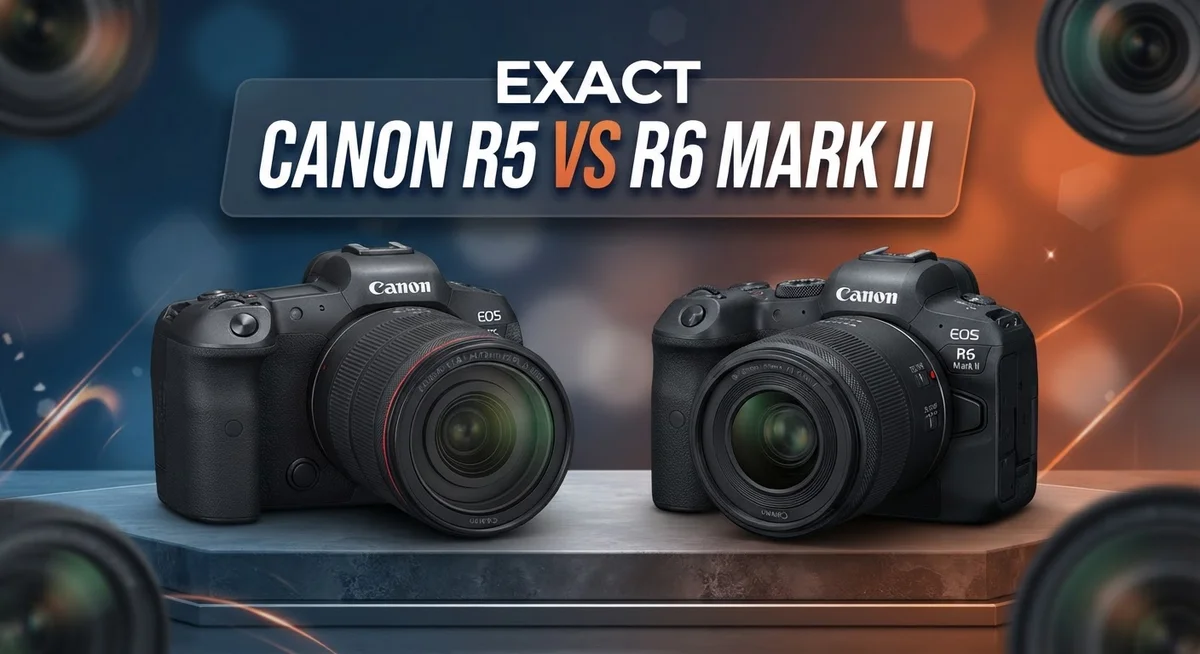
Choosing between the Canon R5 and R6 Mark II feels tricky. Both cameras pack serious power. But they shine in different ways.
The R5 gives you more megapixels. It also offers faster data transfer with its CFexpress card slot. This makes it great for detailed, large prints.
The R6 Mark II takes a different path. It focuses on speed and low light skills. You get better autofocus and higher burst rates, up to 40 fps.
So which camera fits your needs? A landscape photographer may want resolution. A sports or wildlife shooter may want speed.
This guide breaks down every key difference. We compare specs, performance, and real world use cases. By the end, you will know exactly which Canon camera belongs in your bag.
In a Nutshell
Here is a quick summary to help you decide fast.
-
Resolution matters: The R5 packs more megapixels for large prints and heavy cropping. Choose this if detail is your top priority.
-
Speed wins: The R6 Mark II shoots up to 40 fps, almost double the R5. Sports and wildlife shooters will notice this gap immediately.
-
Low light performance: The R6 Mark II handles high ISO much better than the R5. Night events and dim venues favor this body.
-
Autofocus tracking: The R6 Mark II offers smarter, more reliable autofocus. It locks onto subjects faster in tricky scenes.
-
Storage needs: The R5 uses CFexpress Type B cards for quick transfers. These cards work faster but need extra investment in your kit setup.
-
Future options: Both the R6 Mark III and R5 Mark II exist as upgrades. Keep these in mind if you want newer tech later.
Pick based on your shooting style, not just specs. Speed or resolution should guide your final call.
Sensor Resolution and Megapixel Comparison
The sensor is where these two cameras diverge most clearly. The R5 delivers superior megapixel count, which matters if you print large or crop heavily. You get more pixels to work with for detailed landscapes and studio work.
The R6 Mark II takes a different approach. It uses a lower resolution sensor but pairs it with exceptional engineering. This camera excels at capturing clean images in challenging light conditions.
Let’s talk about what resolution really means. More megapixels sound impressive, but they come with trade-offs. The R5’s higher pixel density can introduce more noise at high ISO settings. The R6 Mark II’s lower resolution actually helps it maintain cleaner files when you push the ISO up.
For practical work, consider your output. Do you need massive prints? The R5 wins here. Do you shoot frequently in dim environments? The R6 Mark II performs better. Wedding photographers and event shooters often prefer the R6 Mark II’s cleaner high ISO output. Studio and landscape photographers frequently choose the R5’s resolution advantage.
The sensor readout speed matters too. The R5 Mark II introduced a faster 6.3ms readout, reducing rolling shutter distortion. This benefits video and fast action equally. The R6 Mark II also handles burst shooting at 40 fps, which demands excellent sensor performance.
Processing power backs up the hardware. Both cameras use Canon’s latest processors to handle their sensor data efficiently. The R6 Mark II’s processor focuses on autofocus computation and burst speed. The R5’s processor prioritizes detail extraction from those extra megapixels.
Your shooting style determines which sensor fits best. Fast action and low light favor the R6 Mark II. Static subjects and detailed composition favor the R5. Neither sensor is objectively “better.” They’re optimized for different priorities.
Think about your typical shooting day. How often do you need massive prints? How much do you shoot in low light? The answers point you toward the right sensor choice. Test both cameras if possible before deciding. Hands-on experience reveals which sensor philosophy matches your workflow.

- FULL-FRAME CMOS SENSOR: 24.2 effective megapixels (approx.) lets you capture sharp, detailed images...
- DIGIC X IMAGE PROCESSOR: Enhances digital camera performance and processes, including image...

Last update on 2026-11-09 / Affiliate links / Images from Amazon Product Advertising API
Autofocus Performance and Burst Shooting Speed
The autofocus system separates these two cameras in meaningful ways. The R6 Mark II features improved autofocus that tracks subjects with greater accuracy. Canon enhanced the AF algorithm to lock onto moving objects faster and hold focus longer.
The R5 uses a solid autofocus system, but it doesn’t match the R6 Mark II’s intelligence. You’ll notice the difference when shooting fast action or unpredictable motion. The R6 Mark II’s AF system responds quicker to subject changes.
Burst shooting speed shows a clear winner. The R6 Mark II shoots at 40 fps, while the R5 maxes out at 30 fps. This means you capture one third more frames per second with the newer model. That extra speed helps when you need to catch the perfect moment in a series.
The R5’s 30 fps still handles most shooting situations well. Sports and wildlife photographers appreciate this speed. However, professionals covering fast events prefer the R6 Mark II’s capability.
Buffer capacity matters too. Both cameras write to fast memory cards, but the R6 Mark II maintains its burst rate longer. You won’t drop frames as quickly when shooting extended sequences. The CFexpress Type B slot in the R5 transfers files faster to your computer afterward, but the R6 Mark II’s sustained performance during shooting wins here.
Eye tracking AF appears on the R5 Mark II, which represents the newest technology. This feature locks onto and follows a subject’s eye automatically. If you’re considering future upgrades, this matters for long term use.
Real world performance depends on your subjects. Portrait photographers benefit from the eye tracking capabilities. Action shooters need that 40 fps burst rate from the R6 Mark II. Wildlife photographers value both speed and autofocus reliability.
The R6 Mark II edges ahead for autofocus and burst shooting. Choose the R5 if you rarely need extreme burst speeds and prefer traditional AF systems. Pick the R6 Mark II when you shoot fast action regularly and want modern autofocus tracking.
High ISO Performance and Low-Light Capability
The R6 Mark II stands out when you shoot in challenging light. This camera handles high ISO settings with noticeably less noise than the R5. You can push the ISO higher and still get clean images.
The R5 struggles more at high ISO values. Noise becomes visible faster as you increase sensitivity. This matters if you frequently shoot indoors, at events, or during golden hour without a tripod.
Low-light autofocus performance differs between these cameras too. The R6 Mark II’s autofocus system works more reliably when light drops. It locks onto subjects faster and maintains focus better in dim conditions. The R5’s autofocus performs adequately but loses some confidence in shadows.
Real-world shooting shows the gap clearly. A sports photographer shooting an indoor event will find the R6 Mark II more forgiving. You can use faster shutter speeds at lower ISOs. The R5 forces you to either accept more noise or use slower shutter speeds.
Video shooters benefit from the R6 Mark II’s advantages too. High ISO performance directly impacts video quality. The R6 Mark II produces cleaner footage in low light without heavy noise reduction artifacts.
The R5’s strength lies elsewhere. Its higher megapixel count helps if you plan to crop footage significantly. However, for pure low-light capability, the R6 Mark II wins decisively.
Sensor technology matters here. The R6 Mark II uses a newer sensor design that captures light more efficiently. This efficiency translates to cleaner images at high ISO. The R5’s sensor, while excellent, simply doesn’t match this capability.
Your shooting environment determines which camera suits you better. If you work mostly in controlled lighting, both cameras perform well. If you regularly face dim venues, outdoor night shoots, or fast-moving low-light situations, the R6 Mark II becomes the practical choice.
The difference isn’t subtle. Testing both cameras side by side shows the R6 Mark II maintaining detail and color accuracy at ISO 6400 and beyond. The R5 shows more grain at these settings. For professional low-light work, this gap matters significantly.
Top 3 Alternatives
Nikon Z9

- 45.7MP Stacked CMOS sensor and EXPEED 7 image processing. Fast powerful AF that can keep up with the...
- Subject detection uses deep learning to automatically detect and track people, cats, dogs, birds...
Last update on 2026-11-08 / Affiliate links / Images from Amazon Product Advertising API
The Nikon Z9 stands out as a professional-grade mirrorless camera that competes directly with Canon’s high-end offerings. This camera delivers exceptional autofocus performance with 493 focus points. The Z9 captures 8K video at 60fps, making it ideal for videographers and content creators.
Its weather-sealed magnesium alloy body handles tough shooting conditions. The camera features dual XQD card slots for reliable data storage. Battery life extends to approximately 700 shots per charge, which is impressive for extended shoots.
Sony A1

- 50.1MP full-frame stacked Exmor RS CMOS sensor w/ integral memory
- 8x more powerful, next generation BIONZ XR image processing engine
Last update on 2026-11-08 / Affiliate links / Images from Amazon Product Advertising API
The Sony A1 combines cutting-edge technology with versatile performance. This full-frame mirrorless camera offers 8K video recording and real-time tracking autofocus. The A1 features 759 phase-detection autofocus points that cover nearly the entire frame.
Its 50.1-megapixel sensor captures stunning detail in every shot. The camera supports high-speed continuous shooting at up to 30fps with full autofocus tracking. Dual SD UHS-II card slots provide flexibility for professional workflows.
Panasonic Lumix S1R

- Pro-Level Photo and Video Performance: Made to support professionals, this professional camera...
- 24.1MP BSI CMOS Sensor for True-to-Life Detail: Full-frame mirrorless camera has a developed...
Last update on 2026-11-08 / Affiliate links / Images from Amazon Product Advertising API
The Panasonic Lumix S1R offers a unique value proposition for photographers seeking high resolution. This camera features a 47.3-megapixel full-frame sensor that excels in landscape and studio photography. The S1R delivers exceptional color science and dynamic range performance.
Its in-body image stabilization provides up to 6 stops of compensation. The camera includes dual SD UHS-II card slots and a robust build quality. The S1R appeals to photographers who prioritize image quality and stability over maximum speed, making it an excellent alternative for those seeking different strengths than Canon’s lineup.
Memory Card Slot and Data Transfer Speed
The memory card slot and data transfer speed form a crucial difference between these two cameras. The R5 uses CFexpress Type B cards, which deliver significantly faster write speeds than standard options. This matters when you shoot high resolution files or record demanding video formats.
The R6 Mark II also accepts CFexpress Type B cards, so both cameras share this advantage. However, the R5’s higher megapixel output generates larger files. More pixels mean bigger file sizes, and bigger files need faster card slots to prevent buffer slowdowns.
Real world shooting reveals why this matters. When you shoot burst sequences, the camera writes data to the card continuously. A slower card forces the camera to pause and wait. The R5’s faster transfer speeds keep your shooting uninterrupted, especially during extended bursts.
The CFexpress Type B standard offers write speeds up to 1400 MB/s on premium cards. Both cameras can leverage this speed, but the R5 fills cards faster due to its resolution. You’ll notice this difference most when recording 8K video or shooting rapid bursts of high resolution stills.
Storage requirements differ between these models. The R5 demands faster, more capable cards to perform optimally. The R6 Mark II can work with slightly less extreme cards, though premium CFexpress Type B remains the best choice for consistent performance.
Consider your workflow when evaluating this factor. If you transfer files frequently to a computer, faster cards save time. If you edit directly from the card or use external SSDs, the difference becomes less critical. Professional photographers who shoot continuously benefit most from the R5’s speed advantage.
Both cameras support dual card slots (on some models), which provides backup and overflow storage. This redundancy protects your work during important shoots. The slot speed ensures neither camera becomes a bottleneck in your creative process.
Choosing between them means weighing file size against transfer speed. The R5 generates larger files but handles them quickly. The R6 Mark II produces smaller files that process slightly more slowly. Your storage infrastructure and shooting demands should guide this decision.
Build Quality and Ergonomics
The body and handling characteristics of these cameras reveal important differences for daily shooting. The R5 features a robust magnesium alloy chassis that professionals trust for demanding work. The R6 Mark II shares similar construction quality, so both cameras feel solid in your hands.
Weight distribution matters when you hold these cameras for extended sessions. The R5 weighs slightly more due to its higher megapixel sensor and internal components. The R6 Mark II feels marginally lighter, which some photographers prefer during long shooting days. Neither camera feels uncomfortable, but your hand size and grip strength determine which feels better personally.
Button layout and control placement differ between these models. The R5 positions controls in traditional Canon locations that experienced users recognize immediately. The R6 Mark II refines this layout with improved accessibility to frequently used functions. Both cameras offer customizable buttons so you can arrange controls to match your shooting style.
Weather sealing protects both cameras from dust and moisture during outdoor work. The R5 includes comprehensive sealing around all openings and joints. The R6 Mark II matches this protection standard, making both suitable for challenging environments. Rain, sand, and humidity won’t damage either camera if you maintain proper care.
The viewfinder experience differs slightly between these two options. The R5’s optical viewfinder provides excellent clarity with high magnification. The R6 Mark II’s viewfinder matches this quality while offering improved refresh rates for smoother panning. Electronic viewfinder features like exposure preview work identically on both models.
Battery grip compatibility matters for photographers who shoot extended sessions. Both cameras accept optional battery grips that add extra capacity and vertical shooting buttons. The grip system remains consistent across Canon’s full frame lineup, so existing accessories work with either camera.
Shoulder strap attachment points feel equally secure on both models. The connection hardware uses the same durable design that Canon has refined over many generations. Comfort during long shoots depends more on your strap choice than the camera body itself.
The build quality between these cameras sits at similar levels, so your decision should focus on performance features that match your specific shooting needs rather than construction durability.
Pros and Cons
Pros
- R5: Captures more detail with its higher megapixel sensor, perfect for large prints and cropping flexibility
- R5: Processes files faster through CFexpress Type B memory cards with speeds up to 1400 MB/s
- R6 Mark II: Excels in low light situations with superior high ISO performance that keeps images clean
- R6 Mark II: Locks focus on moving subjects faster with improved autofocus system and 40 fps burst rate
- R6 Mark II: Handles video in challenging light better, delivering cleaner footage without excessive noise
Cons
- R5: Struggles at high ISO values, producing more visible noise when shooting in dim environments
- R5: Shoots at 30 fps burst rate, which is slower for capturing fast action sequences
- R6 Mark II: Lower resolution means less flexibility when cropping or printing at large sizes
- R6 Mark II: Requires premium CFexpress cards for optimal performance, adding to your storage needs
Who Should Buy It
The Canon R5 works best for photographers who need maximum resolution and detail capture. If you shoot landscapes, architectural work, or fashion photography where cropping flexibility matters, the R5 delivers. You’ll appreciate having 45 megapixels when you enlarge prints to large formats or need to reframe shots in post production.
Choose the R5 if your workflow centers on fast data transfer and storage management. The CFexpress Type B slot moves files quickly, which speeds up your post shoot backup process. This matters when you photograph events back to back and need to clear cards fast.
The R6 Mark II suits photographers who shoot in challenging light conditions regularly. Wedding photographers, event shooters, and documentary creators benefit from its superior high ISO performance. Your images stay clean and usable even when you shoot in dim venues or outdoor evening scenes.
Pick the R6 Mark II if you photograph fast moving subjects constantly. The 40 fps burst rate and improved autofocus system lock onto moving subjects faster and more reliably. Sports photographers, wildlife shooters, and action videographers find this speed essential for their work.
The R6 Mark II appeals to video creators who work in low light. Its cleaner high ISO performance translates to less noise in your footage, especially during indoor events or night shoots. Your videos maintain better quality without heavy noise reduction that can look artificial.
Choose the R5 if resolution matters more than speed in your typical shooting day. Studio photographers, fine art creators, and commercial photographers who control their lighting appreciate the extra megapixels. You gain creative freedom when you need to crop or enlarge images significantly.
The R6 Mark II fits photographers who value autofocus reliability over megapixels. If you shoot unpredictable situations where focus speed determines whether you capture the moment, this camera performs better. Your keeper rate improves with the faster autofocus and burst capabilities.
Both cameras serve professionals well. Your choice depends on whether you prioritize resolution and detail or speed and low light performance in your daily shooting.
Final Verdict
Choosing between these two cameras comes down to your personal shooting style. Both models pack serious power into their bodies. Neither one is a wrong choice.
If you shoot portraits, landscapes, or studio work, the R5 gives you room to grow. Its detail capture supports creative projects that need cropping or large format printing.
If you shoot sports, wildlife, or events, the R6 Mark II keeps up with the action. Its speed and low light skills handle unpredictable moments with ease.
Think about your future needs too. Photographers who want the latest technology might look at the R5 Mark II instead. It offers a faster sensor readout and Eye Control AF for quicker focusing.
The R6 Mark III also stands as a strong competitor. It brings newer features that some buyers may prefer over these two models.
Your workflow should guide this decision more than specs alone. Ask yourself what you shoot most often. Then match that answer to the camera built for it.
Neither camera disappoints in real world use. Users rate the newer R5 Mark II high for autofocus and build quality. This shows Canon keeps improving its lineup year after year.
Final thought: pick the R5 for detail and resolution. Pick the R6 Mark II for speed and low light strength. Both cameras reward photographers who know their own needs.
Take time to picture your typical shooting day. Count how often you shoot fast subjects versus still scenes. Let that pattern point you to the right camera.
Whichever you choose, you get a reliable tool from Canon’s mirrorless lineup. Your final decision simply depends on which strengths matter more to your craft.
Frequently Asked Questions
Which camera handles fast moving subjects better?
The R6 Mark II wins here. It shoots at 40 frames per second, while the R5 maxes out at 30 fps. This extra speed means you catch more decisive moments when photographing sports or wildlife. The R6 Mark II also has a faster autofocus system that locks onto moving subjects quicker.
Should I choose the R5 if I do a lot of cropping in post production?
Yes, the R5 makes sense for heavy cropping workflows. Its higher megapixel count gives you more pixels to work with when you crop images later. You maintain better detail even after significant cropping. This matters if you shoot from a distance or like to reframe shots during editing.
Does the R6 Mark II really perform that much better in dim lighting?
The difference is noticeable. The R6 Mark II handles high ISO values cleanly, producing images with less visible noise in low light. The R5 struggles more at high ISO settings, showing grain in dark environments. If you shoot events, concerts, or indoor venues regularly, the R6 Mark II keeps your images cleaner without heavy noise reduction.
How do their memory card speeds affect my workflow?
The R5 uses CFexpress Type B cards that transfer data at speeds up to 1400 MB/s. This matters when you have large file batches to offload after a shoot. You spend less time waiting and more time editing. The R6 Mark II uses UHS II SD cards, which are slower but work fine for most shooting scenarios.

Dillip is the founder and editor of Switch & Size, where he breaks down tech products, accessories, and gadgets to help readers make smarter buying decisions. With a passion for testing and comparing the latest technology, he delivers honest reviews, in-depth guides, and side-by-side comparisons that cut through the marketing noise.