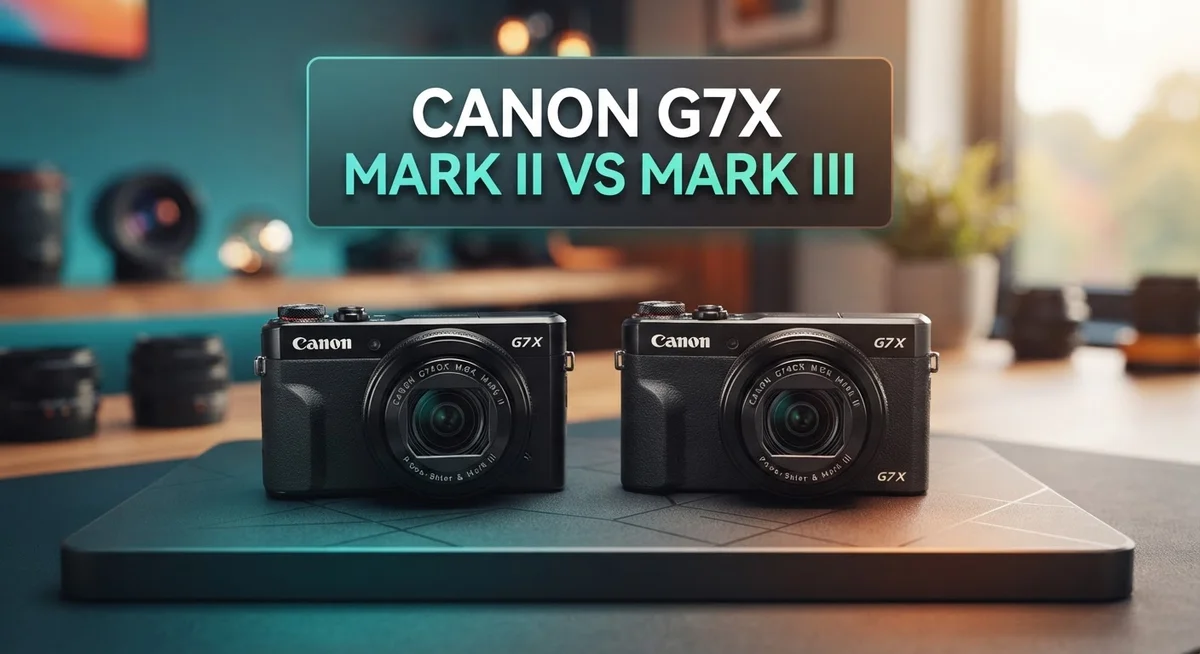
Canon G7X Mark II vs Mark III: Complete Comparison Guide
Choosing a compact camera can feel tricky. The Canon G7X Mark II and Mark III both pack a punch in a tiny body. But which one fits your needs better?
Both cameras share a similar design. They fit easily in your pocket. They travel well too.
The real differences show up in the details. The Mark III brings 4K video to the table. It also adds live streaming for YouTube fans.
The Mark II still holds its own for photography lovers. It offers great stills quality and a fast lens.
This guide breaks down every key feature. We compare sensors, video quality, autofocus, and design. You will find out which camera matches your shooting style.
Let’s explore what sets these two Canon cameras apart.
In a Nutshell
-
Same Core: Both cameras share a 20.1MP 1.0 inch sensor and a 24 100mm F1.8 2.8 lens with 4.2x optical zoom.
-
Video Upgrade: The Mark III delivers 4K uncropped video, while the Mark II stays limited to Full HD footage.
-
Faster Brain: A Digic 8 processor drives the Mark III, unlocking 30fps RAW burst shooting for quick action shots.
-
Creator Friendly: The Mark III adds live YouTube streaming and vertical video support, great for social content.
-
Flexible Screen: Both models include a tilt LCD, though the Mark III offers smarter framing for vloggers and selfies.
-
Pocket Size: At around 304g, both cameras stay light and compact enough for daily carry.
-
Final Take: The Mark III suits video first shooters, while the Mark II still pleases photo lovers who skip 4K.
Sensor and Image Quality
When it comes to sensor performance, both cameras deliver impressive results in a compact form factor. The 1.0 inch sensor on each model captures sharp, detailed images with excellent color accuracy. This larger sensor size compared to typical smartphone cameras means better light gathering ability and cleaner images in low light situations.
The 20.1MP resolution remains consistent across both generations. This megapixel count provides enough detail for printing large photos and cropping without losing quality. Real world shooting shows that both cameras excel at street photography, travel, and everyday moments. The sensor size matters more than raw megapixel count for image quality, and Canon got this right on both models.
Where the Mark III pulls ahead is in dynamic range and noise performance. The newer Digic 8 processor handles image data more efficiently than the Mark II’s older engine. This means the Mark III produces cleaner shots at higher ISO settings. If you shoot in dimly lit restaurants, concerts, or evening events, the Mark III shows noticeably better results.
The F1.8 aperture at the wide end is genuinely fast for a compact camera. This wide opening lets in plenty of light and creates that pleasing background blur effect. Both cameras maintain this speed throughout the zoom range, which is rare and valuable. You get shallow depth of field control that enthusiasts love, even in a pocket sized body.
Color science differs slightly between generations. The Mark III produces warmer, more saturated tones that many content creators prefer. The Mark II renders colors slightly cooler and more neutral. Neither approach is wrong, just different. Your editing software can adjust these anyway, so the difference matters less than you might think.
For video, the Mark III’s 4K capability means sharper footage on larger screens. The Mark II’s Full HD output looks good on phones and social media but shows limitations on 4K displays. Both cameras produce smooth, well exposed video with minimal noise.
Bottom line: image quality feels nearly identical for still photos. The processor upgrade in Mark III makes a real difference in video and fast action shooting. For casual photography, either sensor performs beautifully.

- NB-13L Battery Pack (3.6V, 1250mAh)
Last update on 2026-11-08 / Affiliate links / Images from Amazon Product Advertising API
Video Capabilities and Performance
When you hit record, the Mark III gives you something the Mark II simply cannot: 4K uncropped video at 30fps. This matters most if you plan to edit on large screens or deliver content to modern platforms. The Mark II maxes out at Full HD, which looks softer when viewed on 4K displays.
The Digic 8 processor in the Mark III handles video encoding more efficiently. This means better autofocus tracking during video, smoother pans, and less stuttering when you move quickly through scenes. The Mark II’s older processor works fine for casual recording, but struggles with fast movement.
For content creators, the Mark III opens new doors. Live YouTube streaming lets you broadcast directly from the camera without a computer. Vertical video support helps if you shoot for Instagram Reels or TikTok. The Mark II doesn’t have either feature, forcing you to use workarounds.
Both cameras include a tilt LCD screen, but the Mark III’s implementation feels smarter for vlogging. You can frame yourself more easily while recording, and the vertical video mode automatically adjusts the interface. If you shoot selfie content regularly, this difference becomes noticeable.
Audio performance stays similar between both models. Neither camera has exceptional microphone quality, so external audio gear helps if sound matters for your videos. Wind noise affects both equally during outdoor recording.
The Mark III’s 4K output also gives you flexibility in post production. You can crop, zoom, or reframe shots in editing without losing as much detail. The Mark II’s Full HD footage limits these options.
Stabilization works comparably on both cameras. Optical image stabilization keeps handheld video reasonably smooth, though neither replaces a tripod for professional results. The Mark III doesn’t add electronic stabilization, so the improvement stays modest.
For casual vlogging or travel videos, the Mark II remains functional. You get usable footage, and Full HD still looks good on smaller screens. However, if you want future proof video capability or plan to stream live, the Mark III’s 4K and streaming features justify the step up. The choice depends on whether you need these specific features or if Full HD meets your current needs.
Design, Portability, and Handling
Both cameras fit easily into a jacket pocket or camera bag. The Mark III weighs 304 grams, making it light enough for all-day shooting without fatigue. You’ll notice the compact body measures just 105.5 x 60.9 x 41.4mm, so it travels well.
The grip feels natural in your hand on both models. Canon designed these cameras for photographers who want serious performance without bulk. Your fingers rest comfortably on the body, and the controls stay within easy reach.
The tilt LCD screen appears on both generations. This feature lets you frame shots from unusual angles without contorting your body. The Mark III’s implementation feels smarter for vlogging, with vertical video support built in. If you shoot selfies or overhead content, this advantage matters.
Build quality impresses on both cameras. The metal body resists minor bumps during travel. Buttons feel responsive, and the zoom ring turns smoothly. You won’t feel like you’re handling a toy camera here.
Portability wins with these compact cameras. Unlike larger mirrorless or DSLR systems, you can carry the G7X without a dedicated camera bag. Slip it into your backpack’s front pocket, and you’re ready to shoot. This convenience encourages you to bring it everywhere.
The tilt screen also helps with low angle shots. You can place the camera on a table and tilt the display up to frame your subject. This flexibility opens creative possibilities without needing a tripod or remote trigger.
Handling differences between the two models feel minimal. Both offer the same button layout and menu structure. If you’ve used the Mark II, switching to the Mark III requires no learning curve. Your muscle memory transfers instantly.
The compact size makes these cameras ideal for travel photographers. Whether you’re hiking mountains or exploring cities, the lightweight body won’t slow you down. You get professional image quality without professional-sized gear. This balance between performance and portability defines the G7X line.
Top 3 Alternatives
Sony RX100 VII

- Sony USA Authorized. Bundle Includes: Sony Cyber-shot DSC-RX100 VII Digital Camera, 64GB Memory...
- Premium Compact Performance – The RX100 VII combines a 20.1MP 1-inch stacked CMOS sensor with the...
Last update on 2026-10-12 / Affiliate links / Images from Amazon Product Advertising API
The Sony RX100 VII stands out as a powerful alternative in the compact camera space. This camera delivers excellent autofocus performance with real-time tracking that follows your subject smoothly. The sensor captures sharp images even in low light conditions, giving you flexibility in various shooting environments.
You get a 24-200mm equivalent zoom range, which provides versatility for different shooting scenarios. The electronic viewfinder helps you frame shots accurately before you capture them. Video recording capabilities include 4K options, making this camera suitable for content creators who need both photos and videos.
Panasonic Lumix LX100

- Legendary LUMIX LX Series with manual controls Designed to Inspire Creativity
- Superior light capture with large, multi aspect micro four thirds sensor
Last update on 2026-11-08 / Affiliate links / Images from Amazon Product Advertising API
The Panasonic Lumix LX100 offers a unique fixed lens design with a 24-75mm equivalent focal length. This camera features a large aperture that lets in more light, perfect for photography in dim settings. The manual control options give you creative freedom when you want to adjust exposure and focus yourself.
The built-in electronic viewfinder provides a clear view of your composition. You can shoot in RAW format, which gives you more flexibility during photo editing. The compact body makes this camera easy to carry around for daily photography adventures.
Nikon Coolpix A

- 20MP 1/2.3" BSI CMOS Sensor. Focal length : 4.3 to 151mm
- NIKKOR f/3.4-6.9 ED Lens. Bluetooth Specification Version 4.1
Last update on 2026-11-08 / Affiliate links / Images from Amazon Product Advertising API
The Nikon Coolpix A brings a fixed 28mm equivalent lens that appeals to street and travel photographers. This camera prioritizes simplicity and speed, letting you focus on capturing moments rather than adjusting complicated settings. The APS-C sensor size ensures strong image quality across different lighting situations.
The lightweight design makes it perfect for photographers who value portability. You get straightforward controls that respond quickly to your input. The fixed focal length encourages creative thinking about composition and perspective.
Lens Performance and Optical Zoom
The lens on both cameras shares the same focal range of 24-100mm, giving you a 4.2x optical zoom. This means you get a wide angle for landscapes and a decent telephoto for distant subjects. The F1.8 aperture at the wide end lets in plenty of light, which helps in dim settings without forcing you to boost ISO.
Where these lenses differ comes down to internal improvements. The Mark III uses newer glass elements that reduce chromatic aberration. You’ll notice cleaner colors at the edges of your frame, especially when shooting against bright skies. The Mark II’s optics are solid but show slightly more color fringing in extreme conditions.
Both cameras deliver sharp images across the entire zoom range. The autofocus system feels snappy on both models. The Mark III’s Digic 8 processor speeds up focus tracking, so moving subjects stay locked in place more reliably. This matters when you’re filming or shooting fast action.
Optical stabilization works on both lenses to minimize blur from hand shake. You get about 4 stops of compensation, which is impressive for a compact camera. Handheld video feels smooth on either model, though the Mark III’s faster processor coordinates stabilization more intelligently.
The Mark III’s lens breathes less during zoom movements, meaning focal length shifts don’t cause noticeable focus shifts. The Mark II shows minor focus breathing, which matters if you’re shooting video and zooming smoothly.
Macro capability stays the same on both. You can focus as close as 5cm at the wide end, perfect for detail shots of food or small objects.
The real advantage of the Mark III lens comes through in dynamic range performance. The newer optical design works better with the improved sensor, capturing more detail in shadows and highlights simultaneously. For stills, this difference feels subtle. For video, it becomes more obvious when you’re grading footage in post production.
Both lenses feel well built and responsive. The zoom ring turns smoothly without grinding. Neither camera feels cheap or plasticky. For everyday shooting and travel, both deliver optical performance that punches well above their compact size.
Processing Power and Features
The processing power difference between these two cameras shows up most clearly when you push them beyond basic shooting. The Mark III uses Canon’s Digic 8 processor, while the Mark II relies on an older generation chip. This matters because the newer processor handles complex tasks faster and more efficiently.
Burst shooting performance separates these cameras noticeably. The Mark III captures RAW files at 30fps in burst mode, letting you freeze fast action and pick the perfect frame later. The Mark II manages continuous shooting, but at slower speeds. For photographers who shoot sports, wildlife, or unpredictable moments, this speed difference becomes important.
Processing speed affects your workflow too. The Mark III writes files to the memory card faster, so you spend less time waiting between shots. When you’re capturing multiple sequences, those seconds add up. The older processor in the Mark II takes longer to process and save images, which can feel frustrating during active shooting sessions.
Image processing algorithms on the Mark III have improved. Canon refined how the camera handles noise reduction, white balance, and color science. You’ll see this in challenging lighting situations where the Mark III produces cleaner shadows and more accurate colors straight from the camera.
Autofocus performance shows another processing advantage. The Mark III’s faster processor enables quicker focus acquisition and better subject tracking. The Mark II still focuses reliably, but the newer camera responds faster to moving subjects. This matters for video work especially, where smooth focus transitions look more professional.
The Digic 8 processor also enables features the Mark II cannot support. Live YouTube streaming, advanced metering modes, and improved face detection all depend on processing power. These features appeal to content creators who need modern connectivity and automation.
Both cameras deliver excellent results for everyday photography. The processing difference becomes meaningful when you demand speed, advanced features, or work in demanding conditions. Your shooting style determines whether this gap matters to your needs.
Pros and Cons
Pros
- Mark III captures 4K video uncropped at 30fps, while Mark II maxes out at 1080p
- Mark III streams live to YouTube directly from the camera, perfect for content creators
- Mark III’s Digic 8 processor handles faster autofocus and smoother burst shooting
- Both cameras slip into your pocket and weigh under 350g for true portability
- Fast F1.8 lens at wide end lets you shoot in low light without pushing ISO too high
Cons
- Mark III costs significantly more than finding a used Mark II on the secondhand market
- Neither camera matches dedicated video cameras for professional filmmaking work
- Mark II’s older processor struggles with rapid-fire shooting compared to Mark III’s speed
- Mark III’s premium features mean you pay extra if you only need basic stills photography
Who Should Buy It
The Mark II appeals to photographers who already own Canon gear and want a compact upgrade without major changes. You’ll appreciate the familiar menu system and lens characteristics. This camera works well if you shoot mostly stills and don’t need 4K video.
The Mark III targets content creators and hybrid shooters. You film videos regularly and want 4K capture in your pocket. Live YouTube streaming from the camera matters to you. You post content online and need smooth autofocus during video recording.
Travel photographers benefit most from the Mark III. You move between countries and need a single camera for both photos and videos. The tilt LCD helps you frame shots from awkward angles. Vertical video support lets you capture content for social media without rotating footage later.
If you shoot in low light often, the Mark III’s faster processor handles high ISO better. Your burst sequences stay sharp and quick. You won’t wait for the camera to process images between shots.
Vloggers should seriously consider the Mark III. You film yourself talking to the camera and want reliable autofocus that tracks your face. The direct YouTube upload saves you time after filming. You can go live from anywhere without extra equipment.
Casual photographers who take occasional videos find the Mark II sufficient. You mainly shoot photos and use video as a secondary feature. You don’t need 4K and prefer simplicity over advanced features.
Professional photographers skip both models. You need interchangeable lenses and larger sensors. These cameras can’t replace your main system for client work.
Street photographers love the Mark III’s size and image quality. You want something that doesn’t attract attention but delivers sharp, colorful images. The fast lens helps you work in dim urban environments.
Travelers on their first compact camera purchase should choose the Mark III. You get current technology and features that last longer. The newer processor feels snappier and more responsive to your inputs.
Choose the Mark II only if you find it used and want to save money while staying in the Canon ecosystem. Otherwise, the Mark III’s features justify the investment for anyone doing hybrid photography and video work.
Final Verdict
Choosing between these two cameras comes down to your shooting style. Both models share the same core design and sensor, so image quality stays close between them.
The real difference lies in what you plan to create. If video matters to you, the Mark III pulls ahead easily.
Photographers who focus mostly on stills may find the Mark II does everything they need. It handles portraits, landscapes, and street photography just as well.
Think about how you use your camera daily. Content creation, streaming, and hybrid shooting push you toward the newer model.
Simple photo taking with occasional clips fits the older model perfectly. You get a proven camera without extra features you might never use.
Consider your growth as a creator too. If you plan to start vlogging or sharing more video content, the Mark III gives you room to grow into those skills.
Some buyers prioritize having the latest technology. Others prefer sticking with familiar tools that already work well for their needs.
Your accessory collection matters here as well. If you already own Canon batteries, chargers, or cases, either camera fits into that setup smoothly.
Long term use plays a role in this decision. The Mark III’s newer processor means better software support and compatibility as time passes.
Think about how often you shoot in tricky lighting conditions. Frequent low light or fast action shooting favors the Mark III’s quicker responses.
Casual users who shoot in good light most of the time won’t notice much difference. Both cameras perform reliably in everyday conditions.
Your final choice should match your actual shooting habits, not just specs on paper. Pick the camera that fits your real workflow, not the one with more features you might skip.
Either camera delivers strong image quality in a pocket sized body. The right pick depends on how you plan to use it, not which one sounds more advanced.
Frequently Asked Questions
Which camera has better autofocus performance?
The Mark III wins this round. Its Digic 8 processor delivers faster autofocus tracking and more reliable subject detection. The Mark II uses an older processor that struggles when you need rapid-fire shooting or quick focus shifts.
If you shoot moving subjects like kids or pets, the Mark III keeps up better. The older Mark II works fine for static scenes and landscapes.
Can I shoot 4K video on both cameras?
No. Only the Mark III records 4K video at 30fps. The Mark II maxes out at 1080p, which limits your options if you plan to create YouTube content or need higher resolution footage.
The Mark III also supports live streaming directly to YouTube. This feature makes it genuinely useful for vloggers and content creators who want to go live without extra equipment.
Is the Mark II still worth buying used?
Yes, if you shoot mostly stills in good lighting. The Mark II handles everyday photography perfectly well. You get a pocket camera with a fast lens and excellent image quality.
However, if you shoot videos regularly or work in dim environments, the Mark III’s improvements justify the investment. The newer processor also means longer software support and better compatibility with future Canon apps.
What’s the main difference between the sensors?
Both cameras have a 20.1MP, 1.0 inch sensor. The real difference is how the Mark III’s processor handles the image data. It produces cleaner high ISO files and faster burst rates.
In normal daylight, you won’t spot major quality differences. The advantage shows up when you push the camera in challenging conditions.

Dillip is the founder and editor of Switch & Size, where he breaks down tech products, accessories, and gadgets to help readers make smarter buying decisions. With a passion for testing and comparing the latest technology, he delivers honest reviews, in-depth guides, and side-by-side comparisons that cut through the marketing noise.