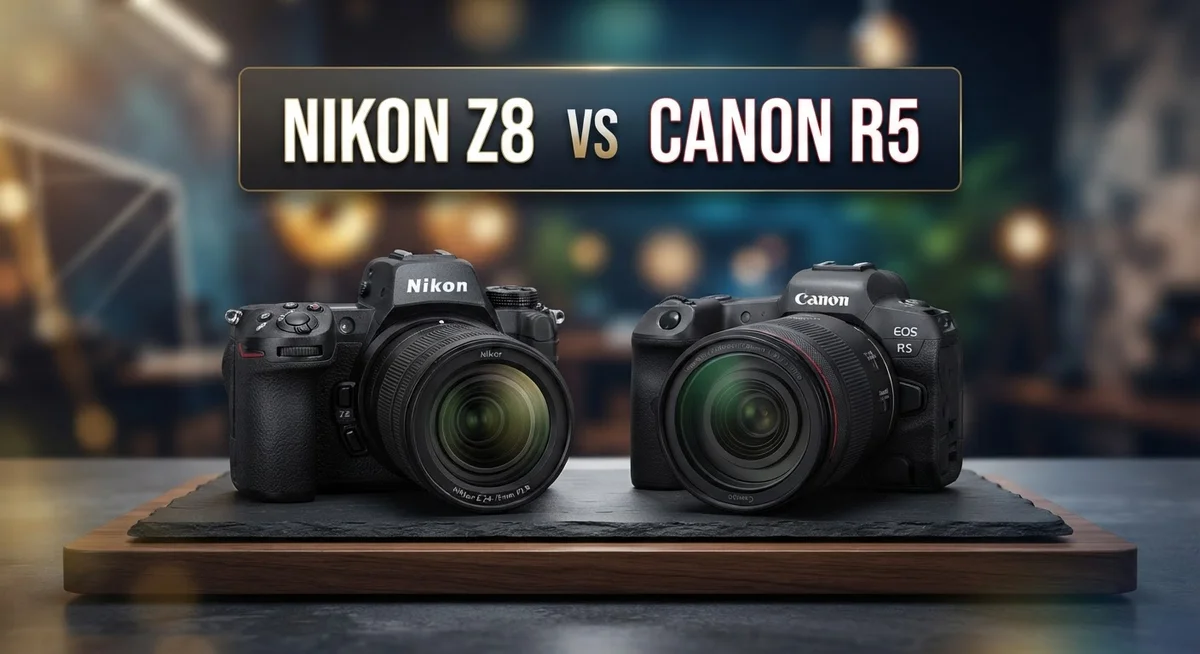
Nikon Z8 vs Canon EOS R5: Professional Mirrorless Camera Comparison
Choosing a new camera feels exciting but tricky. The Nikon Z8 and Canon R5 both stand out as top picks for photographers.
Both cameras pack serious power into smaller bodies. They deliver high resolution images and fast performance for demanding shoots.
The Z8 brings a stacked sensor and quick burst speeds. This makes it a great choice for action and wildlife shots.
The R5 offers clean image quality and Canon’s trusted autofocus system. Photographers who already use Canon lenses will find it a natural fit.
So which camera fits your style better? This guide breaks down specs, features, and real world performance. You will see how each camera handles resolution, speed, and image quality.
By the end, you will know exactly which one matches your creative needs. Let’s jump into the details and find your perfect match.
In a Nutshell
-
Nikon Z8 relies on a stacked sensor, giving near zero rolling shutter for sharp action shots.
-
Canon R5 pairs its sensor with Dual Pixel autofocus, delivering precise eye and subject tracking.
-
The Z8’s EXPEED 7 processor pushes more data per second, helping fast continuous shooting stay smooth.
-
Canon’s DIGIC X plus Accelerator combo supports steady 8K video with better heat control over long clips.
-
Both cameras handle advanced video codecs, but the R5 leans toward cinematic color rendering for filmmakers.
-
Nikon’s Z mount lens lineup keeps growing, opening new doors for wildlife and sports shooters.
-
Canon’s RF mount already has a deep lens catalog, backed by years of trusted optical design.
-
Ergonomics differ too: the Z8 feels compact yet solid, while the R5 offers a familiar grip for longtime Canon users.
-
Battery life leans slightly in Canon’s favor, useful for long outdoor sessions without frequent swaps.
-
Both models suit hybrid shooters who mix stills and video, but each brings its own creative flavor to the table.
Sensor and Resolution Comparison
The sensor and resolution battle between these two flagships reveals subtle but meaningful differences in how each camera captures light and detail.
Both cameras deliver 45 megapixels of resolution, so print size and crop flexibility feel nearly identical. The Z8 pushes 45.7MP while the R5 sits at 45.0MP. This tiny gap matters far less than the architecture behind each sensor.
Nikon chose a stacked sensor design for the Z8. This means the photodiodes and processing circuits sit on separate layers. The advantage? Faster readout speeds reduce rolling shutter and enable that impressive 20fps burst rate. The trade-off is a slight increase in thermal noise, especially at higher ISOs. You will notice this mostly in shadow areas or extreme underexposure situations.
Canon’s R5 uses a traditional sensor layout paired with its DIGIC X processor and dedicated accelerator chip. This approach delivers cleaner, quieter output straight from the camera. The image processing feels more refined, and noise patterns appear less visible in real world shooting. Canon shooters often praise the R5’s color rendering and baseline image quality.
When it comes to raw file flexibility, the Z8 shines. The stacked sensor captures data with less internal processing baked in. This means your raw files hold more information for post-production adjustments. Photographers who edit heavily appreciate this extra latitude. Canon’s files feel more “finished” from the start, which some shooters prefer and others find limiting.
The EXPEED 7 processor in the Z8 handles data throughput differently than the DIGIC X combo. Nikon’s approach prioritizes speed and buffer depth. You can fire off 200+ shots before the camera slows down. Canon’s system manages heat better during extended 8K recording sessions.
Neither sensor is objectively “better.” Your choice depends on priorities. Need maximum burst capability and raw editing power? The Z8 wins. Prefer clean, straight-from-camera image quality with proven reliability? The R5 delivers. Both handle professional landscape, wildlife, and hybrid video work with genuine excellence.

- Completely NEW Canon designed full-frame back-illuminated stacked CMOS 45MP sensor.
- Fast sensor read-out speeds allow for up to 30 fps electronic shutter performance.
Last update on 2026-11-08 / Affiliate links / Images from Amazon Product Advertising API
Autofocus and Burst Performance
The autofocus systems in these two cameras take different approaches to speed and accuracy. The Z8 uses Nikon’s advanced phase detection across the entire frame, locking onto subjects with impressive speed. The R5 relies on Canon’s Dual Pixel autofocus technology, which excels at eye and animal detection.
In real shooting situations, both cameras track moving subjects reliably. The Z8 edges ahead when you need continuous focus on fast action like wildlife in flight. The R5 shines when you’re shooting portraits or video where smooth, predictable focus transitions matter more.
Burst performance separates these cameras most clearly. The Z8 fires at 20 frames per second while maintaining full autofocus and metering, keeping every shot perfectly exposed. The R5 delivers strong burst speeds, but they fall slightly behind the Z8’s raw output. For wildlife photographers capturing unpredictable moments, the Z8’s sustained burst rate means you catch more keepers.
The Z8’s stacked sensor design contributes to its burst advantage. This architecture lets the camera read data faster without the rolling shutter distortion that plagues traditional sensors. You get sharper action shots, especially with fast-moving subjects across the frame.
Heat management plays a role too. The Z8 handles extended burst shooting without throttling performance. The R5 performs well during normal sessions, but intense rapid-fire shooting can trigger thermal limits on longer bursts.
Buffer capacity also matters. The Z8 holds more frames in its memory before slowing down, letting you shoot longer sequences without pausing. The R5’s buffer fills faster under sustained shooting.
For video autofocus, both cameras perform excellently. The R5 offers slightly smoother focus transitions during filming. The Z8 focuses faster but with marginally more hunting in certain lighting.
Choose the Z8 if you shoot fast action and need maximum burst speed. Pick the R5 if smooth, predictable autofocus and video transitions matter more to your style. Neither camera disappoints in real world use. Your specific shooting situations should guide your decision.
Image Quality and Processing Power
Image quality comes down to how each camera captures light and processes the data. The Z8 uses a stacked sensor design, which means the photodiodes sit on a separate layer from the circuitry. This setup enables faster data readout and smoother burst shooting without overheating.
The Canon R5 employs a traditional sensor layout with its DIGIC X processor plus a dedicated accelerator chip. This combination produces exceptionally clean image output straight from the camera. Many photographers notice the R5 delivers slightly less noise in the shadows, especially at higher ISOs.
Both cameras pack 45 megapixels, so cropping flexibility and print sizes feel nearly identical. The real difference emerges in raw file processing. The Z8’s EXPEED 7 processor handles raw data differently than Canon’s system. You get more flexibility when editing Z8 files in post-production, particularly when recovering highlight detail or adjusting shadows aggressively.
Processing power directly impacts burst performance. The Z8 maintains 20 frames per second with continuous autofocus at full resolution. The R5 delivers competitive burst rates but falls slightly short in sustained shooting. Heat management matters here too. The Z8’s stacked sensor design dissipates heat more efficiently during long bursts.
For video work, the R5 edges ahead with cinematic color rendering built into its processing pipeline. The DIGIC X accelerator keeps 8K recording stable even during extended sessions. The Z8 handles 8K capably but requires more attention to cooling during marathon shoots.
Neither sensor is objectively superior. Your choice depends on priorities. Choose the Z8 if you prioritize raw editing flexibility, maximum burst speed, and sustained shooting without thermal concerns. Pick the R5 if you value cleaner straight-from-camera images, established Canon workflows, and cinematic video output.
Both cameras punch well above their weight for landscape, wildlife, and hybrid photo-video work. The processing differences matter most to photographers who spend significant time editing raw files or who demand extreme burst performance during fast action.
Top 3 Alternatives
Sony Alpha A1

- 50.1MP full-frame stacked Exmor RS CMOS sensor w/ integral memory
- 8x more powerful, next generation BIONZ XR image processing engine

Last update on 2026-11-08 / Affiliate links / Images from Amazon Product Advertising API
The Sony Alpha A1 stands out with its 50.1-megapixel full-frame sensor. You get fast autofocus performance that tracks moving subjects with precision. The camera shoots 8K video at 24p, which opens creative possibilities for professional filmmakers.
Real-time eye AF works on humans, animals, and birds. You’ll appreciate the silent shooting mode during events. The buffer capacity handles rapid-fire bursts without slowing down. Built-in stabilization helps you capture smooth footage in challenging light.
Canon EOS R3

- Canon USA Authorized. Items Include: Canon EOS R3 Mirrorless Camera | 24MP Full Frame Sensor 6K RAW...
- 24MP Full Frame Sensor: The Canon EOS R3 is built for professionals, featuring a 24MP full-frame...
Last update on 2026-11-08 / Affiliate links / Images from Amazon Product Advertising API
Canon’s EOS R3 delivers a 24.1-megapixel sensor with exceptional speed. It shoots at 15 fps with the mechanical shutter and up to 30 fps electronically. The autofocus system includes gaze detection, letting you focus by looking at subjects through the viewfinder.
Weather sealing makes this camera reliable in harsh conditions. Dual card slots give you backup storage options. The 4K video capabilities suit content creators. You’ll find the ergonomic grip comfortable during extended shooting sessions.
Nikon Z9

- 45.7MP Stacked CMOS sensor and EXPEED 7 image processing. Fast powerful AF that can keep up with the...
- Subject detection uses deep learning to automatically detect and track people, cats, dogs, birds...
Last update on 2026-11-08 / Affiliate links / Images from Amazon Product Advertising API
Nikon’s Z9 offers a 45.7-megapixel sensor with impressive dynamic range. This camera shoots 8K video at 60p, making it powerful for high-end production work. The autofocus system covers 90% of the frame, giving you flexibility in composition.
The Z9 handles extreme temperatures and moisture exposure. Its titanium shutter reaches 11 fps with the mechanical option. Battery life extends beyond competing models, keeping you shooting longer. The deep buffer allows continuous shooting without interruption.
All three cameras serve professional photographers and videographers. Your choice depends on whether you prioritize resolution, speed, or video capabilities.
Lens Ecosystem and Compatibility
Nikon and Canon built their lens ecosystems around completely different mounts. The Z8 uses Nikon’s Z mount, while the R5 relies on Canon’s RF mount. Each system has grown significantly, but they serve different photographer needs.
Nikon’s Z mount arrived in 2018 and has expanded rapidly. The Z8 works with over 40 native Z mount lenses today. Nikon also offers the FTZ II adapter, which lets you use thousands of older F mount lenses. This backward compatibility gives Z8 owners enormous flexibility. You can shoot vintage glass or modern primes without buying new equipment.
Canon’s RF mount launched around the same time. The R5 accesses more than 50 native RF lenses currently. Canon also provides the EF to RF adapter, opening access to their extensive EF lens library. The RF ecosystem feels slightly more mature because Canon released professional lenses earlier in the mount’s lifecycle.
The real difference lies in lens philosophy. Nikon pushed compact, lightweight Z mount designs. Their lenses often feel more portable for travel and hiking. Canon emphasized optical performance and build quality in their RF lenses, which sometimes means larger, heavier designs.
For specialized work, both systems excel. Wildlife photographers find excellent telephoto options in both mounts. Landscape shooters appreciate the wide angle selections available from each brand. Video creators benefit from the autofocus performance in both lens lineups.
Third party lens support matters too. Tamron and Sigma now produce lenses for both Z and RF mounts. This expands your options beyond official brand offerings. You’re not locked into expensive first party glass anymore.
Consider your existing gear before choosing. If you own Canon EF lenses, the R5 makes sense. If you have Nikon F mount glass, the Z8 becomes more attractive. New buyers should think about which ecosystem feels right for their future plans.
Both mounts are here to stay. Neither system will disappear. Your choice depends on which lens selection matches your shooting style and budget for future purchases.
Video Capabilities and Hybrid Features
Video work separates these two cameras in meaningful ways. The Z8 captures 8K RAW video internally, while the R5 maxes out at 8K with external recording. This matters if you need maximum flexibility in post production.
The Z8’s stacked sensor gives it a speed advantage that translates to smoother video autofocus tracking. Fast-moving subjects stay locked in the frame without hunting. The R5 handles video autofocus well too, but the Z8 feels more responsive in demanding situations.
Frame rates tell part of the story. Both shoot 4K at 120fps, which opens creative options for slow motion work. At higher resolutions, the Z8 maintains frame rate stability better due to its processor design. Heat buildup affects longer recording sessions, and the Z8 manages thermal load more efficiently.
Color science differs between these cameras. The R5 renders skin tones with a warm, cinematic quality that many video creators prefer straight out of camera. The Z8 requires more color grading to achieve similar results, but this gives you more control in post work.
Autofocus performance in video mode favors the Z8 slightly. Its eye detection and subject tracking feel snappier, especially with fast moving wildlife or sports. The R5’s autofocus remains reliable and smooth, making it excellent for narrative work where predictability matters.
Codec options expand your workflow choices. The Z8 supports more compressed formats, reducing file sizes without sacrificing quality. The R5 sticks to fewer codec options, which simplifies editing but creates larger files.
Heat management becomes critical during extended shoots. The Z8 handles long recording sessions better, while the R5 may throttle video features after 20 30 minutes of continuous recording in hot conditions.
Choose the Z8 if you shoot fast action video or need 8K RAW recording. Pick the R5 if you prioritize cinematic color rendering and smooth, predictable autofocus for narrative projects. Both cameras excel at hybrid photo video work, so your specific shooting style matters most.
Pros and Cons
Nikon Z8 Pros
- Delivers 20fps burst with full autofocus tracking, beating the R5’s competitive but slower rate
- Stacked sensor design captures data faster, giving you smoother video autofocus and better action tracking
- Raw files offer superior post-processing flexibility for color grading and fine-tuning
- Compact, lightweight Z mount lenses keep your kit nimble without sacrificing optical quality
- Excels at 8K RAW video recording, a rare feature for hybrid shooters
Nikon Z8 Cons
- Stacked sensor design introduces slightly more noise in shadow areas compared to traditional layouts
- Smaller Z mount ecosystem means fewer third-party lens options than Canon RF
- Requires new Z mount lenses if you’re switching from other systems
Canon R5 Pros
- Traditional sensor layout produces cleaner, smoother image output straight from the camera
- Established RF mount ecosystem with abundant native lens choices
- Autofocus system feels predictable and reliable across most shooting scenarios
- Cinematic color rendering built into the DIGIC X processor appeals to video professionals
- Strong performance for landscape and wildlife work
Canon R5 Cons
- Slower burst rate limits fast action photography compared to the Z8
- Requires investment in RF mount lenses if you own older Canon EF glass
- Processing power doesn’t match the Z8’s speed advantage for demanding workflows
Who Should Buy It
Professional photographers choosing between these two cameras should ask themselves what matters most in their workflow.
Choose the Z8 if you shoot fast action. You need 20fps burst with full autofocus tracking. Wildlife photographers love this speed. Sports shooters benefit from the stacked sensor’s faster data capture. If you grade your own raw files, the Z8’s raw flexibility lets you push colors further in post production. Video creators who need 8K RAW recording will find this feature rare and valuable. You also prefer a lighter kit. Nikon’s Z mount lenses stay compact without losing optical quality.
Pick the R5 if you value clean image output. The traditional sensor design produces cleaner shadows straight from the camera. Your existing Canon EF lens collection already sits in your bag. The RF mount ecosystem feels familiar and established. You shoot more portraits and studio work where burst speed matters less. Cinematic color science appeals to you. Canon’s color rendition needs less adjustment in post production.
Consider hybrid shooters specifically. Both cameras excel at mixing photo and video work. The Z8 edges ahead for fast video autofocus tracking and action sequences. The R5 delivers when you need that polished, straight-out-of-camera look for client deliverables.
Think about your lens future. Do you already own glass in one system? That investment matters more than any single camera feature. Both mounts will stick around for years. Third party support exists for both, though Canon RF has slightly more options currently.
Ask yourself about noise tolerance. The Z8’s stacked sensor trades a tiny bit of shadow cleanliness for speed. If you shoot in low light constantly and need pristine shadows, the R5 wins. Most photographers never see this difference in real world shooting.
Your choice depends on whether you prioritize speed and flexibility or clean output and ecosystem comfort. Neither camera is wrong. Your shooting style determines which one fits better.
Final Verdict
Both cameras deliver incredible image quality and video performance. Your final choice depends on what fits your daily shooting style best.
The Nikon Z8 stands out for photographers who chase movement. Wildlife shooters and sports photographers benefit most from its speed advantage.
The Canon R5 appeals to shooters who value a mature system. Its menu layout feels familiar to anyone who has used Canon cameras before.
Build quality plays a role too. The Z8 uses a magnesium alloy body that feels solid in hand. The R5 offers similar durability with slightly different weather sealing points.
Battery life differs between these systems. The Z8 tends to squeeze out more shots per charge in real world testing. This matters if you shoot long events without easy charging access.
Viewfinder resolution is another quiet factor. Both cameras offer sharp electronic viewfinders, but eye comfort varies slightly based on grip depth and eye relief distance.
Think about where you already stand. If you own Nikon glass, the Z8 makes sense right away. If Canon lenses fill your bag, the R5 keeps that investment working for you.
Neither camera is a wrong choice. Both models compete at the top of the hybrid camera market. Your workflow, not the spec sheet alone, should guide your final decision.
If you shoot fast paced content and want raw processing freedom, lean toward the Z8. If you want proven color accuracy and a wider lens ecosystem, the R5 covers that need well.
Try holding both cameras before deciding, if possible. Grip comfort and menu speed often matter more day to day than any spec on paper.
Your creative goals should lead this decision, not marketing claims. Pick the tool that disappears in your hands and lets you focus on the shot itself.
Frequently Asked Questions
Which camera handles fast action better?
The Nikon Z8 wins here. It shoots at 20fps with continuous autofocus tracking on every single frame. The Canon R5 II reaches slower burst speeds, so if you photograph sports, wildlife, or any fast-moving subject, the Z8 keeps up better. The stacked sensor design in the Z8 enables this speed advantage.
Does sensor type really matter for image quality?
Yes, but the difference is subtle. The Z8 uses a stacked sensor that processes data faster, which creates slightly more noise in deep shadows. The R5 II uses a traditional sensor layout that produces cleaner shadow areas straight out of the camera. For most photographers, both deliver excellent results. The choice depends on whether you prefer spending time in post-processing (Z8) or getting cleaner files immediately (R5 II).
What about the lens ecosystem?
Canon has more third-party lens options available right now. The RF mount has been around longer, so manufacturers support it heavily. Nikon’s Z mount is growing fast but remains smaller. If you already own lenses in one system, that investment matters more than any camera spec. Switching systems means replacing your entire lens collection.
Which is better for video work?
Both cameras excel at video, but the Z8 stands out for 8K RAW recording. This rare feature gives you maximum flexibility in post-production color grading. The R5 II offers excellent 4K performance with strong autofocus. Choose based on your video resolution needs and editing workflow.
Should I buy used or new?
Both cameras hold value well in the used market. Buying used saves money but means no manufacturer warranty. New purchases include full support and peace of mind. Consider your budget and how long you plan to keep the camera.

Dillip is the founder and editor of Switch & Size, where he breaks down tech products, accessories, and gadgets to help readers make smarter buying decisions. With a passion for testing and comparing the latest technology, he delivers honest reviews, in-depth guides, and side-by-side comparisons that cut through the marketing noise.