Canon C80 vs C400: Professional Cinema Camera Comparison
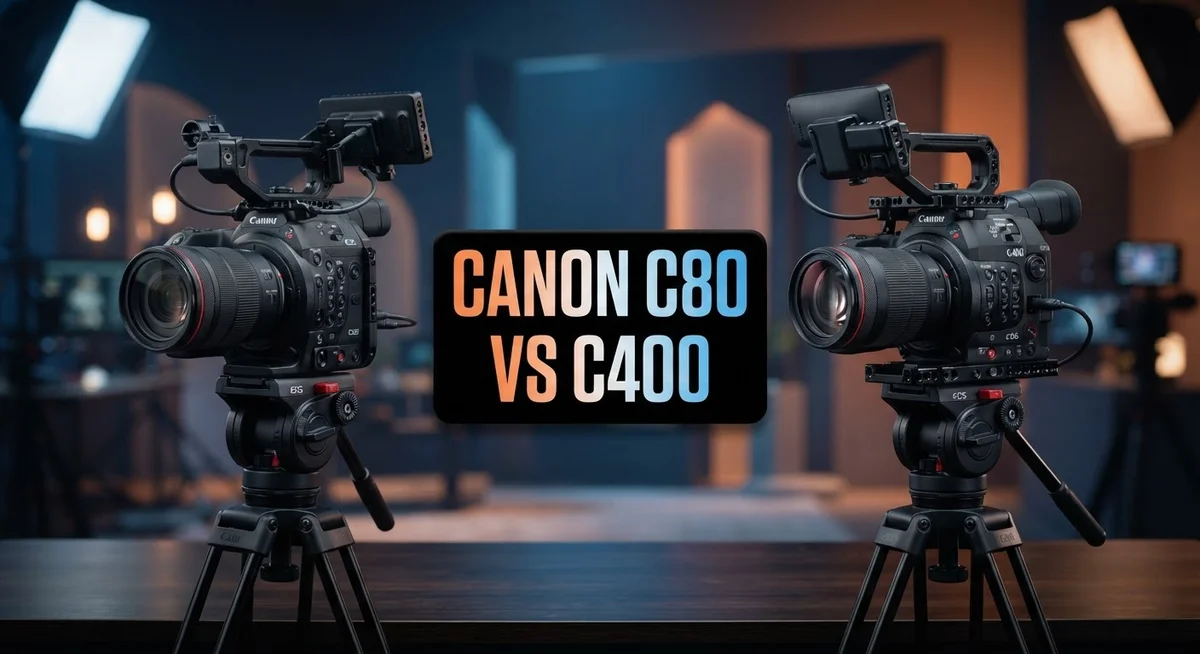
Picking a cinema camera can feel tricky. Canon gives us two strong options: the C80 and the C400. Both share the same RF mount and sensor technology.
But they serve different needs. The C80 packs a compact DSLR-style body. It fits creators who want power without extra bulk.
The C400 steps up with higher bitrate and more frame rate options. It suits teams who need flexible I/O and long-term video projects.
Both cameras support real-time IP streaming through SRT. Both also include built-in Wi-Fi and Ethernet for fast workflows.
So which one fits your work? This guide breaks down every key difference. We compare specs, pros, and cons side by side.
By the end, you will know exactly which camera matches your shooting style and goals.
In a Nutshell
Here’s the quick rundown to help you decide fast:
-
The C80 packs a compact DSLR style body. It fits well for solo shooters and run and gun setups.
-
The C400 uses a larger body with more physical controls. This suits crews who need fast access to buttons and ports.
-
Storage differs a lot. The C80 relies on SD cards. The C400 supports faster media types for its higher data rates.
-
Both cameras share the same sensor technology. So image quality stays close between them in many situations.
-
The C400 offers more I/O options. This helps on bigger sets with external monitors and audio gear.
-
If you shoot fast paced content, the C80’s lighter body helps you move quickly. The C400 fits stationary or planned shoots better.
-
Neither camera has a global shutter. Keep this in mind if you shoot fast motion or handle lots of camera movement.
Both cameras share the same RF mount and support Wi-Fi streaming. Your final pick depends on your shooting style and daily workflow needs.
Sensor Technology and Image Quality
The sensor technology in both cameras represents Canon’s commitment to professional video capture. Both the C80 and C400 use identical sensor architecture, which means you get the same color science and dynamic range performance from either body.
The real difference emerges in how each camera processes and records that sensor data. The C80 maxes out at 576 Mbps bitrate using Cinema Raw Light format. This delivers excellent image quality for most productions. The C400 jumps to 2.1 Gbps bitrate, giving you substantially more information per frame.
Higher bitrate means more color information and finer detail preservation. When you grade footage in post production, the C400’s extra data becomes noticeable. You get smoother gradations and cleaner color transitions. The C80 still produces stunning images, but the C400 provides additional headroom for aggressive color work.
Frame rate flexibility also impacts image quality. The C400 shoots 6K at 50p, while the C80 operates within tighter frame rate constraints. More frame rate options mean better slow motion capabilities and smoother motion representation. If your projects demand high speed capture or specific frame rates, the C400 adapts more easily.
Both cameras lack global shutter technology. This means rolling shutter artifacts can appear when panning quickly or capturing fast moving subjects. Neither camera solves this limitation, so your choice won’t change this characteristic.
The RF mount connects both cameras to Canon’s growing lens ecosystem. Lens quality directly affects final image output. The C400’s larger body accommodates more complex lens designs and heavier glass without balance issues. The C80’s compact form works beautifully with lighter RF lenses.
Storage media also influences practical image quality. The C80 uses SD cards, which have bitrate limitations for sustained recording. The C400 offers more flexible I/O options for external recording solutions. This matters when you need to maintain consistent quality throughout long shooting days.
In summary, identical sensors mean identical base image capture. The C400 pulls ahead through higher bitrate recording, more frame rate options, and better I/O flexibility for maintaining quality during post production workflows. The C80 delivers professional results with simpler, more portable recording solutions.

- 6K FF Back-Illuminated CMOS Sensor
- Full Frame and Super35 Modes
Last update on 2026-11-05 / Affiliate links / Images from Amazon Product Advertising API
Bitrate, Frame Rates, and Recording Formats
The bitrate difference between these cameras shapes your recording options significantly. The C80 maxes out at 576 Mbps using Cinema Raw Light format. The C400 pushes to 2.1 Gbps, giving you substantially more data per frame. Higher bitrate means richer color information and smoother gradations in your footage.
Frame rates tell a different story for each camera. The C400 shoots 6K at 50p, opening doors for slow motion work and high frame rate projects. The C80 focuses on standard cinema frame rates without the extreme high speed options. If your projects demand 6K capture or frequent slow motion, the C400 handles this natively.
Recording format flexibility matters for post production workflows. The C400’s S16 crop mode adds shooting versatility that the C80 doesn’t offer. This crop mode lets you frame shots differently without changing lenses. Both cameras record to professional codecs, but the C400’s higher bitrate gives you more editing headroom.
Storage media creates a practical divide between these cameras. The C80 uses SD cards, which means ongoing media costs add up quickly at 576 Mbps. The C400 uses more robust storage solutions suited to its 2.1 Gbps output. Think about your shooting schedule and how many cards you’ll need throughout a project.
Real world shooting reveals these differences clearly. Documentary crews moving between locations often prefer the C80’s compact design paired with SD card simplicity. Broadcast and commercial studios gravitate toward the C400’s higher bitrate and professional I/O connections.
The choice depends on your content type. Fast paced news and event work suits the C80’s efficient bitrate and portability. Long form productions, color grading intensive projects, and high end commercials benefit from the C400’s bitrate headroom. Both cameras deliver professional quality, but the C400 leaves nothing on the table for demanding productions. The C80 makes smart compromises to stay portable and practical for field work.
Body Design and Portability
The C80 features a compact DSLR style body that feels familiar in your hands. This design makes it perfect for solo operators or run and gun shooting scenarios. You can hold it steady for extended periods without arm fatigue.
The C400 takes a different approach with a larger, more professional form factor. Its bigger body houses more physical controls and buttons. This layout gives you faster access to key functions during active shoots.
Weight matters when you’re on your feet all day. The C80 stays noticeably lighter, which reduces shoulder strain during long sessions. The C400 weighs more, but that extra mass often translates to better stability when mounted on rigs or tripods.
Both cameras use the RF mount, so lens selection works the same way. However, the C80’s compact size pairs better with smaller, lighter lenses. The C400 accommodates larger glass without looking unbalanced.
The fixed monitor on the C80 keeps things simple and compact. You see your image right there without adding external screens. The C400 offers more monitor flexibility for different shooting positions.
Connectivity options differ between these cameras. The C80 has limited I/O ports due to its smaller chassis. The C400 provides more connection points for external devices and monitoring equipment. This matters if you regularly use external recorders or monitoring solutions.
Portability also depends on your storage choice. The C80 uses SD cards, which are small and light but expensive for extended shoots. The C400’s larger body accommodates different storage solutions more easily.
For travel and location work, the C80 wins on pure portability. You pack less gear and move faster between setups. The C400 makes more sense if you’re building a stationary kit or working from a vehicle base.
Both cameras feel professional in hand. Your choice depends on whether you value speed and mobility or prefer having everything built into the body itself.
Top 3 Alternatives
Sony FX30

- 20.1 MP Exmor R APS-C (Super 35mm format) image sensor with wide dynamic range
- S-CinetoneTM for a cinematic look straight out of the camera without grading

Last update on 2026-11-05 / Affiliate links / Images from Amazon Product Advertising API
The Sony FX30 brings professional video capabilities to creators who want cinema-quality results. This camera features a full-frame sensor that captures stunning detail in various lighting conditions. The autofocus system works smoothly, letting you focus on your creative vision rather than technical settings.
You get built-in stabilization that keeps footage steady during handheld shooting. The camera records in multiple formats, giving you flexibility in post-production. External recording options expand your workflow possibilities when you need extra storage or backup.
Panasonic S5X

- A LIGHTWEIGHT, POWERFUL HYBRID CAMERA FOR VIBRANT STILL PHOTOGRAPHY AND CINEMATIC VIDEO: Realize...
- DETAILED PHOTO AND VIDEO THAT WILL DELIGHT ENTHUSIASTS AND EXPERTS ALIKE: Capture content in...
Last update on 2026-11-05 / Affiliate links / Images from Amazon Product Advertising API
The Panasonic S5X offers impressive image quality with its full-frame sensor design. This camera handles both photo and video work, making it versatile for mixed-media projects. The autofocus performs well in challenging scenes, and the body feels comfortable during extended shooting sessions.
You’ll appreciate the compact form factor that doesn’t sacrifice performance. The camera includes useful features like in-body stabilization and weather sealing. Multiple recording options let you choose formats based on your specific project needs.
Blackmagic Pocket Cinema

- INCREDIBLE IMAGE QUALITY: Features 4/3” image sensor with native resolution of 4096 x 2160 and an...
- MULTIPLE RECORDING OPTIONS: Record your footage to SD/UHS-II and CFast 2.0 cards or alternatively to...
Last update on 2026-11-05 / Affiliate links / Images from Amazon Product Advertising API
The Blackmagic Pocket Cinema camera stands out for serious filmmakers seeking professional tools. This camera delivers exceptional color science that many productions rely on. The compact design makes it portable without compromising on features.
You get professional codecs built in, which streamlines your editing process. The camera supports external recording for longer sessions. Battery life planning becomes important, but the lightweight body makes extended shooting days manageable. Many professionals choose this camera for its consistent performance across different lighting situations and its ability to integrate smoothly into existing professional workflows.
Storage, Connectivity, and I/O Options
Storage choices create the first practical difference between these cameras. The C80 uses SD card slots, which are widely available but demand faster, higher capacity cards for cinema workflows. The C400 adds CFast Type B card support, giving you more flexibility when managing large file sizes at maximum bitrate.
Real world shooting reveals how storage impacts your day. SD cards work fine for the C80’s 576 Mbps bitrate. You’ll need reliable, fast cards to avoid dropped frames. The C400’s higher bitrate of 2.1 Gbps pushes you toward CFast cards, which handle sustained data writes more smoothly during long takes.
Connectivity separates these cameras significantly. Both feature built in Wi Fi and Ethernet ports for remote monitoring and real time IP streaming using SRT protocol. The C400 goes further with additional I/O options that professionals expect. It includes more SDI outputs, headphone connections, and external control interfaces. The C80 keeps things simpler with fewer connector options.
For location work, this matters. The C80’s streamlined I/O keeps your rig compact and lightweight. You connect what you need and move fast. The C400 accommodates more external monitors, audio gear, and control systems simultaneously. This flexibility helps on larger productions where you’re integrating with existing broadcast workflows.
USB connectivity differs too. Both cameras support USB connections for file transfer and power management. The C400 provides more robust external control options through its expanded interface panel.
Your choice depends on production scale. Solo operators and small crews benefit from the C80’s straightforward connectivity. It does what you need without extra complexity. Larger productions and facilities benefit from the C400’s expanded I/O. You can connect more devices without hunting for adapters.
Storage media longevity matters for archiving. SD cards remain stable long term, though they’re slower. CFast cards offer speed but require careful handling. Both formats are industry standard, so you’ll find support for either choice in post production facilities.
Streaming and Networking Capabilities
Both cameras bring real-time IP streaming to your productions. They support SRT streaming, which means you can send live feeds to remote locations instantly. This feature opens doors for remote monitoring, live events, and distributed workflows.
The C80 and C400 both include built-in Wi-Fi and Ethernet connectivity. Wi-Fi lets you connect wirelessly for quick file transfers or remote control. Ethernet provides stable, wired connections for professional environments where reliability matters most.
Here’s where the cameras separate on networking scope. The C400 offers more I/O options overall. You get additional ports and connection points that expand your setup possibilities. The C80 keeps things simpler, which works well for solo operators and smaller crews.
Network streaming changes how you work on location. Instead of waiting to offload files later, you push content live to your editing suite. Remote directors can monitor feeds in real time. This eliminates guesswork and speeds up your approval process significantly.
The C80’s compact body means fewer cables and a lighter bag. Your networking setup stays minimal yet functional. The C400’s larger frame accommodates more connection points without feeling cramped. Professional facilities benefit from this extra flexibility.
Both cameras handle streaming at full resolution. You don’t sacrifice image quality when you go live. The bitrate differences between them matter less for streaming since you typically reduce bitrate for network transmission anyway. Your internet connection becomes the limiting factor, not the camera.
Ethernet connections prove essential in studio environments. Broadcast facilities, streaming studios, and control rooms all rely on wired networks. The C400’s additional I/O makes it more comfortable in these settings. The C80 still connects, but with fewer redundant options.
Wi-Fi streaming suits field work perfectly. You move between locations without hunting for cables. Both cameras handle this equally well. Your choice depends more on your typical shooting environment than on these cameras’ networking abilities.
Real-time monitoring changes your production workflow. Directors stay informed. Technical issues surface immediately. Clients see footage as it happens. This transparency builds confidence and prevents costly mistakes during shoots.
Pros and Cons
Pros
- C80: Compact DSLR style body fits easily in your bag and feels familiar in your hands
- C80: Delivers most C400 quality while keeping your setup lighter for all day shooting
- C400: 2.1 Gbps bitrate gives you maximum flexibility in post production workflows
- C400: More frame rates and 6K 50p option mean you capture everything without compromise
- C400: Larger form factor with professional I/O options suits long term video work better
Cons
- C80: SD card slots mean expensive media costs add up quickly during productions
- C80: Limited I/O feels restricted if you need multiple simultaneous connections
- C400: Larger and heavier body becomes tiring when you’re on your feet all day
- Both cameras: No global shutter option limits your shooting in certain lighting situations
Who Should Buy It
The C80 suits filmmakers who prioritize mobility and simplicity. You work best with this camera if you shoot documentaries, run solo operations, or travel frequently between locations. The compact DSLR style body fits naturally in your hands and packs light for all day shoots.
Choose the C80 if you handle most work yourself. The straightforward menu system and familiar ergonomics mean less learning curve. You’ll appreciate how quickly you can set up and start filming without extra gear weighing you down.
The C400 belongs in the hands of production teams with bigger ambitions. You need this camera if you manage multi camera setups or require maximum flexibility in post production. The higher bitrate gives you room to grade aggressively and still maintain image quality.
Pick the C400 if you shoot broadcast or streaming content regularly. The 6K 50p option and extra frame rates mean you capture everything without compromise. The larger form factor actually works in your favor during long shooting days because it sits more comfortably on your shoulder.
The C80 wins for independent creators and small crews. You’ll love how it handles run and gun scenarios. The camera keeps up with your creative pace without slowing you down.
The C400 excels when you have infrastructure in place. Studio environments, controlled sets, and planned productions play to this camera’s strengths. Your team benefits from the professional I/O options and networking capabilities.
Consider the C80 if storage costs concern you but you still want professional quality. You make smart compromises on connectivity while keeping image fidelity intact.
Go with the C400 if you refuse to compromise on anything. You want maximum bitrate, every frame rate option, and seamless integration with your existing RF mount lenses. This camera handles whatever you throw at it.
The real question is simple: Do you need everything the C400 offers, or does the C80’s focused feature set match your actual workflow? Your answer determines which camera earns a spot in your kit.
Final Verdict
Both cameras share the same sensor and RF mount. This means image quality stays consistent across the lineup. Your choice comes down to how you work, not what you see on screen.
The C80 fits creators who value simplicity. It handles solo shoots, documentary work, and travel projects with ease. You get professional results without extra weight slowing you down.
The C400 fits teams who need every tool ready. It supports demanding shoots where frame rate options and I/O flexibility matter most. Production crews benefit from its complete feature set.
Think about your future projects too. If your work scales up soon, the C400 gives you room to grow. If you stay lean and mobile, the C80 keeps pace with your needs.
Lens compatibility plays a role here as well. The C400 has fewer third party RF lens choices right now. This might affect creators who rely on specific glass for their style.
Neither camera has a global shutter. Keep this in mind if you shoot fast motion or handle heavy rigging work. Both models share this limitation equally.
Ask yourself what your typical shoot day looks like. Do you move between locations often? Do you need to output multiple feeds at once? Your daily workflow answers this question better than any spec sheet.
Your final decision should match your actual shooting style. Skip the temptation to buy for hypothetical future needs. Buy for the work you do right now.
The C80 rewards creators who want quality without extra bulk. The C400 rewards teams who need flexibility built into every corner of their kit.
Pick the camera that disappears into your process. The best tool feels invisible when you use it daily. Let your shooting habits guide this final choice, not just the spec comparison.
Frequently Asked Questions
Which camera handles 4K shooting better?
Both the C80 and C400 shoot 4K beautifully. The C80 maxes out at 576 Mbps bitrate, which gives you excellent quality for most projects. The C400 pushes to 2.1 Gbps, so it captures more detail and gives you extra flexibility when color grading later.
The C400 also offers 6K 50p recording. This means you get higher resolution and smoother motion if you need it. For standard 4K work, the C80 performs admirably and keeps your workflow simpler.
Can I use the same lenses on both cameras?
Yes. Both cameras use the RF mount, so your lens collection works on either body. Keep in mind that third party RF lens options remain limited across the market.
The C400’s larger body might feel more balanced with certain heavier lenses. The C80’s compact design pairs better with smaller, lighter glass for mobility focused shoots.
What storage differences should I know about?
The C80 uses SD cards exclusively. This means your media costs climb quickly during longer productions. You’ll need multiple cards and backup solutions.
The C400 offers more I/O flexibility. You get additional connection options for external recording and data transfer, which streamlines your workflow on set.
Does one camera shoot faster motion better?
The C400 gives you more frame rate options overall. Neither camera includes a global shutter, so fast motion with heavy camera movement requires careful planning on both bodies.
If you regularly shoot slow motion or high speed sequences, the C400’s extra frame rates provide more creative freedom.

Dillip is the founder and editor of Switch & Size, where he breaks down tech products, accessories, and gadgets to help readers make smarter buying decisions. With a passion for testing and comparing the latest technology, he delivers honest reviews, in-depth guides, and side-by-side comparisons that cut through the marketing noise.