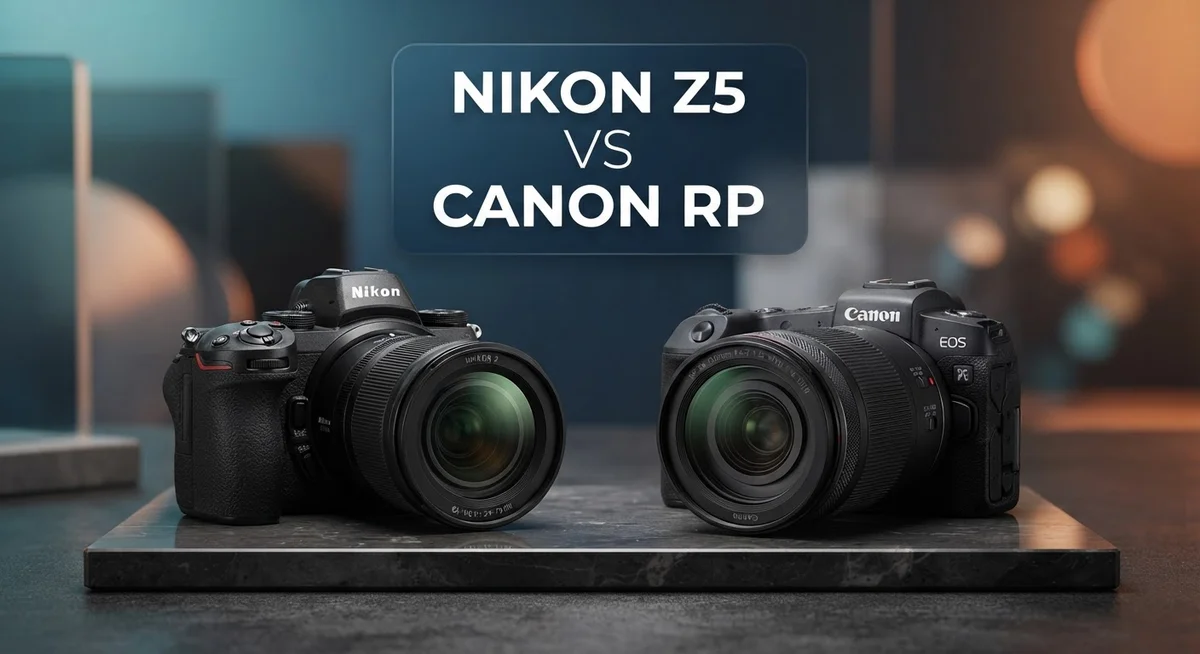
Nikon Z5 vs Canon EOS RP: Full-Frame Mirrorless Comparison
Picking a full frame camera can feel tricky. The Nikon Z5 and Canon EOS RP both offer great entry points into full frame photography. But they serve different needs.
The Z5 shines with its dynamic range. It gives you better shadow recovery and a sharper viewfinder. This makes it a strong pick for still photography lovers.
The Canon RP takes a different path. It stays light and compact. Its fully articulating screen makes vlogging and selfies simple.
So which camera fits your style? Do you want rich image quality or easy portability? This guide breaks down specs, pros, and cons side by side.
We compare sensors, processors, and screens in detail. You will also see how each model stacks up against the Sony a7 II. By the end, you will know exactly which camera suits your photography journey.
In a Nutshell
Here is a quick summary to help you decide fast.
-
The Nikon Z5 gives you better dynamic range. Shadows recover well in tricky light. It suits photographers who edit RAW files often.
-
The Canon RP feels lighter in your hands. It weighs 190g less than the Z5. This makes long shoots more comfortable.
-
Screen style differs a lot between these two. The Z5 has a tilting touchscreen. The RP offers a fully articulating screen for vloggers and selfies.
-
Viewfinder quality favors the Z5. It has a larger and sharper viewfinder. This helps when framing shots in bright outdoor settings.
-
Processing power sits on the RP’s side with its DIGIC 8 chip. But the Z5’s EXPEED 6 processor handles noise and detail with more finesse.
-
Both cameras are full frame mirrorless models built for beginners. They compete closely with the Sony a7 II in this same category.
Bottom line: Pick the Z5 for image quality. Pick the RP for portability and screen flexibility.
Sensor and Image Quality
The sensor differences between these two cameras shape how your photos look. The Nikon Z5 captures 24.3 megapixels, while the Canon RP records 26.2 megapixels. More pixels sound better, but resolution tells only part of the story.
Dynamic range matters more for real shooting. The Z5 pulls ahead here with noticeably superior shadow recovery. When you shoot in tricky lighting, the Z5 lets you rescue detail in dark areas during editing. The RP struggles more in these situations. This advantage makes the Z5 shine for landscape and portrait work where shadows carry important details.
The EXPEED 6 processor inside the Z5 handles color and contrast smoothly. The Canon RP uses the DIGIC 8 chip, which processes images quickly but with less flexibility in RAW files. If you edit your photos after shooting, the Z5 gives you more room to adjust shadows and highlights without losing quality.
Viewfinder quality reflects sensor performance too. The Z5 offers a larger, higher resolution viewfinder at 1.04 million dots. You see more detail when composing shots. This bigger view helps you nail focus and framing before you press the shutter button.
Color science differs between brands. Nikon tends toward neutral, accurate colors straight from the camera. Canon leans slightly warmer. Neither approach is wrong. Your preference matters here. Some photographers love Canon’s natural warmth. Others prefer Nikon’s precision.
Low light performance favors the Z5 as well. The superior sensor design handles high ISO better, producing cleaner images when light drops. The RP becomes noisier faster at higher sensitivities.
Both cameras deliver full frame quality that rivals cameras costing significantly more. The Z5 edges out the RP for image quality overall. You get better shadow detail, cleaner files at high ISO, and more editing flexibility. The RP trades some image quality for its compact size and lighter weight. Choose the Z5 if image quality tops your priority list. Pick the RP if portability matters more to your shooting style.

- Full-frame Power: 24.5MP BSI-CMOS FX-format sensor and EXPEED 7 processing engine unlock...
- Impressive Low-light Performance: Autofocus in near-total darkness with AF detection down to -10EV...

Last update on 2026-10-12 / Affiliate links / Images from Amazon Product Advertising API
Design, Build, and Ergonomics
The Nikon Z5 and Canon RP take different approaches to how they feel in your hands. The Z5 weighs more, but that extra mass comes from a robust build that many photographers appreciate. The Canon RP feels noticeably lighter, making it easier to carry for long shooting sessions.
Your screen experience matters when you’re framing shots. The Z5 offers a tilting screen that moves up and down. The Canon RP gives you a fully articulating display that rotates in multiple directions. If you shoot from awkward angles or create video content, the RP’s flexibility wins here.
The viewfinder tells a different story. The Z5 features a larger, higher resolution viewfinder with 1.04 million dots. This means you see more detail when composing your image. The RP’s viewfinder is smaller and less detailed by comparison. For photographers who spend time with their eye to the viewfinder, this difference feels real.
Button layout and controls feel intuitive on both cameras, though they’re arranged differently. The Z5 follows Nikon’s traditional layout that many photographers already know. The RP uses Canon’s familiar button placement. Your preference here depends on what system you’ve used before.
Grip comfort matters during long shoots. The Z5 provides a deeper grip that suits larger hands well. The RP’s shallower grip works better for people with smaller hands or those who prefer minimal bulk.
Build quality on both cameras is solid. The Z5 feels slightly more substantial overall. The RP prioritizes being lean and portable without sacrificing durability.
Weather sealing differs between these two. The Z5 offers better environmental protection with enhanced sealing. The RP has basic protection but isn’t designed for harsh conditions. If you shoot in rain or dust frequently, the Z5 handles it better.
Both cameras feel professional in your hands. The Z5 emphasizes stability and traditional ergonomics. The RP emphasizes portability and modern minimalism. Your choice depends on whether you value comfort during extended sessions or appreciate traveling light.
Viewfinder and Screen Technology
The viewfinder experience shapes how you frame every shot. The Nikon Z5 offers a larger, higher resolution viewfinder that displays more detail. You see your scene with greater clarity and precision. The Canon RP provides a smaller viewfinder that still delivers solid performance for most shooting situations.
Screen technology differs significantly between these cameras. The Z5 features a tilting 1.04 million dot touchscreen. You can angle it up or down for creative compositions. The Canon RP includes a fully articulating LCD that rotates outward. This gives you more flexibility when shooting from unusual angles or at ground level.
The Z5’s tilting screen works well for standard shooting positions. You gain extra reach without removing the camera from your eye. The RP’s articulating design excels for vlogging, low angle shots, and overhead framing. Both screens respond quickly to touch input and let you adjust settings easily.
Resolution matters when reviewing your images. The Z5’s higher dot count means sharper preview images on the screen. You catch focus issues and exposure problems faster. The RP’s display remains bright and accurate, though slightly less detailed for pixel peeping.
Touchscreen responsiveness feels snappy on both cameras. You can tap to focus, swipe through menus, and adjust settings without using buttons. This speeds up your workflow during active shooting sessions. Both screens handle outdoor shooting reasonably well, though bright sunlight can reduce visibility on either model.
The viewfinder optical quality connects directly to sensor performance. The Z5’s superior dynamic range shows up in the viewfinder preview. You see more shadow detail and highlight information in real time. The RP’s viewfinder displays accurate colors thanks to its DIGIC 8 processor.
Consider your shooting style when choosing between these screens. If you shoot mostly from eye level, the Z5’s tilting screen serves you well. If you need extreme angles, vlogging capability, or creative positioning, the RP’s articulating design wins. Both cameras let you work comfortably, just in different ways.
Top 3 Alternatives
Sony Alpha a7 III

- Sony USA Authorized. Bundle includes the Alpha a7 III with 28–70mm lens, plus a 64GB Extreme PRO...
- The Sony Alpha 7 III delivers remarkable clarity with its 24.2MP full-frame Exmor R CMOS sensor and...
Last update on 2026-11-08 / Affiliate links / Images from Amazon Product Advertising API
The Sony Alpha a7 III brings full-frame power to photographers who want reliability. This camera uses a 24.2-megapixel sensor that captures sharp images in most lighting conditions. You get 693 phase-detection autofocus points across the frame, which means fast and accurate focusing.
The battery life reaches 710 shots per charge. You can shoot 4K video at 30fps. The compact design makes it easy to carry during long shooting sessions. Weather sealing protects your investment during light rain or dust exposure.
Canon EOS R6

- FULL-FRAME HYBRID PERFORMANCE - Canon EOS R6 Mark II features a 24.2MP full-frame CMOS sensor, DIGIC...
- RF 50MM F1.8 STM PRIME LENS - Added Canon RF 50mm f/1.8 STM lens delivers a bright f/1.8 aperture...
Last update on 2026-11-08 / Affiliate links / Images from Amazon Product Advertising API
Canon’s EOS R6 offers 20-megapixel resolution with exceptional autofocus performance. The camera includes 1,053 autofocus points that cover nearly the entire frame. You’ll appreciate the 4K 60fps video capability for modern content creation.
This model features in-body image stabilization that reduces blur from camera shake. The dual SD UHS-II card slots give you backup storage options. Professional-grade build quality means this camera handles demanding work environments well.
Nikon Z6 II

- Mirrorless versatility on a whole new level. 24.5MP BSI resolution that excels in low light. 14 FPS...
- Full frame. Full pixel readout. Full featured 4K UHD Video. Top of the line video performance with...
Last update on 2026-11-08 / Affiliate links / Images from Amazon Product Advertising API
Nikon’s Z6 II delivers 24.2-megapixel imaging with improved autofocus compared to its predecessor. The camera includes 273 autofocus points with animal eye-detection for wildlife work. You get 4K UHD video recording at 60fps.
The battery system provides approximately 410 shots per charge. Dual SD card slots offer flexibility for backup or extended shooting. The Z-mount lens ecosystem continues to expand, giving you more options for future lens purchases. The compact body makes it ideal for travel photography.
Processing Power and Performance
The EXPEED 6 processor in the Z5 and the DIGIC 8 chip in the RP handle image data differently. Both chips work fast, but they approach processing in their own ways.
The Z5’s EXPEED 6 excels at managing shadow detail and tonal gradation. This processor pulls more information from dark areas of your images. You get smoother transitions between light and dark zones. The chip also handles white balance calculations with precision, which means your colors stay accurate across different lighting situations.
The Canon RP’s DIGIC 8 processor focuses on speed and responsiveness. It delivers quick autofocus performance and rapid image processing. The chip keeps up well during continuous shooting sessions. However, the RP’s processing approach doesn’t recover shadow detail quite as effectively as the Z5.
Real world performance shows meaningful differences. When you shoot in mixed lighting or challenging conditions, the Z5 gives you more flexibility in post processing. The EXPEED 6 writes more tonal information to your files. This means your RAW files contain richer data. The Canon RP’s files are solid, but they offer less latitude for shadow lifting.
Autofocus speed matters too. The RP’s DIGIC 8 processor powers faster autofocus acquisition in some scenarios. The Z5 focuses accurately and reliably, though slightly slower in certain conditions. For video work, the RP handles continuous autofocus tracking with smooth performance.
Buffer performance differs between these cameras. The Z5 maintains steady performance during extended shooting bursts. The RP also handles bursts well, though buffer clearing takes slightly longer on some tasks.
Color rendering shows processor influence. The Z5 produces warm, natural skin tones. The RP leans slightly cooler in its color science. Neither approach is wrong. Your preference depends on your shooting style.
Battery life connects to processor efficiency too. The Z5 uses power more conservatively. The RP drains batteries faster during video recording and continuous autofocus use.
Both processors handle 4K video competently. The Z5 offers smoother codec options. The RP’s video performance feels responsive and capable for most users.
Video and Creative Capabilities
When you’re shooting video, both cameras deliver full frame quality that works well for creative projects. The Z5 captures 4K at 30p, while the RP matches that capability. Your video output depends on how you use the autofocus during recording.
The Z5’s autofocus tracking performs better when subjects move across the frame. You get smoother focus transitions during video work. The RP’s autofocus can hunt occasionally in video mode, especially with moving subjects. This matters if you’re shooting interviews or action sequences.
Dynamic range becomes crucial in video production. The Z5 retains more shadow detail in your footage. This gives you extra information when you grade in post production. The RP’s sensor captures good video, but you have less latitude in the shadows. Highlight recovery works similarly on both cameras.
The tilting screen on the Z5 helps with low angle shots. You can position it upward for overhead framing. The RP’s fully articulating screen offers more flexibility for creative angles. You can rotate it 180 degrees for vlogging or flip it completely around. This screen advantage matters if you shoot selfie style content or unconventional angles.
Color science in video differs between these cameras. Nikon’s color rendering leans toward natural skin tones. Canon’s DIGIC 8 processor adds slight warmth to footage. Your grading workflow adapts to whichever camera you choose. Both produce usable color information straight from the sensor.
Stabilization features work differently on each camera. Neither offers in body stabilization, so you’ll need external rigs or lenses with stabilization. This affects your handheld video quality significantly.
The Z5 handles continuous autofocus better during video. You get fewer focus adjustments that interrupt your shot. The RP requires more manual focus control for professional video work. If you’re creating cinematic content, the Z5 gives you more confidence in autofocus performance.
Codec options matter for your workflow. Both cameras record H.264 video. The Z5 gives you more flexibility with frame rate options. Your editing software works smoothly with either camera’s output.
Pros and Cons
Pros
- Z5 captures more shadow detail in RAW files, giving you greater flexibility during post processing
- Z5’s larger 1.04M dot viewfinder makes framing and composition feel more natural
- RP weighs 190g less, making it easier to carry on all day shoots
- RP’s fully articulating screen rotates in any direction for creative angles
- Z5 delivers superior dynamic range across the entire tonal spectrum
Cons
- Z5 is noticeably heavier, which affects portability during extended sessions
- Z5’s tilting screen cannot flip around like the RP’s articulating display
- RP’s DIGIC 8 processor struggles with shadow recovery compared to the Z5’s EXPEED 6
- RP offers less flexibility when you need to push RAW files during editing
Who Should Buy It
The Nikon Z5 suits photographers who prioritize image quality and flexibility in post production. You’ll appreciate the superior dynamic range and shadow recovery. If you shoot landscapes, portraits, or situations with tricky lighting, the Z5 gives you more data to work with in RAW files.
The Z5 works best for still photography enthusiasts. The larger viewfinder makes composition easier and more enjoyable. Your eye sees more of the scene before you press the shutter button.
Choose the Z5 if you value stability during hand held shooting. The heavier body actually reduces camera shake. This matters when you use longer lenses or shoot in dim light without a tripod.
The Canon EOS RP appeals to photographers who move frequently. You’ll appreciate carrying a lighter camera all day. The fully articulating screen opens creative possibilities that the Z5’s tilting screen cannot match.
The RP excels for vloggers and content creators. The rotating screen lets you frame yourself from any angle. You can position the camera in tight spaces and still see your composition clearly.
Pick the RP if you prioritize portability over maximum image quality. Travel photographers and street shooters benefit from the compact design. You sacrifice some shadow detail and dynamic range, but you gain freedom of movement.
The RP suits hybrid shooters who blend video and stills. The articulating screen helps with video framing more than the Z5’s tilting option. You’ll find it easier to shoot from awkward angles without contorting yourself.
Neither camera is wrong for you. The choice depends on your specific needs. Ask yourself these questions: Do you shoot mostly stills or video? Do you travel constantly? Do you work in challenging lighting? Do you need creative screen angles?
The Z5 rewards photographers who stay in one location longer. You’ll process images extensively and need that shadow detail. The RP rewards photographers in motion who value convenience over maximum technical performance.
Final Verdict
Both cameras earn their place in the full frame mirrorless lineup. Your final choice comes down to how you shoot and what you carry every day.
The Z5 fits photographers who want a reliable workhorse. Its build feels solid in hand and the grip supports longer shooting sessions. Beginners moving up from crop sensor cameras will find the menu system easy to learn.
The RP fits creators who travel light and often. Canon’s RF mount opens doors to a growing lens lineup that keeps expanding each year. This gives new photographers room to grow without switching systems later.
Think about where you shoot most. Studio work, portraits, and landscapes reward the Z5’s steady handling. Street photography, travel, and quick setups reward the RP’s compact body.
Battery life also plays a role in your daily workflow. Longer shoots without frequent charging breaks matter for event photographers and wedding shooters who cannot pause often.
Weather sealing differs slightly between both bodies too. Check how much outdoor exposure your typical shoot involves before deciding which body suits your environment.
Nikon’s Z mount system also opens future lens options, giving you room to expand your kit over time. This matters if you plan to invest in more glass down the road.
Consider your existing gear as well. Photographers already holding Nikon or Canon lenses may find one system fits their setup better than starting fresh.
In short, both cameras serve different lifestyles well. The Z5 supports photographers who value steady results and deeper post production control. The RP supports creators who value light gear and quick movement between locations.
Your daily shooting habits, not just camera specs, should guide this final decision. Pick the body that matches how you already work behind the camera.
Frequently Asked Questions
Which camera handles low light better?
The Nikon Z5 excels in shadow recovery. Its EXPEED 6 processor pulls detail from dark areas that the Canon RP’s DIGIC 8 processor struggles with. You get cleaner shadows and more usable data in your RAW files. The Z5’s larger viewfinder also helps you see what you’re shooting in dim conditions.
The RP can still shoot in low light, but you’ll have less flexibility when editing those darker tones later.
Can I use the same lenses on both cameras?
No. Each camera uses a different mount system. The Z5 uses Nikon’s Z mount, while the RP uses Canon’s RF mount. Both systems are growing, so you have expanding lens options with either choice.
You cannot swap lenses between these two bodies. Plan your lens purchases based on which camera you choose.
Which screen is better for video work?
The Canon RP wins here. Its fully articulating screen rotates in any direction. You can flip it out for selfie shots, angle it for overhead angles, or tuck it away. This flexibility matters for vloggers and hybrid shooters.
The Z5’s tilting screen only moves up and down. It works for still photography but limits creative video angles.
How much does weight affect daily shooting?
The RP weighs 190g less than the Z5. Over a full day of shooting, this difference adds up. Your shoulders and neck feel it during extended sessions.
If you move between locations frequently, the lighter RP reduces fatigue. If you stay in one spot longer, the Z5’s weight matters less.

Dillip is the founder and editor of Switch & Size, where he breaks down tech products, accessories, and gadgets to help readers make smarter buying decisions. With a passion for testing and comparing the latest technology, he delivers honest reviews, in-depth guides, and side-by-side comparisons that cut through the marketing noise.