
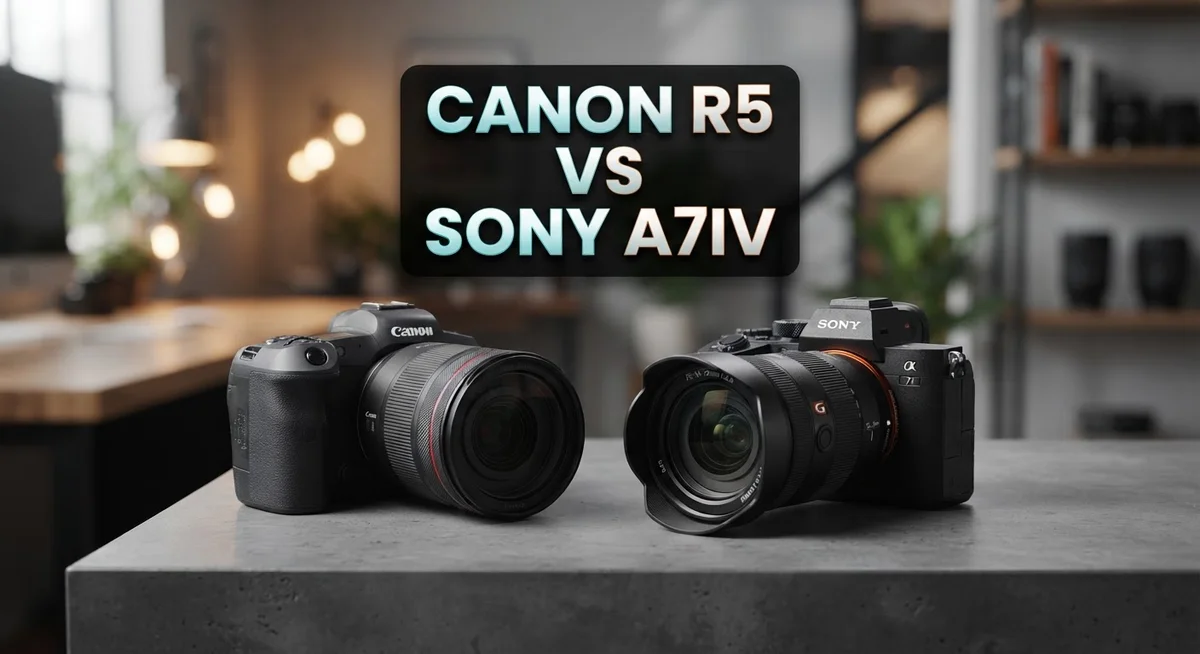
Canon R5 vs Sony A7IV: Full-Frame Mirrorless Camera Comparison
Choosing a camera can feel tricky. The Canon R5 and Sony A7IV both stand out as top choices for photographers and videographers.
Each camera brings something special to the table. The Canon R5 impresses with its 45MP sensor and stunning 8K video. The Sony A7IV offers a reliable 33MP sensor and smooth autofocus performance.
You might wonder which camera fits your style best. Do you need extreme resolution and video power? Or do you want a versatile all-rounder with a huge lens selection?
This guide breaks down every detail. We compare specs, features, and real-world performance. By the end, you will know exactly which camera matches your creative needs.
Let’s explore what makes these two cameras so popular among creators today.
In a Nutshell
Here is a quick snapshot to help you decide fast.
-
Canon R5 packs a 45MP sensor and shoots stunning 8K raw video. It suits photographers who want maximum detail and top tier video quality.
-
Sony A7IV offers a 33MP sensor with a wide ISO range. It works great for creators who need flexibility across different lighting conditions.
-
The R5 gives you 5-axis sensor-shift stabilization. This helps you capture sharp handheld shots even in tricky situations.
-
The A7IV shines with its huge lens lineup and reliable autofocus. It adapts well to portraits, events, and everyday shooting.
-
If video is your main focus, the R5’s 4K 120p 10-bit output gives you smoother slow motion and richer color grading options.
-
Both cameras have strong points. Your final choice depends on whether you prioritize resolution and video power or lens choices and everyday versatility.
Think about your shooting style first. Then pick the camera that matches your creative goals best.
Sensor Resolution and Image Quality
The sensor sits at the heart of any camera. It captures light and converts it into the images you see on screen. Understanding how these two sensors perform helps you pick the right tool for your work.
Canon’s R5 features a 45MP full-frame CMOS sensor. This higher megapixel count means you get more detail in every shot. You can crop images heavily in post-production without losing sharpness. Landscape photographers and studio professionals love this extra resolution. The sensor also supports 8K raw video recording at 30 frames per second. This capability opens doors for serious filmmakers who need maximum flexibility in color grading.
Sony’s A7IV uses a 33MP full-frame back-illuminated CMOS sensor. The BSI design pulls light through the back of the chip, improving low-light performance. The sensor delivers an ISO range from 100 to 51200, with expandable settings reaching 50 to 204800. This means you can shoot in darker conditions without adding as much digital noise.
Color science differs between these cameras. Canon’s R5 produces warmer, more saturated tones straight from the camera. Many portrait and wedding shooters prefer this look right out of the box. Sony’s A7IV leans toward cooler, more neutral color rendering. This approach gives you more control in post-production editing.
Image stabilization also impacts sharpness. The R5 includes 5-axis sensor-shift stabilization built into the body. This helps you handhold at slower shutter speeds. The A7IV relies on lens-based stabilization, which works well but varies by lens.
Both sensors handle dynamic range beautifully. You can recover shadow detail and highlight information in both cameras. The R5 edges ahead for extreme situations due to its higher resolution. The A7IV matches it for everyday shooting scenarios.
Your choice depends on your needs. Pick the R5 if resolution and raw video matter most to you. Choose the A7IV if you want a versatile sensor with excellent low-light capability and simpler file management.

- Completely NEW Canon designed full-frame back-illuminated stacked CMOS 45MP sensor.
- Fast sensor read-out speeds allow for up to 30 fps electronic shutter performance.
Last update on 2026-11-09 / Affiliate links / Images from Amazon Product Advertising API
Video Capabilities and Recording Formats
When it comes to recording video, these two cameras take different approaches. The Canon R5 dominates raw video capture with its ability to shoot 8K at 30 frames per second directly to an external recorder. This gives you maximum flexibility in post-production editing and color grading.
The Sony A7IV focuses on in-camera compression. It records 4K video at up to 60 frames per second with 10-bit color depth. This means your files stay smaller and easier to manage on your hard drives.
Frame rate options matter for your project type. The R5 shoots 4K at 120 frames per second in 10-bit format. The A7IV maxes out at 60 frames per second for 4K recording. If you need ultra-smooth slow motion footage, the R5 gives you more creative options.
Codec support differs between these cameras. The R5 uses Canon’s proprietary codecs and can output to external recorders for higher quality workflows. The A7IV uses Sony’s XAVC S codec, which balances quality with file sizes that work well for most editing systems.
Autofocus during video recording strongly favors the Sony. The A7IV uses Sony’s advanced phase-detection system that tracks moving subjects smoothly. The R5 has reliable autofocus too, but many videographers find Sony’s system more responsive during handheld shooting.
Heat management becomes important during long recording sessions. The R5 can generate heat during extended 8K raw recording. The A7IV handles sustained 4K recording without thermal issues, making it better for events and documentaries.
Audio handling also differs. The R5 includes a professional XLR input adapter for balanced microphone connections. The A7IV uses a standard 3.5mm jack, requiring external adapters for professional microphones.
Both cameras excel at video, but they serve different needs. Choose the R5 if you want maximum recording flexibility and raw quality. Pick the A7IV if you need reliable performance during long shoots with excellent autofocus tracking.
Autofocus System and Lens Ecosystem
The autofocus system you choose directly impacts how fast you capture sharp shots. Canon’s R5 uses a Dual Pixel CMOS AF system with 1053 autofocus points. Sony’s A7IV employs a real-time tracking autofocus with 759 phase-detection points across the frame.
Canon’s R5 excels at tracking moving subjects in optical viewfinder mode. The system responds quickly to sudden movements and maintains focus lock on fast-moving objects. Sony’s A7IV shines with its eye-tracking and animal-detection features. These intelligent algorithms find and follow eyes and animal subjects automatically, which photographers love.
The lens ecosystem differs significantly between these two cameras. Sony offers an enormous selection of native E-mount lenses. Third-party manufacturers like Sigma, Tamron, and Zeiss produce extensive options for Sony shooters. You’ll find affordable primes, versatile zooms, and specialty lenses readily available.
Canon’s RF-mount system is newer but growing rapidly. The R5 works with premium RF lenses designed for professional use. Canon also offers an RF to EF adapter, letting you use older EF lenses. The RF lineup emphasizes high quality over quantity right now.
For video autofocus, Sony takes the lead. The A7IV maintains smooth focus during recording without hunting or pumping. Canon’s R5 autofocus during video works well but requires more manual tweaking in some situations. Real-time tracking helps, yet Sony’s implementation feels more refined for videography.
If you shoot fast action or sports, Canon’s R5 autofocus performs excellently. The system locks onto subjects quickly and holds focus reliably. For hybrid shooters mixing stills and video, Sony’s A7IV offers superior autofocus continuity across both formats.
Your shooting style matters here. Choose the R5 if you need rapid subject tracking and professional RF lenses appeal to you. Pick the A7IV if you want extensive lens choices, eye-detection autofocus, and smooth video focus performance. Both systems deliver professional results. Your workflow and subject matter should guide your decision.
Top 3 Alternatives
Nikon Z6 III

- VIDEO - 6K/60p Internal N-RAW video recording + oversampled 4K UHD, 4K/120p, Full HD/240p slow...
- BEST IN CLASS EVF - Max brightness of 4000 nits gives a clear, vibrant view even in very bright...

Last update on 2026-11-09 / Affiliate links / Images from Amazon Product Advertising API
The Nikon Z6 III offers excellent autofocus performance with 1053 focus points. This camera handles fast action and moving subjects well. The sensor delivers clean images at high ISOs, making it great for low-light work. Battery life is solid, giving you more shooting time between charges. Video capabilities include 4K at 60fps, which works well for content creators.
Panasonic Lumix S5II

- Key Upgrades to a Compact Hybrid Powerhouse: Panasonic S5II with Phase Hybrid Autofocus, Improved...
- Fast, Accurate Phase Hybrid Autofocus: This full frame mirrorless camera uses advanced subject...
Last update on 2026-11-09 / Affiliate links / Images from Amazon Product Advertising API
Panasonic built the Lumix S5II with strong stabilization that reduces camera shake. The full-frame sensor produces detailed images with accurate colors. This camera feels comfortable to hold and operates intuitively. The compact size makes it portable for travel and outdoor shoots. Video features include 4K recording with good color science, perfect for filmmakers seeking reliable performance.
Canon EOS R6

- FULL-FRAME CMOS SENSOR: 24.2 effective megapixels (approx.) lets you capture sharp, detailed images...
- DIGIC X IMAGE PROCESSOR: Enhances digital camera performance and processes, including image...
Last update on 2026-11-09 / Affiliate links / Images from Amazon Product Advertising API
The Canon EOS R6 combines powerful autofocus with fast continuous shooting. It handles both stills and video exceptionally well. The camera body feels professional and durable. Autofocus tracks subjects smoothly, even in challenging conditions. Built-in stabilization helps you shoot without a tripod. The RF lens ecosystem offers many quality options for different shooting styles.
Each camera serves different needs. Choose the Nikon Z6 III if you want cutting-edge autofocus. Pick the Panasonic Lumix S5II for compact size and stabilization. Select the Canon EOS R6 if you need versatility across stills and video. All three cameras deliver professional-grade results and build quality.
Stabilization and Handling
Both cameras handle stabilization differently, which affects how steady your footage and photos appear in real situations.
The Canon R5 uses 5-axis sensor-shift stabilization. This system moves the sensor itself to correct camera shake. You get smooth handheld shots even with longer lenses. The stabilization works across all focal lengths and lens types. This means older Canon lenses benefit too. The system excels during video recording, reducing the need for external rigs.
The Sony A7IV relies on in-body stabilization as well, though with a different implementation. Sony’s approach integrates with its lens stabilization features. When you pair the A7IV with stabilized lenses, you get combined stabilization benefits. This dual system creates excellent shake reduction. However, the A7IV’s stabilization works best when you use Sony’s native E-mount glass.
Handling comfort matters when you’re shooting all day. The R5 feels substantial in your hands due to its larger body. The grip wraps around your fingers securely. The R5 suits photographers with bigger hands. Weight distribution feels balanced even with professional telephoto lenses.
The A7IV is noticeably more compact and lighter. You’ll appreciate this during long shoots or travel work. The smaller body makes it easier to carry in bags. The grip remains comfortable, though some users with large hands prefer the R5’s design.
Viewfinder experience differs between these cameras too. The R5 offers a high-refresh optical viewfinder option. You see real light through the lens with minimal lag. The A7IV uses an electronic viewfinder. Some photographers prefer the electronic view for exposure previews. Others find optical viewfinders more natural.
Button placement and menu systems affect your workflow. The R5 features Canon’s familiar interface. The A7IV uses Sony’s menu structure. Both systems become intuitive after practice.
For handheld work, the R5’s stabilization gives you confidence with longer focal lengths. The A7IV’s compact size makes it ideal for mobility. Your choice depends on whether you prioritize stabilization power or portability.
ISO Performance and Low-Light Capability
ISO performance separates these two cameras in meaningful ways. The Sony A7IV excels in high ISO situations with its native range of ISO 100 to 51,200. You can push it further to 204,800 with expanded settings. This makes the A7IV a genuine low-light workhorse for photographers who shoot in dim environments regularly.
The Canon R5 handles ISO differently due to its higher megapixel count and sensor design. With 45 megapixels, the R5 produces larger files at every ISO level. This means you get more detail, but noise becomes slightly more visible when you zoom into 100 percent crops at very high ISOs.
In practical shooting, the Sony maintains cleaner images at ISO 6,400 and above for most uses. The A7IV’s back-illuminated sensor design gives it an advantage in shadow recovery. You can lift underexposed areas without introducing excessive grain. This becomes crucial when you’re shooting in restaurants, concert venues, or nighttime events.
The R5 shines in different situations. Its resolution means you can crop aggressively in post-production without losing quality. If you shoot at ISO 3,200 and need to enlarge your images, the extra pixels work in your favor. The R5 also performs well in controlled lighting where you manage ISO strategically.
Noise reduction algorithms differ between these cameras too. Sony applies aggressive in-camera noise reduction by default. You can adjust this in the menu. Canon takes a more conservative approach, giving you more control over the final look.
For video recording, low-light capability matters significantly. The Sony A7IV handles video noise better at high ISOs because of its smaller output size. The R5 records at higher bitrates, which preserves more detail but requires brighter lighting for cleaner results.
Your shooting style determines which ISO performance matters more. If you photograph events, weddings, or concerts regularly, the Sony’s native high ISO range gives you immediate confidence. If you prioritize resolution and detail, the R5’s approach suits you better. Both cameras deliver usable images in low light when you understand their strengths.
Pros and Cons
Pros
- Canon R5 delivers 45MP resolution for stunning detail in large prints and crop flexibility
- R5 shoots 8K 30p raw video, perfect for professional color grading and post-production work
- Sony A7IV offers an extensive RF-mount lens library with rapid growth and excellent third-party support
- A7IV body feels compact and lightweight, making all-day shooting sessions more comfortable
- Sony A7IV excels at video autofocus tracking, especially for moving subjects in video mode
Cons
- Canon R5 requires a larger investment compared to the A7IV
- Sony A7IV maxes out at 33MP, limiting aggressive cropping and large format printing options
- R5 generates substantial heat during extended 8K recording, requiring careful session management
- A7IV produces more visible noise at high ISO levels above 6,400 in challenging light situations
Who Should Buy It
The Canon R5 works best for professionals who need maximum resolution and advanced video capabilities. If you shoot for commercial clients, produce 8K content, or print large format images, this camera delivers. You’ll appreciate the 45MP sensor when you need to crop aggressively in post-production without losing quality.
The R5 appeals to videographers who require raw recording options. Color grading becomes easier with 8K 30p raw footage. You gain complete control over your final image. This camera suits studios and production houses where post-production flexibility matters most.
The Sony A7IV fits photographers and content creators who value speed and ease of use. You get a compact body that doesn’t fatigue your hands during long shoots. The autofocus system excels at tracking moving subjects, making it ideal for event photography and hybrid content creation.
Choose the A7IV if you already own Sony E-mount lenses or plan to build a collection quickly. The lens ecosystem offers more options at various quality levels. Third-party manufacturers support this mount extensively, giving you flexibility in your purchasing decisions.
The A7IV suits travel photographers perfectly. Its lighter weight and smaller dimensions pack easily into camera bags. You’ll move faster between locations without feeling weighed down by gear.
The R5 demands commitment to your craft. You need to understand when its advanced features actually benefit your work. If you rarely print larger than 16×20 inches or don’t shoot video professionally, you’re paying for capabilities you won’t use.
The A7IV works for photographers transitioning from entry-level cameras. It offers professional features without overwhelming complexity. Menu systems feel intuitive, and you’ll reach competency faster than with the R5.
Choose based on your actual workflow, not theoretical possibilities. The R5 shines when you consistently need its advantages. The A7IV serves you better if you want a capable all-rounder that handles most situations confidently. Your current lens collection and future buying plans should influence this decision too.
Final Verdict
Picking between these two cameras comes down to your personal goals as a creator. Both models deliver professional results, but they serve different purposes.
The Canon R5 stands out for creators who push technical boundaries. It rewards users who need every pixel and every frame for demanding projects.
The Sony A7IV works best for creators who value consistency over raw specs. It handles everyday shooting scenarios with confidence and reliability.
Think about your long term goals before deciding. Ask yourself where your career or hobby is heading in the next few years.
If you shoot commercial work, weddings, or high end video projects, the R5 supports that growth. Its capabilities scale with increasingly complex client demands.
If you create content regularly across different genres, the A7IV adapts easily. It handles portraits, events, and casual video work without extra fuss.
Your existing gear matters too. Check your current lenses, accessories, and editing software before switching systems.
Both cameras hold their own against competitors like the Canon R6 Mark II and Sony A7R IV. Each brand offers strong alternatives within the same lineup.
Neither camera is objectively better. They simply serve different creative journeys and different working styles.
Trust your instincts about your own shooting habits. You already know if you crave technical depth or practical simplicity.
Consider renting both cameras before committing. Hands on testing reveals preferences that spec sheets cannot show you.
Your creative vision should guide this decision more than brand loyalty or marketing claims. Choose the tool that disappears in your hands while you work.
Ultimately, both the R5 and A7IV represent excellent choices for serious photographers and videographers. The right pick depends entirely on how you plan to use it every single day.
Frequently Asked Questions
Which camera has better autofocus for video?
The Sony A7IV excels at video autofocus tracking, especially when you film moving subjects. Its autofocus system locks onto people and objects with impressive speed and accuracy during recording.
The Canon R5 offers solid autofocus too, but the A7IV’s real-time tracking gives it an edge for video work. If you shoot a lot of moving content, the A7IV handles it more smoothly.
Can I use my existing lenses on either camera?
This depends on what lenses you already own. Canon R5 uses the RF mount system. Sony A7IV uses the E mount system. These two mounts are completely different, so lenses don’t swap between them.
Check your current lenses before deciding. If you own Canon RF lenses, the R5 is your natural choice. If you have Sony E mount lenses, stick with the A7IV. Switching systems means buying new glass, which adds up quickly.
Which camera is better for large prints?
The Canon R5 wins here with its 45MP sensor. Higher megapixel count gives you more detail for printing large images or aggressive cropping in post production.
The Sony A7IV maxes out at 33MP, which still works great for most print sizes up to 16×20 inches. For billboard sized prints or heavy cropping, the R5 gives you more flexibility.
Is the Canon R5 really necessary for most photographers?
Not always. The R5 shines when you need maximum resolution, advanced video features, or raw recording options. Many photographers and content creators get excellent results with the A7IV’s simpler feature set.
The A7IV adapts easily across different genres. It works for travel photography, portraits, events, and casual video. Choose based on what you actually shoot, not what sounds impressive in specs.

Dillip is the founder and editor of Switch & Size, where he breaks down tech products, accessories, and gadgets to help readers make smarter buying decisions. With a passion for testing and comparing the latest technology, he delivers honest reviews, in-depth guides, and side-by-side comparisons that cut through the marketing noise.


