Canon R5 vs R8: Complete Comparison Guide for Photographers
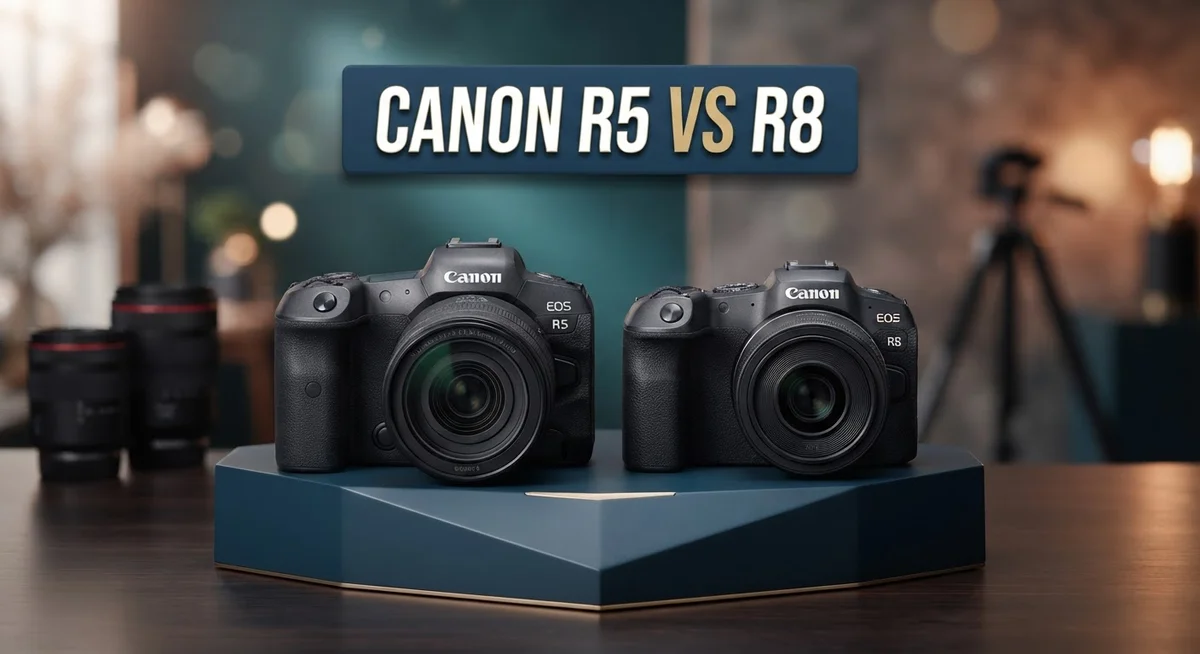
Picking a camera can feel tricky. The Canon R5 and Canon R8 both stand out in Canon’s lineup. But they serve different photographers.
The R5 packs a 45MP sensor. It offers advanced video features too. You get 4K recording at 120fps and rock solid in body stabilization.
The R8 takes a different path. It stays light and compact. You still get reliable autofocus and strong dynamic range in a smaller body.
So which camera fits your needs? This guide breaks down the real differences between these two cameras. We will look at resolution, video power, shutter type, and overall handling.
By the end, you will know exactly which Canon camera matches your shooting style. Let’s jump right in and compare these two popular models side by side.
In a Nutshell
Here’s a quick snapshot of what sets these two cameras apart:
- The R5 offers 8.0 stop image stabilization, giving you steadier shots in low light.
- It also features a mechanical shutter, useful for fast moving subjects and flash photography.
- The R8 relies only on an electronic shutter, which keeps the body compact and light.
- Video shooters will notice the R5 supports 4K at 120fps, perfect for smooth slow motion clips.
- Both cameras share the same dynamic range, so image quality in shadows and highlights stays consistent.
- The R8 has a faster sensor readout at 14.5ms, helping reduce rolling shutter effects.
- If you want pro level controls and weather sealing, the R5 is the stronger pick.
- For everyday shooting and travel friendly design, the R8 shines with its lighter build.
Each camera serves a different type of photographer, so think about your priorities before deciding.
Sensor Resolution and Image Quality
When you compare these two cameras, sensor resolution becomes the first major difference you notice. The R5 delivers 45 megapixels, which means you capture more detail in every shot. This extra resolution shines when you crop images, print large formats, or need flexibility in post-processing.
The R8 takes a different approach with a lower megapixel count. For most photographers, this still provides plenty of detail for standard prints and web use. The difference matters most if you shoot commercial work, landscapes, or situations where you need maximum cropping freedom.
Both cameras share the same dynamic range, which is important for image quality. This means they handle shadows and highlights equally well. You get consistent color accuracy and tonal range from either camera.
The sensor readout speed differs slightly between them. The R8 reads at 14.5ms while the R5 takes 16.3ms. This faster readout on the R8 reduces rolling shutter distortion, especially when filming or photographing fast action. It’s a subtle advantage that matters more for video work than stills.
Resolution also connects to file sizes. Larger files from the R5 demand more storage space and require faster memory cards. If you shoot constantly, you’ll notice the storage impact over time.
For practical use, consider your actual needs. Street photographers and travel shooters often find the R8’s lower resolution perfectly adequate. They appreciate the compact body more than extra megapixels. Meanwhile, commercial photographers, fashion shooters, and studio professionals frequently prefer the R5’s 45MP for maximum editing control.
The R5 excels at producing prints larger than 16×24 inches without quality loss. The R8 handles standard sizes beautifully. Neither camera produces poor image quality. The choice depends on whether you need maximum resolution flexibility or prefer a lighter, more compact system.
Both sensors deliver sharp, detailed images in real world conditions. Your shooting style and output requirements matter more than raw megapixel numbers.

- High Image Quality: Canon EOS R5 8K digital camera features a stacked, back-side illuminated...
- Powerful Image Processor: DIGIC X image processor with an ISO range of 100-51200; expandable to...

Last update on 2026-11-07 / Affiliate links / Images from Amazon Product Advertising API
Video Performance and Capabilities
The R5 and R8 handle video differently, and understanding these differences matters for your shooting goals.
Video frame rates tell the first story. The R5 captures 4K video at up to 120fps, letting you create ultra smooth slow motion sequences. This capability works well for sports, action, and creative projects where frame rate flexibility matters. The R8 offers solid video performance too, but at lower frame rates. For standard 4K work and everyday video needs, the R8 performs reliably.
Autofocus during video is where both cameras shine. Canon equipped both with dependable autofocus systems that track subjects smoothly. You will notice minimal focus hunting during recording. This makes both cameras suitable for interviews, vlogs, and cinematic work.
The shutter type affects video quality in specific ways. The R5 includes a mechanical shutter, while the R8 uses only an electronic shutter. Electronic shutters can introduce rolling shutter artifacts with fast pans or moving subjects. The R5’s mechanical option gives you flexibility to avoid these issues when needed.
Sensor readout speed impacts rolling shutter performance. The R8’s faster 14.5ms readout helps reduce distortion during rapid camera movements. The R5 reads at 16.3ms, which is still solid but slightly slower. For fast action video, this small difference can matter.
Heat management differs between these cameras. The R5 handles extended recording sessions better due to its larger body and better cooling design. The R8 may throttle recording during long, continuous shoots in warm conditions. This is important if you film documentaries or events requiring extended takes.
Recording formats on both cameras include standard options like H.264 and H.265. The R5 offers more advanced codec choices for professionals. The R8 keeps things straightforward with reliable, compatible formats.
For professional video work, the R5 delivers more control and capability. For content creators, vloggers, and hobbyists, the R8 provides excellent video quality without unnecessary complexity. Your specific video needs should guide your choice between these two cameras.
Design, Build Quality, and Portability
The R5 and R8 take different approaches to how they feel in your hands and perform in the field. Let’s explore what makes each one unique.
The R5 is built for professionals who demand durability and advanced features. Its body includes a mechanical shutter, which gives you more control over fast-moving subjects and flash photography. The camera also packs 8.0 stops of in-body image stabilization, keeping your shots steady even in challenging light. This combination makes the R5 heavier but more capable for demanding work.
The R8 prioritizes portability and simplicity. It uses an electronic shutter only, which allows Canon to create a more compact design. If you travel frequently or prefer a lighter setup, the R8 feels noticeably easier to carry. The trade-off is less weather sealing compared to the R5, so you’ll want to be more careful in harsh conditions.
Both cameras share the same dynamic range, meaning they handle shadows and highlights with equal skill. The R8’s sensor readout speed is slightly faster at 14.5ms, which helps reduce rolling shutter effects during video. The R5 reads at 16.3ms, still excellent but marginally slower.
Resolution tells a different story between these two. The R5 delivers 45MP, making it ideal for large prints and detailed crops. The R8 offers a lower megapixel count, which means smaller file sizes and faster processing on your computer. For most shooting situations, the R8 provides more than enough detail.
Build quality on the R5 reflects its professional status. It features robust construction with better sealing against dust and moisture. The R8 feels solid but has more limited weather resistance, so you’ll want to protect it during rain or sandy environments.
Your choice depends on your needs. Choose the R5 if you shoot professionally and need maximum resolution, mechanical shutter control, and superior weather protection. Pick the R8 if you value a lighter camera that’s easier to carry and still delivers excellent image quality for everyday and enthusiast photography.
Top 3 Alternatives
Sony Alpha 7R V

- A whole new level of camera intelligence from new AI processing unit.Aspect Ratio : 3:2
- Next-generation AF with Real-time Recognition autofocus deep learning AI
Last update on 2026-11-08 / Affiliate links / Images from Amazon Product Advertising API
The Sony Alpha 7R V offers exceptional resolution with its 61-megapixel sensor. This camera excels at capturing fine details in landscapes and studio work. The autofocus system uses advanced AI technology to track subjects with precision.
Sony’s full-frame design provides excellent low-light performance. The camera handles high ISO values well, keeping images clean and sharp. Users appreciate the compact body size compared to similar competitors.
Nikon Z9

- Bundle Includes: Nikon Z9 Mirrorless Digital Camera (Body Only) + 120GB G Series XQD Memory Card...
- Experience exceptional image quality with the Nikon Z9's 45.7MP FX-format stacked CMOS sensor paired...
Last update on 2026-11-08 / Affiliate links / Images from Amazon Product Advertising API
The Nikon Z9 delivers professional-grade features for demanding photographers. Its 45.7-megapixel sensor captures stunning images across various lighting conditions. The camera includes built-in weather sealing for outdoor adventures.
The Z9 features a fast and accurate autofocus system. It tracks moving subjects reliably during video and photography sessions. The battery life extends beyond 700 shots per charge, which photographers find practical for long shooting days.
Canon EOS R6

- FULL-FRAME HYBRID PERFORMANCE - Canon EOS R6 Mark II features a 24.2MP full-frame CMOS sensor, DIGIC...
- RF 50MM F1.8 STM PRIME LENS - Added Canon RF 50mm f/1.8 STM lens delivers a bright f/1.8 aperture...
Last update on 2026-11-08 / Affiliate links / Images from Amazon Product Advertising API
The Canon EOS R6 combines versatility with affordability. This full-frame camera offers 20 megapixels, ideal for general photography and videography. The sensor performs admirably in both bright sunlight and dim environments.
The R6 includes in-body image stabilization that reduces camera shake. This feature helps you shoot handheld at slower shutter speeds. The autofocus system locks onto faces and eyes quickly, making portrait photography straightforward.
All three cameras represent solid alternatives. Each brings unique strengths to different shooting styles. Your choice depends on your specific needs, whether that’s resolution, speed, or balanced performance.
Autofocus System and Shooting Speed
The autofocus systems in both cameras represent Canon’s latest technology, but they operate with subtle differences that matter for fast action shooting.
The R5 delivers 1053 autofocus points across the entire frame. This extensive coverage means you can focus on subjects anywhere in your composition without reframing. The R8 uses a simpler autofocus array with fewer focus points, though it still tracks moving subjects effectively. For wildlife and sports, the R5’s denser focus grid gives you more precision and flexibility.
Both cameras feature Canon’s Dual Pixel CMOS AF technology. This system excels at tracking eyes, faces, and bodies during continuous shooting. You’ll notice reliable subject detection whether you’re photographing people, animals, or vehicles. The autofocus speed remains impressive on both models, locking onto subjects quickly in good light.
Shooting speed separates these cameras significantly. The R5 fires at 12 frames per second with the mechanical shutter, and up to 20 fps with the electronic shutter. This rapid burst rate handles fast action without missing decisive moments. The R8 shoots at 6 fps with its electronic shutter only. Since the R8 lacks a mechanical shutter, you’re limited to electronic capture.
The electronic shutter introduces different considerations. The R5 lets you choose between mechanical and electronic capture, giving you flexibility for different situations. The R8’s electronic only approach works well for most photography, but some shooters prefer the mechanical option for certain scenarios.
Buffer capacity affects how many frames you can capture before the camera slows down. The R5 handles longer bursts before buffering becomes an issue. The R8 buffers more quickly with its lower resolution files, meaning you won’t experience much slowdown during typical shooting sessions.
Autofocus tracking during continuous shooting remains strong on both cameras. They maintain focus lock while you’re firing rapidly, which is essential for professional work. The R5’s faster frame rate combined with its extensive autofocus points makes it the stronger choice for demanding action photography. The R8 handles most shooting scenarios competently, though it trades speed for simplicity.
Weather Resistance and Durability
The R5 and R8 take different approaches to protecting your camera from harsh conditions. Understanding these differences helps you choose the right tool for your shooting environment.
Weather sealing on the R5 is comprehensive. Canon built this camera for professional photographers who work in rain, dust, and extreme temperatures. The R5 features extensive gaskets around buttons, dials, and internal components. This protection keeps moisture and particles away from sensitive electronics.
The R8 offers limited weather resistance compared to its bigger sibling. While Canon designed the R8 with some protection, it lacks the full gasket system found on the R5. The R8 can handle light rain and dust, but it is not built for prolonged exposure to harsh conditions. This reflects the R8’s focus on portability over heavy duty protection.
Shutter durability differs significantly between these models. The R5 features a mechanical shutter rated for approximately 500,000 actuations. The R8 uses only an electronic shutter with no mechanical option. Electronic shutters typically last longer in theory, but the R8’s design prioritizes simplicity over the redundancy that mechanical shutters provide.
Body construction tells another story. The R5 uses a magnesium alloy chassis with reinforced joints. This material resists impacts and temperature swings better than plastic compounds. The R8 uses a more compact design with lighter materials. This choice makes the R8 easier to carry, but less rugged overall.
Thermal performance matters for durability too. The R5 handles heat better during extended shooting sessions. Its larger body accommodates better cooling systems. The R8 manages heat adequately for most users, but sustained video or continuous shooting can trigger thermal limits faster.
For photographers working in challenging environments like coastal areas, deserts, or mountainous terrain, the R5 delivers superior protection. If you shoot mainly in controlled settings or mild weather, the R8’s simpler design works fine. Your shooting environment should guide this decision more than anything else.
Pros and Cons
Pros
- R5: 45MP sensor captures exceptional detail for large prints and heavy cropping
- R5: 8.0 stops of stabilization keeps handheld shots sharp in low light
- R5: Mechanical shutter option eliminates rolling shutter distortion in fast action
- R5: 4K at 120fps video gives you slow motion options professionals expect
- R8: Lightweight and compact design makes all day shooting comfortable
- R8: Electronic shutter operates silently for weddings and wildlife
- R8: Same dynamic range as R5 means you recover shadows and highlights equally well
- R8: Reliable autofocus performance handles most shooting situations smoothly
Cons
- R5: Overkill for landscape and travel photography where you don’t need 45MP
- R5: Heavier body and grip fatigue during extended handheld sessions
- R8: No mechanical shutter forces you to accept electronic shutter limitations
- R8: Lower resolution means less flexibility when cropping or printing large
- R8: Limited weather sealing leaves gaps in dust and moisture protection
Who Should Buy It
The R5 suits professional photographers and serious enthusiasts who demand maximum performance. You should choose the R5 if you shoot high end commercial work, fashion, or sports photography. The 45MP sensor lets you crop aggressively and still maintain print quality for billboards or large gallery displays.
Video professionals benefit from the R5’s advanced capabilities. You get 4K at 120fps, which opens doors for slow motion storytelling and color grading flexibility. The mechanical shutter option prevents rolling shutter artifacts during fast pans or dynamic scenes. Professional videographers appreciate these tools for client deliverables.
The R5 makes sense for landscape photographers who print large. You can capture intricate details in mountains, forests, and seascapes. The 8.0 stops of stabilization keeps your handheld shots sharp during golden hour when light fades fast.
The R8 targets travel photographers and content creators who value mobility. Your camera bag stays lighter. Your shoulders won’t ache after eight hours of shooting events or exploring cities. The compact body fits easily into backpacks and doesn’t intimidate subjects during street photography.
Hybrid creators thrive with the R8. You shoot photos for your portfolio, then record video for social media or YouTube. The electronic shutter operates silently for interviews and ambient sound recording. You don’t need dual cameras anymore.
Wedding photographers moving from entry level cameras find the R8 perfect. The autofocus tracks moving subjects reliably during ceremonies and receptions. The dynamic range matches the R5, so you recover blown skies and dark shadows equally well in post processing.
The R8 suits photographers learning advanced techniques. You get professional features without unnecessary complexity. The camera teaches you manual controls, exposure metering, and RAW editing without overwhelming options.
Choose the R5 if maximum resolution and video power matter. Choose the R8 if you value portability and simplicity. Both cameras deliver outstanding image quality. Your shooting style, not the camera’s capabilities, should guide your decision.
Final Verdict
Picking between these two cameras comes down to your goals. Both models share the same Canon lens ecosystem, so your glass investment stays safe either way.
Think about how your photography style might change over the next few years. Your camera should support that growth, not hold you back.
If you shoot professionally or plan to sell large prints, the R5 gives you room to expand. It handles demanding assignments like commercial shoots, studio portraits, and high end video projects with ease.
Photographers who want a simple, capable tool will love the R8. It fits easily into a daily bag and works great for social content, travel journals, and casual portrait sessions.
Consider your typical shooting environment too. Studio photographers rarely face harsh weather, so the R8 works fine indoors. Outdoor adventurers who face rain or dust benefit more from the R5’s tougher build.
Your editing workflow matters as well. Larger files from the R5 need more storage space and a stronger computer setup. The R8 keeps files smaller, which speeds up your editing process.
Think about your long term career path. Freelancers building a client base often start with the R8 and upgrade later. Established professionals usually jump straight to the R5 for its expanded feature set.
Neither camera is a wrong choice. Both deliver sharp images and reliable performance for everyday use. Your final decision should match your actual shooting needs, not just spec sheets.
Ask yourself these simple questions: Do you print large photos often? Do you shoot professional video projects? Do you need extreme durability in tough conditions?
If you answered yes to these questions, the R5 makes sense for you. If you value a lighter setup and simpler operation, the R8 will serve you well.
Whichever model you pick, you get access to Canon’s excellent lens lineup and dependable image quality. Your creative vision matters more than the camera body itself.
Frequently Asked Questions
Can the R8 handle professional video work like the R5?
The R5 pulls ahead for serious video projects. It shoots 4K at 120fps, which opens doors for slow motion and high frame rate content. The R8 records video too, but at lower frame rates and resolution limits. If you edit videos regularly or deliver 4K projects to clients, the R5 gives you more creative options. The R8 works fine for social media clips and casual video content.
Which camera is better for sports and wildlife photography?
The R5 excels here because of its mechanical shutter and faster readout speed (16.3ms vs 14.5ms). Mechanical shutters eliminate rolling shutter problems during fast action. The R5 also delivers 45MP, so you can crop tight on distant subjects without losing detail. The R8’s electronic shutter is silent and capable, but the R5 was built for this work. Both cameras have excellent autofocus, yet the R5’s specs favor rapid shooting sequences.
Does the R8 struggle in bad weather compared to the R5?
Yes, weather sealing differs between them. The R5 has professional level weather resistance for rain, dust, and extreme conditions. The R8 offers basic protection but isn’t designed for harsh environments. If you shoot in storms, deserts, or coastal spray regularly, the R5 is the safer choice. The R8 works fine for typical outdoor conditions and light rain.
Should I choose the R8 just because it’s smaller?
Size matters only if you actually carry your camera daily. The R8’s compact design wins for travel and run and gun shooting. But the R5 isn’t bulky either. If you stay in one place or use a camera bag, the size difference becomes less important. Pick based on your actual shooting habits, not just specs on paper.

Dillip is the founder and editor of Switch & Size, where he breaks down tech products, accessories, and gadgets to help readers make smarter buying decisions. With a passion for testing and comparing the latest technology, he delivers honest reviews, in-depth guides, and side-by-side comparisons that cut through the marketing noise.