
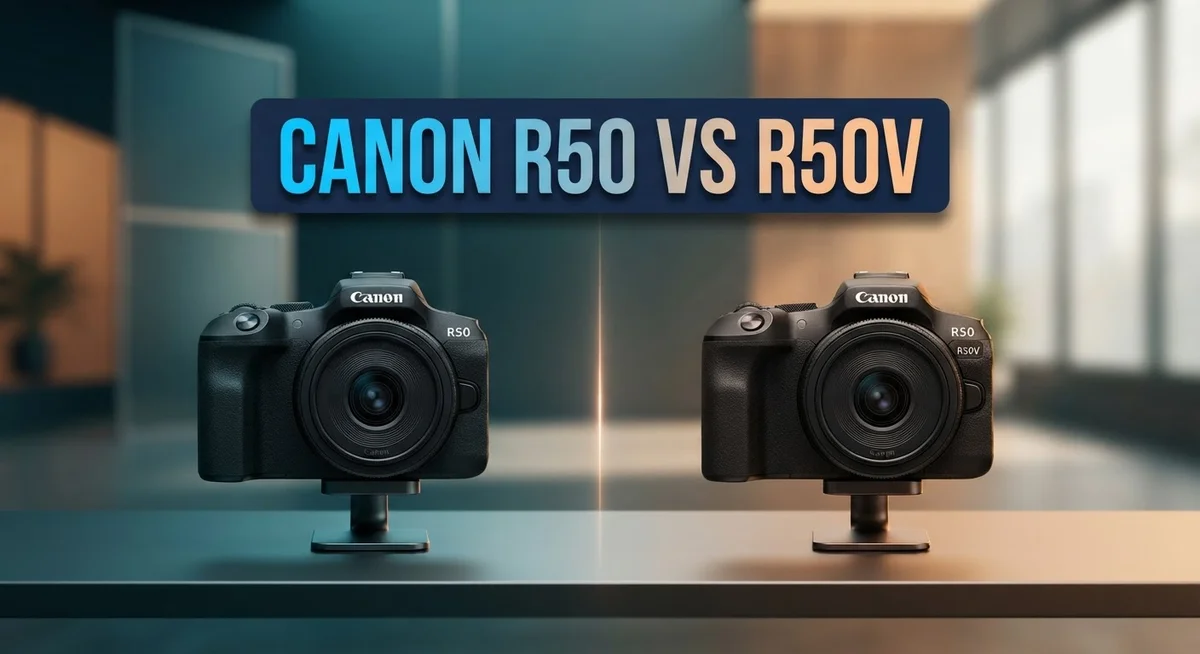
Canon R50 vs R50V: Complete Comparison Guide for Content Creators
Picking between the Canon R50 and R50V can feel tricky. Both cameras share the same 24.2MP APS-C sensor. Both use the powerful DIGIC X processor too.
But small differences set them apart. The R50V skips the viewfinder. It also packs an upgraded card slot for longer bursts and higher bitrate video.
The R50 keeps things classic. It offers a standard viewfinder for traditional shooting.
So which one fits your style? Vloggers and streamers often lean toward the R50V. Photographers who love a viewfinder might prefer the R50.
This guide breaks down every key difference. You will learn about autofocus, video quality, and design. By the end, you will know exactly which camera suits your creative needs.
In a Nutshell
Here’s the quick rundown before you decide:
-
Both cameras share the same core: a 24.2MP APS-C sensor and DIGIC X processor. Image quality stays identical between them.
-
The R50V skips the viewfinder entirely. This makes it lighter and more streamlined for handheld shooting.
-
Card slot upgrades on the R50V allow longer burst shooting and higher bitrate video. This matters if you shoot fast action or detailed footage.
-
Both models handle 4K video well, hitting 30p at full width and 60p with a slight crop. Full HD reaches a smooth 119.8p.
-
The vari angle touchscreen on both cameras helps with flexible framing. This works great for solo shooting or awkward angles.
-
Dual Pixel AF keeps focus sharp and fast on both models. This is a big plus for tracking moving subjects.
-
Watch out for rolling shutter issues. Fast pans or quick motion might show some distortion in your footage.
Sensor, Processor, and Image Quality
The sensor and processor work identically in both cameras. You get a 24.2MP APS-C CMOS sensor that captures sharp, detailed images across most lighting conditions. The DIGIC X processor handles all the heavy lifting behind the scenes, managing autofocus, exposure, and color science.
Where these cameras truly shine is video performance. Both shoot 4K at 30fps with the full sensor width, which means you capture everything without cropping. Step up to 4K 60fps, and you’ll notice a 1.56x crop kicks in. For slower motion work, Full HD recording goes up to 119.8fps, giving you plenty of slow motion options.
The R50V’s upgraded card slot makes a real difference here. You can record longer bursts without dropping frames, and higher bitrate video becomes possible. This matters if you’re pushing the camera hard during extended shoots.
Autofocus performance deserves special attention. Both models use Dual Pixel AF, which means the entire sensor participates in focusing. You’ll experience fast, responsive tracking whether you’re shooting stills or video. This technology works especially well for vlogging and streaming, where subjects move around unpredictably.
One weakness affects both equally: rolling shutter. When you pan quickly or film fast action, vertical lines bend slightly. It’s not a deal breaker for most users, but it’s worth knowing if you shoot dynamic content regularly.
The touchscreen on both cameras measures 3.0 inches and tilts in multiple directions. This vari angle design lets you frame shots from unusual angles without contorting yourself. Screen quality stays consistent between models.
Color science and image processing follow Canon’s standard approach. Images come out warm and pleasing straight from the camera. Video menus feel intuitive and comprehensive, with enough controls for serious creators without overwhelming beginners.
Battery life and buffer speeds remain identical too. You won’t notice performance differences between the two when it comes to sensor output or processor speed. The real split comes down to viewfinder presence and card slot capability, not image quality itself.

- Compact, lightweight RF mount camera with a 24.2 Megapixel CMOS (APS-C) sensor and DIGIC X...
- 4K uncropped movie with Dual Pixel CMOS AF II at up to 30 fps oversampled from 6K and Full HD...
Last update on 2026-11-08 / Affiliate links / Images from Amazon Product Advertising API
Video Performance and Frame Rate Options
The R50 and R50V share identical video specs at their core. Both cameras record 4K video at 30 frames per second using the full sensor width. When you need faster motion, the 4K 60p mode kicks in with a 1.56x crop. Full HD recording pushes even higher at 119.8p, which is great for slow motion work.
The real difference emerges in how long you can actually record. The R50V’s upgraded card slot accepts faster memory cards. This means longer burst sequences and higher bitrate video files without dropping frames. If you’re streaming or capturing extended takes, this matters.
Both cameras use Canon’s Dual Pixel AF system for video. Focus tracking stays smooth and responsive during pans and subject movement. The autofocus rarely hunts or hesitates when you’re rolling.
Frame rate matching is not automatic on either model. You’ll need to manually adjust settings when switching between 24p, 30p, and 60p modes. This takes a few extra seconds but isn’t complicated.
The vari angle touchscreen helps both cameras for video work. You can flip it out for low angles, high angles, or selfie mode while recording. The 3.0 inch display shows focus peaking and histogram data.
Rolling shutter affects both equally. Fast horizontal pans reveal some wobble in the image. This is a sensor limitation you can’t avoid on either camera.
Audio inputs work the same way too. Both have a 3.5mm microphone jack and headphone monitoring port. You can connect external mics for cleaner dialogue or ambient sound.
The R50V edges ahead for serious video creators who need maximum recording time and higher bitrates. The R50 handles video well but works better for mixed shooting. If you shoot stills and video equally, the R50 keeps you flexible. For pure video work, the R50V’s card slot upgrade justifies the choice.
Design and Physical Differences
The physical design of these two cameras tells an interesting story about different shooting styles. Both models share the same compact, lightweight body that fits comfortably in a camera bag or backpack. You get the same 24.2MP APS-C sensor and DIGIC X processor in each one.
The most obvious difference jumps out immediately. The R50 includes an electronic viewfinder, while the R50V removes it completely. This choice matters more than it sounds. Viewfinder shooters appreciate the traditional framing experience. Screen-only shooters prefer the lighter weight and simpler design of the R50V.
The 3.0 inch vari-angle touchscreen appears on both cameras. This screen tilts and flips to help you frame shots from unusual angles. The touchscreen makes vlogging and selfie work much easier on either model. Both cameras respond quickly to touch input, which matters when you’re recording and need fast menu access.
Card slot upgrades separate the R50V from the standard R50. The R50V accepts faster, higher capacity cards. This means longer continuous recording sessions and support for higher bitrate video formats. If you plan extended shoots, this difference becomes significant. The R50 handles normal video recording fine, but the R50V removes recording time limits for serious creators.
Both cameras feature multiple ports in identical locations. You get USB-C, mini HDMI, headphone jack, and microphone input on each model. The port placement remains convenient for streaming and recording workflows on both versions.
The body materials feel identical between models. Both use the same durable plastic construction that keeps weight down. Grip texture matches perfectly. Button placement stays consistent. You won’t notice any difference in how either camera feels in your hands during actual shooting.
The design philosophy differs slightly though. The R50 maintains a traditional camera appearance with its viewfinder bump. The R50V embraces a streamlined profile without it. Choose based on your shooting preferences. Viewfinder lovers pick the R50. Screen-focused creators gravitate toward the R50V’s cleaner design.
Top 3 Alternatives
Canon EOS R6

- FULL-FRAME CMOS SENSOR: 24.2 effective megapixels (approx.) lets you capture sharp, detailed images...
- DIGIC X IMAGE PROCESSOR: Enhances digital camera performance and processes, including image...

Last update on 2026-11-07 / Affiliate links / Images from Amazon Product Advertising API
The Canon EOS R6 offers full-frame performance that many professionals prefer. This camera delivers excellent image quality with its 20-megapixel sensor. You get fast autofocus and reliable video capabilities that work well for content creators.
The R6 handles low-light situations better than entry-level models. Its battery life lasts longer during extended shoots. The lens ecosystem for Canon RF mount continues to grow, giving you more options over time.
Sony Alpha a6700

- 26.0MP APS-C format Exmor R back-illuminated CMOS sensor
- BIONZ XR processing power for exceptional image quality
Last update on 2026-11-07 / Affiliate links / Images from Amazon Product Advertising API
Sony’s a6700 brings advanced autofocus technology to the mid-range segment. This camera features a 26-megapixel sensor that captures sharp details. Real-time tracking follows your subjects automatically, which saves time during editing.
The compact body makes it easy to carry on trips or daily assignments. Video recording includes 4K options at various frame rates. Sony’s growing lens library means you can expand your setup as your skills improve.
Nikon Z6 III

- VIDEO - 6K/60p Internal N-RAW video recording + oversampled 4K UHD, 4K/120p, Full HD/240p slow...
- BEST IN CLASS EVF - Max brightness of 4000 nits gives a clear, vibrant view even in very bright...
Last update on 2026-11-08 / Affiliate links / Images from Amazon Product Advertising API
The Nikon Z6 III presents solid full-frame capabilities for serious photographers. This camera includes a 24-megapixel sensor with effective noise handling. The autofocus system performs well across different lighting conditions.
Nikon’s Z mount offers quality lenses that deliver consistent results. The camera body feels comfortable during long shooting sessions. Video features include 8K recording, which appeals to filmmakers seeking higher resolution options. The Z6 III competes well in its category for both stills and motion work.
Autofocus, Stabilization, and Handling
The autofocus systems on both cameras perform identically in everyday shooting. Dual Pixel AF keeps your subject sharp whether you’re tracking movement or locking onto stationary objects. The autofocus speed feels responsive across both photo and video modes.
When you hold either camera, the handling experience differs slightly based on the missing viewfinder on the R50V. The R50 gives you an optical viewfinder option, which many photographers prefer for composition work. The R50V relies entirely on the rear screen, making it feel more like a vlogging tool than a traditional camera.
The 3.0 inch vari-angle touchscreen serves both models equally well. You can flip it out for selfies, vlogs, or creative angles. The screen responds quickly to your touch inputs and displays information clearly in most lighting conditions.
Stabilization comes from your lens choice rather than in-body technology. Neither camera includes internal image stabilization. If you want smooth video, you’ll need a stabilized lens or external gear. This matters more for video creators than photographers shooting stills.
Rolling shutter remains a weakness on both cameras. Fast pans and quick movements show some distortion, especially in 4K mode. It’s not a dealbreaker, but you’ll notice it if you’re doing dynamic action shots. Slower, deliberate movements minimize this issue.
The R50V’s upgraded card slot makes a practical difference here. You can record longer clips at higher bitrates before the buffer fills up. The standard R50 works fine for casual video, but serious creators will appreciate the R50V’s extended recording capability.
Handling the R50V feels lighter and more compact without the viewfinder. Some people love this streamlined approach. Others miss the viewfinder’s eye-level composition. Your preference depends on whether you shoot mostly video or mix photos with video work.
Both cameras have identical button layouts and control schemes. The grip feels comfortable on both, though compact enough that larger hands might want a grip extension. The touchscreen makes menu navigation fast and intuitive on either model.
Connectivity and Streaming Capabilities
Connectivity options on both cameras are virtually identical, which might surprise you. Each model includes USB-C, mini HDMI, a 3.5mm headphone jack, and a 3.5mm microphone input. This means you can connect external mics, monitor audio in real time, and transfer files at the same speed.
The R50V actually shines when it comes to sustained streaming and content creation. The upgraded card slot supports higher bitrate recording without interruption. If you plan to stream or record long sessions, the R50V keeps rolling while the standard R50 might hit buffer limitations sooner.
USB-C connectivity on both cameras enables direct power delivery. You can charge the battery while shooting, which matters for marathon streaming sessions. The mini HDMI port lets you connect to external monitors or recording devices. This setup works well for live streams or multi-camera setups.
Neither camera offers built-in WiFi or Bluetooth for wireless connectivity. You cannot stream directly to social platforms without external capture devices. This is a notable limitation compared to some competitors. However, the USB-C connection can work with streaming capture cards to fill this gap.
Audio handling deserves attention here. The 3.5mm mic input accepts external microphones, which is essential for vlogging. The headphone jack lets you monitor audio levels during recording. Both cameras give you full control over input levels through the menu system.
The touchscreen interface on both models remains responsive during video work. Menu navigation feels smooth, and you can adjust settings without removing the camera from your eye. The vari-angle design helps you reach controls from different shooting angles.
For serious content creators, the R50V’s card slot upgrade becomes the real connectivity advantage. Faster card speeds mean fewer dropped frames during intense recording sessions. The R50 can still handle streaming work, but you’ll need to manage bitrate settings more carefully.
If your workflow involves external audio equipment or long recording sessions, both cameras support your needs. The R50V simply handles sustained high-bitrate work without compromise.
Pros and Cons
Pros
- Both cameras deliver strong 4K video with full width recording up to 30p, plus 4K 60p with a crop mode
- Fast Dual Pixel autofocus keeps subjects sharp during video and photo work
- Compact, lightweight bodies make them easy to carry for vlogging and travel shoots
- Multiple ports including USB-C, headphone, microphone, and mini HDMI give you flexibility
- R50V’s upgraded card slot handles longer bursts and higher bitrate video without dropping frames
Cons
- Rolling shutter creates visible distortion when panning quickly or shooting moving subjects
- No automatic frame rate matching means you must set rates manually for different recording scenarios
- Kit lens included with both cameras has limited optical range and slower aperture for low light
- These cameras excel at video but produce less impressive results for still photography compared to dedicated photo models
Who Should Buy It
The Canon R50 and R50V serve different photographer profiles, so your choice depends on what you actually do.
Choose the R50 if you shoot stills and video equally. The built-in viewfinder gives you a traditional shooting experience. You’ll frame shots the way most photographers learned. The optical viewfinder helps you see exactly what the sensor captures. This setup works best if you switch between photo and video work throughout your day.
Pick the R50V if video and content creation dominate your workflow. Removing the viewfinder saves weight and reduces bulk. You gain a more compact body that fits easily into bags and backpacks. The vari-angle screen becomes your primary framing tool, which many vloggers and streamers prefer anyway. Content creators often compose on screens rather than through viewfinders.
The R50V’s upgraded card slot makes a real difference for your recording sessions. You’ll capture longer bursts without dropping frames. Higher bitrate video streams smoothly without interruptions. If you record continuously or work with multiple high-resolution projects, this upgrade matters.
Vloggers should lean toward the R50V. The lighter body reduces fatigue during extended handheld shooting. The screen flips and angles to face you for self-recording. You won’t miss the viewfinder when you’re monitoring your own performance on screen.
Still photographers might prefer the R50. The viewfinder feels more natural for composition. You maintain better stability when the camera sits against your face. Traditional framing habits transfer directly to this camera.
Travel photographers face a tougher choice. The R50V’s compact size wins points for luggage space. The R50’s viewfinder option provides shooting flexibility. Consider whether you’ll shoot more video or stills during your trips.
Beginners should consider their primary interest. Video enthusiasts gain from the R50V’s streamlined design. Photo-focused learners benefit from the R50’s viewfinder feedback. Both cameras teach you excellent fundamentals, so your shooting style matters most.
Neither camera disappoints based on this decision alone. Your typical daily shooting determines which body serves you better.
Final Verdict
Choosing between the Canon R50 and R50V comes down to your shooting style. Both cameras share the same sensor and processor. The real difference lies in how you plan to use your camera daily.
Think about your typical shoot. If you photograph events, portraits, or landscapes often, the viewfinder on the R50 gives you a real advantage. Composing through an eyepiece feels natural in bright outdoor light.
If you spend most of your time filming YouTube videos, tutorials, or social content, the R50V fits your needs better. Its design removes what you do not need and keeps what matters for video work.
Neither camera is a bad choice. Both deliver the same image quality, autofocus speed, and video features. Your decision should reflect your workflow, not the specs sheet alone.
Compare this pair against rivals like the Sony ZV-E10 II or the Canon R10. These alternatives offer similar features but with different tradeoffs in size, lens options, or ecosystem support.
For beginners unsure of their direction, the R50 offers more flexibility. You get a viewfinder as a backup option, even if you mostly shoot video.
For creators who already know their focus is content creation, the R50V removes extra weight and gives you a body built around that purpose.
Your final decision should match your goals. Ask yourself how often you shoot stills versus video. Ask if a viewfinder matters to your process. Ask how important faster card performance feels for your projects.
Both cameras represent solid choices within the Canon lineup. Pick the one that removes friction from your specific workflow. That choice will serve you better than chasing every feature on paper.
Frequently Asked Questions
Does the R50V really need the upgraded card slot?
Yes, if you record video frequently. The R50V’s UHS II card slot handles longer burst sequences and higher bitrate footage without frame drops. The standard R50 uses UHS II as well, but the R50V’s slot is optimized for sustained recording. You’ll notice the difference during extended shoots or when using higher quality codecs.
Can you use the R50 viewfinder for video work?
The R50’s electronic viewfinder helps with framing and focus peaking during video. However, many vloggers prefer the R50V’s screen-only setup because it’s lighter and more familiar to phone-based creators. The viewfinder adds minimal weight, but it’s not essential for video work.
Which camera handles autofocus better for moving subjects?
Both cameras use Dual Pixel AF and deliver fast autofocus performance. The real limitation is rolling shutter, not autofocus speed. When you pan quickly or track fast movement, both cameras show some distortion. Autofocus itself stays responsive on either body.
Is the R50 better for photography than the R50V?
Not necessarily. Both cameras have identical sensors and image quality. The R50’s viewfinder simply gives you a traditional shooting experience for stills. If you prefer composing on a screen like smartphone users do, the R50V works just as well for photography. Your choice depends on personal preference, not camera capability.
Which one should a beginner buy?
Choose based on your primary interest. If you’re uncertain whether you’ll focus on stills or video, the R50 offers more flexibility with its viewfinder. If you know you’re building a content creation setup, the R50V’s lighter body and optimized workflow make more sense. Neither choice limits your growth.

Dillip is the founder and editor of Switch & Size, where he breaks down tech products, accessories, and gadgets to help readers make smarter buying decisions. With a passion for testing and comparing the latest technology, he delivers honest reviews, in-depth guides, and side-by-side comparisons that cut through the marketing noise.


