Sony RX100 vs Canon G7X: Complete Comparison Guide
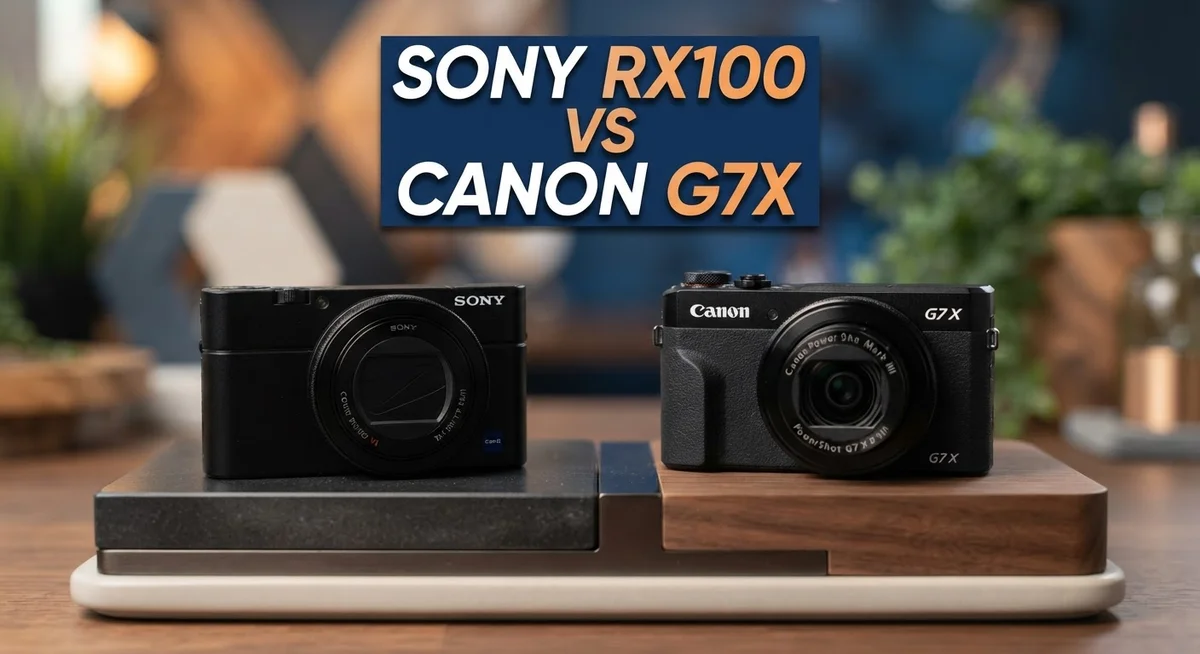
Picking a compact camera can feel tricky. Two names always come up: the Sony RX100 and the Canon G7X. Both cameras pack a punch in a small body.
They share a lot in common. Each one has a 1 inch sensor. Each one fits in your pocket. But they perform very differently once you start shooting.
The Sony RX100 brings faster autofocus and sharper video. It also offers a longer zoom range for wildlife or travel shots. Battery life lasts longer too.
The Canon G7X shines with its brighter lens. It also gives you lovely colors straight out of the camera. Many users love its ergonomics and handling.
So which one fits your style better? Let’s break down every feature. This comparison will help you choose the right camera for your next adventure.
In a Nutshell
Here is a quick summary to help you decide fast.
-
The Sony RX100 offers a longer zoom range, reaching up to 200mm. This gives you more reach for distant subjects.
-
The Canon G7X includes a built in ND filter. This helps you shoot in bright light without extra gear.
-
Battery life leans in favor of the Sony. You get more shooting time before needing a recharge.
-
The Canon has a tilting touchscreen. The Sony uses a fully articulating screen, better for vloggers who face the camera.
-
Video quality favors the Sony RX100. It shoots full sensor 4K without any crop, while the Canon has some limits here.
-
Many users find the Canon G7X more comfortable to hold. Its grip and button layout feel natural for everyday shooting.
-
If color output straight from the camera matters to you, the Canon often pleases users more than the Sony.
Both cameras pack strong features into a small body. Your final pick depends on what you value most, speed or comfort.
Sensor and Image Quality
When you compare these two cameras, sensor performance and image quality become the real deciding factors. Let’s dig into what makes each one stand out.
The Sony RX100 VII uses a newer sensor technology that captures more detail in challenging light. Its autofocus system locks onto subjects faster and more accurately than the Canon. This matters most when you shoot moving subjects or work in dim environments. The sensor also produces cleaner images at higher ISO levels, which means less noise when you push the camera in low light situations.
The Canon G7X Mark III takes a different approach. Its sensor delivers warmer, more natural colors straight out of the camera. Many photographers love this because it requires less editing work afterward. The colors feel pleasing and vibrant without looking oversaturated. If you shoot JPEG files and rarely edit, the Canon’s color science gives you an instant advantage.
Dynamic range tells an important story here. The Sony captures more information in bright skies and dark shadows. This gives you extra flexibility when you edit photos later. The Canon performs well too, but the Sony pulls ahead when you need to recover blown highlights or lift dark areas significantly.
For detail and sharpness, both cameras impress. The Sony’s longer zoom range means you can frame distant subjects without cropping. The Canon’s brighter lens gathers more light, which helps with sharpness when you shoot handheld in low light. Each approach has merit depending on your shooting style.
Texture and grain differ between them. The Sony produces finer grain patterns that look more natural when enlarged. The Canon’s grain appears slightly coarser, though still acceptable for most uses. This becomes noticeable only when you pixel peep or print large.
The Sony edges ahead for technical image quality and sensor performance. The Canon wins for straight out of camera colors and user satisfaction with minimal editing. Your choice depends on whether you value maximum technical capability or pleasant, ready to use results.

- 20. 1MP 1. 0 Type stacked CMOS sensor, Zeiss Vario Sonnar T 24 200 millimeter F2. 8 F4. 5 large...
- 0. 02 sec. High AF speed, 357 point focal plane Phase detection AF and 425 point contrast detection...

Last update on 2026-10-12 / Affiliate links / Images from Amazon Product Advertising API
Zoom Range and Optical Performance
Let’s dive into how these two cameras handle zoom and optical performance.
The Sony RX100 VII stretches to 24-200mm, giving you serious reach for distant subjects. The Canon G7X Mark III tops out at a shorter range. This difference matters when you want to frame tight shots without moving closer.
Optical quality tells another story. The Canon features a brighter lens that opens wider, letting in more light. This helps in dim rooms or during sunset shoots. The Sony’s lens isn’t as bright, but it compensates with superior autofocus speed and accuracy.
The Canon includes a built-in ND filter. This tool cuts down light without changing your lens. You gain more control over shutter speed and depth of field in bright conditions. The Sony lacks this feature, so you’d need an external filter if you want the same effect.
Focus performance separates these cameras significantly. The Sony grabs focus faster and holds it more reliably, especially when tracking moving subjects. The Canon’s autofocus works well but feels slower in comparison. For video work or fast action, this gap becomes noticeable.
Optical stabilization works on both models, but they handle it differently. The Sony’s newer sensor technology combines with its stabilization to produce sharper handheld shots. The Canon’s approach feels more traditional but still effective for most users.
The zoom versatility of the Sony opens creative doors. You can shoot wide landscapes at 24mm, then zoom to 200mm for wildlife or sports. The Canon’s shorter range limits this flexibility, though many users find it sufficient for everyday photography.
Light transmission differs too. The Canon’s faster aperture means better performance in low light situations without pushing ISO too high. The Sony compensates with its newer sensor, which handles higher ISO values cleaner than older generations.
For optical performance overall, the Sony wins on zoom range and autofocus speed. The Canon wins on lens brightness and built-in filters. Your choice depends on whether you need extreme reach or prefer maximum light gathering ability.
Video Capabilities and 4K Recording
When it comes to recording video, these two cameras take different approaches that matter for your content creation needs.
The Sony RX100 VII captures 4K video using its full sensor without cropping the frame. This means you get the complete width of what the lens sees. The camera records at 30 frames per second in 4K, which works well for most situations. You also get 1080p at up to 120 frames per second for smooth slow motion footage.
The Canon G7X Mark III handles 4K differently. It records 4K video at 30 frames per second as well, but the image gets cropped compared to the full sensor. This limits your field of view during video recording. The Canon does offer 1080p at 120 frames per second like the Sony, so both match on that front.
Here’s where the built in ND filter on the Canon becomes useful. When you film outdoors in bright sunlight, this filter reduces light entering the lens. You gain more control over your shutter speed and depth of field without needing an external filter. The Sony lacks this feature, so you’ll need to carry a separate filter if you want similar control.
Autofocus during video performs better on the Sony. The faster autofocus speed means smoother focus transitions when your subject moves. The Canon’s autofocus works acceptably but moves slower, which some creators find less responsive for dynamic scenes.
Both cameras include optical image stabilization to reduce camera shake. The stabilization helps keep footage steady whether you’re walking or panning across a scene. This matters more when you shoot handheld without a tripod.
For color grading flexibility, the Sony captures more technical information in its video files. This gives you greater freedom in post production editing. The Canon produces more pleasing colors straight from the camera, which means less editing work if you want to use footage immediately.
If video quality and full sensor 4K recording matter most to you, the Sony leads. If you value practical features like the built in ND filter and quick color output, the Canon serves you well.
Top 3 Alternatives
Panasonic Lumix LX100

- Legendary LUMIX LX Series with manual controls Designed to Inspire Creativity
- Superior light capture with large, multi aspect micro four thirds sensor
Last update on 2026-11-09 / Affiliate links / Images from Amazon Product Advertising API
The Panasonic Lumix LX100 offers a fixed 24-75mm equivalent lens that gives you solid versatility without changing lenses. This camera features a large sensor for its compact size, which means better image quality in low light situations. The electronic viewfinder helps you frame shots accurately before you press the shutter button.
You get manual controls that let you adjust aperture, shutter speed, and ISO easily. The build quality feels premium, and the camera weighs less than many alternatives. Video recording capabilities are solid if you need that feature alongside photography.
Ricoh GR III

- Optimized for Street Photography: The Ricoh GR IIIx Urban Edition boasts a 26.1mm lens, offering a...
- Advanced Sensor and Processing Power: Equipped with a 24.2MP APS-C CMOS sensor and GR Engine 6, the...
Last update on 2026-11-09 / Affiliate links / Images from Amazon Product Advertising API
The Ricoh GR III is a street photography powerhouse with a fixed 28mm lens and a compact design that fits in your pocket. This camera prioritizes image sharpness and color accuracy above all else. The sensor performs remarkably well even when light is limited.
The GR III includes a macro mode that lets you focus extremely close to subjects. Its autofocus system is fast and reliable in various conditions. The camera body is rugged and weather-resistant, making it ideal for outdoor shooting. Raw file support gives you flexibility during post-processing.
Fujifilm XF10

- 24.2MP APS-C CMOS sensor
- 3.0-Inch” (Approx. 1, 040k-dot) Color LCD Touchscreen, aspect Ratio 3: 2
Last update on 2026-11-09 / Affiliate links / Images from Amazon Product Advertising API
The Fujifilm XF10 combines Fujifilm’s famous color science with a 28mm fixed lens and compact body. This camera delivers images with beautiful color reproduction right out of the box. The hybrid autofocus system ensures sharp focus in most situations.
You’ll appreciate the manual focus ring for precise control. The camera includes film simulation modes that mimic classic Fujifilm film stocks. Battery life is reasonable for a compact camera. The build quality reflects Fujifilm’s attention to detail and durability.
Autofocus Speed and Shooting Performance
When you shoot with the Sony RX100 VII, autofocus locks onto subjects noticeably faster than the Canon G7X Mark III. The Sony’s autofocus system responds quicker in real world shooting situations. This speed advantage matters most when you’re capturing moving subjects or working in fast paced environments.
The Sony excels at continuous autofocus tracking. It maintains focus on moving objects more reliably throughout your shot. The Canon’s autofocus works well for static subjects, but it takes longer to acquire focus initially. For photographers who shoot sports or wildlife, this difference becomes obvious quickly.
Shooting performance shows another clear distinction between these two cameras. The Sony RX100 VII shoots at 20fps, allowing you to capture rapid sequences of images. The Canon G7X Mark III shoots slower, which means you might miss the perfect moment in fast action situations. The Sony’s faster frame rate gives you more chances to get the shot you want.
Autofocus accuracy during continuous shooting favors the Sony as well. The Sony maintains sharp focus across your entire burst sequence. The Canon occasionally struggles to keep focus locked when you’re shooting multiple frames rapidly. For professional work or demanding situations, the Sony’s performance feels more dependable.
In low light conditions, the Sony’s autofocus system still performs admirably. It locks focus faster than the Canon even when light levels drop. The Canon’s autofocus slows down noticeably in dim environments. If you shoot indoors or during evening hours frequently, the Sony’s responsiveness becomes a real advantage.
Battery life also impacts shooting performance overall. The Sony lasts longer between charges, so you spend less time managing batteries during shoots. The Canon requires more frequent charging, which interrupts your workflow on longer assignments.
For hybrid shooters who mix photos and video, the Sony’s autofocus speed during video recording proves superior. The Sony tracks subjects smoothly without the hunting or hesitation you sometimes see on the Canon. Overall, the Sony RX100 VII delivers faster, more reliable autofocus and shooting performance across nearly every scenario.
Design, Ergonomics and Build Quality
The physical design of these two cameras reveals distinct philosophies about how a compact should feel in your hands.
The Sony RX100 VII features a more angular, compact body with a retractable lens that tucks away completely when powered off. This design makes it genuinely pocket-friendly. The screen articulates fully, rotating outward and flipping up for selfies or overhead shots. This flexibility matters when you’re shooting from unusual angles or vlogging.
The Canon G7X Mark III takes a different approach with a fixed lens barrel and a tilting touchscreen that moves up and down only. The body sits slightly larger than the Sony, though still manageable for travel. Canon prioritizes a more traditional grip experience here.
Grip comfort shows real differences between them. The Sony’s body tapers at the sides, which some shooters find less secure during extended use. The Canon offers a more pronounced grip area that feels more natural for longer shooting sessions. If you have larger hands, you’ll likely prefer the Canon’s ergonomics.
Build quality on both cameras feels solid. The Sony uses magnesium alloy construction with a premium finish. The Canon also employs quality materials and feels equally durable. Neither camera feels cheap or fragile in hand.
Weight distribution matters too. The Sony RX100 VII weighs slightly less, making it ideal if you’re hiking or traveling light for days. The Canon sits just above that, but the difference is minimal in real world use.
Button placement and menu systems affect your daily experience. The Sony positions controls slightly tighter together, requiring more precision when adjusting settings. The Canon spreads buttons more generously, making blind adjustments easier during shooting.
The articulating screen on the Sony genuinely changes how you shoot. You gain creative angles the Canon simply cannot reach. However, moving parts mean slightly more maintenance considerations over time.
Both cameras survive casual bumps and weather exposure reasonably well. Neither is weather sealed like professional gear, so treat them with appropriate care during rain or dusty conditions.
Pros and Cons
Sony RX100 VII
Pros
– Longer 24-200mm zoom range gives you more flexibility for distant subjects
– Full-sensor 4K video without crop keeps your framing intact
– Faster autofocus locks onto subjects noticeably quicker than the Canon
– Superior continuous autofocus tracking during video recording
– Better battery life means more shots per charge
Cons
– Fewer color options straight from camera without editing
– Autofocus can hunt occasionally in very low light situations
– Less ergonomic grip compared to Canon for some users
Canon G7X Mark III
Pros
– Brighter and faster lens opens up better low light performance
– Built-in ND filter lets you control shutter speed without extra gear
– Better out-of-camera colors require less editing work
– More comfortable ergonomic grip for extended handheld shooting
Cons
– Shorter zoom range limits reach for distant subjects
– Slower autofocus speed compared to the Sony
– 4K video recording has limitations and crops the sensor
Who Should Buy It
The Sony RX100 VII suits you best if you shoot video regularly. Its full-sensor 4K recording and superior autofocus tracking during video make it the clear winner for hybrid shooters. The longer 24-200mm zoom range also gives you more creative freedom when framing distant subjects.
Choose the Sony if you need all-day shooting sessions without battery swaps. Better battery life means you capture more moments before needing to recharge. This advantage compounds when you’re traveling or working on location.
The Canon G7X Mark III appeals to photographers who prioritize image quality straight from the camera. Its brighter lens performs better in dim lighting without pushing ISO higher. Built-in ND filter gives you creative control over shutter speed without carrying extra equipment.
Pick the Canon if ergonomics matter more to you than autofocus speed. Many users prefer its tilting touchscreen and overall grip comfort during extended shooting sessions. The fixed lens design feels more traditional if you’re coming from older compact cameras.
The Sony wins for travel and adventure photography. Retractable lens design saves space in your bag. Articulating screen opens new angles for creative compositions that the Canon’s tilting screen cannot match.
Consider the Canon if you shoot mostly in good lighting. Its faster lens handles bright outdoor scenes beautifully. Out-of-camera colors look more vibrant without requiring extensive post-processing.
The Sony suits content creators who upload to social media frequently. Faster autofocus means fewer missed shots during quick recording sessions. Superior continuous tracking keeps moving subjects sharp throughout your video clips.
Choose based on your primary use case. Video enthusiasts and travel photographers lean toward the Sony. Still photographers who value ergonomics and lens brightness prefer the Canon. Both cameras deliver excellent image quality. Your shooting style determines which one fits your workflow better. Test both if possible before deciding. Handle them in person to feel the grip difference. Review sample footage from each camera to see autofocus performance firsthand.
Final Verdict
Both cameras deliver excellent image quality. Your final choice depends on what you shoot most often.
The Sony RX100 VII works best as an all-around tool. It handles video, wildlife, and travel shots with ease.
The Canon G7X Mark III shines when you want great photos without much fuss. It rewards casual shooters who value simplicity.
Think about your shooting style first. If you switch between photos and video often, the Sony gives you more flexibility. Its autofocus system adapts quickly to changing scenes.
If you mostly shoot stills in daylight, the Canon keeps things simple. You get pleasing colors without heavy editing.
Consider your future needs too. Content creators who plan to grow into vlogging will appreciate the Sony’s video strengths. Photographers who stick to casual shooting may never miss those extra features.
Neither camera feels outdated. Both use proven 1 inch sensors that produce sharp, clean images. The differences come down to workflow, not raw quality.
Long term users often mention comfort as a deciding factor. Some people simply enjoy holding the Canon more during long shoots. Others prefer the compact folding design of the Sony for quick pocket use.
Your budget for accessories matters as well. The Canon’s built in ND filter saves you from buying extra glass. The Sony’s longer zoom reduces the need for a second lens.
Think about where you shoot most. Frequent travelers benefit from the Sony’s reach and battery life. Studio or portrait shooters may lean toward the Canon’s color rendering.
Both cameras hold their own against newer competitors like the Sony ZV1 and Canon G5X II. Yet these two remain strong choices for photographers who want proven performance.
In the end, pick the camera that matches your daily habits. The right choice feels natural in your hands and fits your creative goals.
Frequently Asked Questions
Which camera has better autofocus performance?
The Sony RX100 VII pulls ahead here. Its autofocus system locks onto subjects faster and tracks movement more smoothly during video. The Canon G7X Mark III has solid autofocus, but it works at a slower pace. If autofocus speed matters for your shooting style, Sony wins.
Can I shoot 4K video on both cameras?
Both cameras record 4K, but the Sony delivers better results. The Sony RX100 VII captures 4K using the full sensor without cropping the image. The Canon G7X Mark III has limited 4K capabilities and crops the frame. For serious video work, the Sony offers more flexibility.
What about the zoom range on each camera?
Sony RX100 VII gives you 24-200mm zoom. Canon G7X Mark III offers a shorter zoom range. The Sony’s longer reach means you can frame distant subjects without moving closer. This makes the Sony better for wildlife or sports photography.
Does the Canon have any features the Sony lacks?
Yes. The Canon G7X Mark III includes a built-in ND filter. This lets you slow down your shutter speed without buying extra equipment. The Canon also has a brighter lens, which performs better in dim lighting. If you shoot frequently in low light without extra gear, the Canon’s lens advantage matters.
Which camera feels better to hold?
This comes down to personal preference. Many users find the Canon’s grip more comfortable during extended shooting sessions. The Sony feels slightly less ergonomic to some hands. Handle both cameras before deciding if comfort is your top priority.

Dillip is the founder and editor of Switch & Size, where he breaks down tech products, accessories, and gadgets to help readers make smarter buying decisions. With a passion for testing and comparing the latest technology, he delivers honest reviews, in-depth guides, and side-by-side comparisons that cut through the marketing noise.