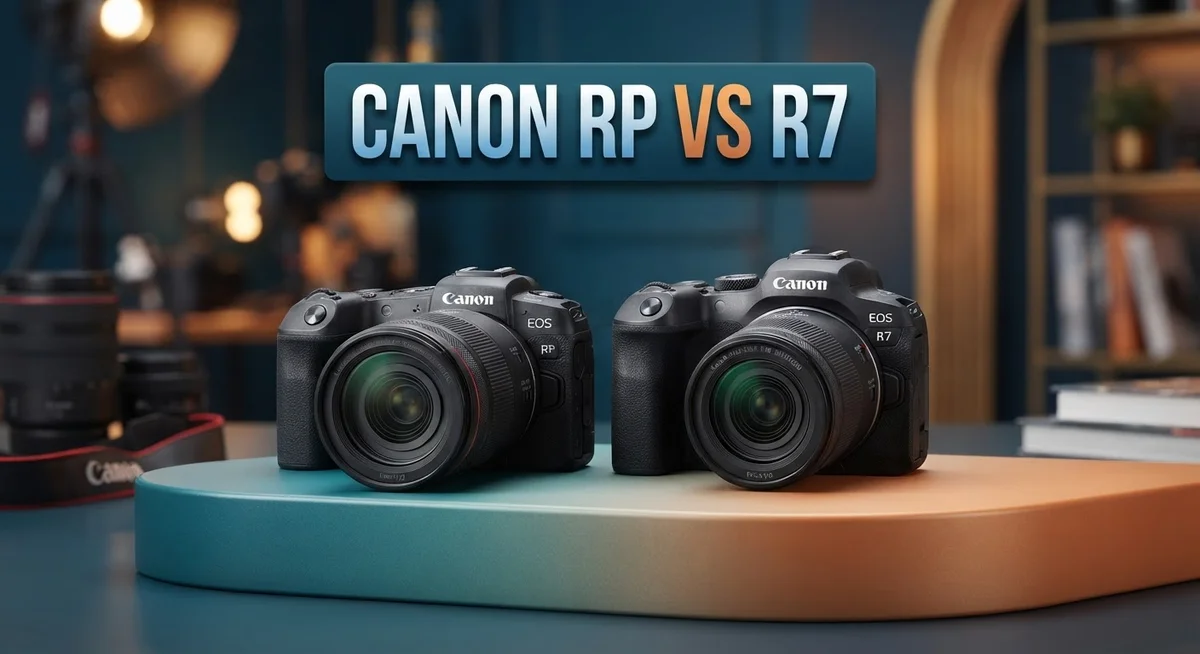
Canon RP vs R7: Full-Frame vs APS-C Mirrorless Camera Comparison
Choosing a camera can feel tricky. The Canon RP and Canon R7 both stand out, but they serve different needs.
The Canon RP brings a full-frame sensor to the table. It delivers smooth low-light shots and simple handling for beginners.
The Canon R7 packs a punch with its 32.5MP APS-C sensor. It offers fast autofocus and quick burst shooting for action lovers.
Do you shoot portraits or wildlife? Do you need speed or a bigger sensor? These questions matter.
This guide breaks down every key difference. We compare autofocus, build quality, and shooting performance.
By the end, you will know which camera fits your style. Let’s explore what makes each one special.
In a Nutshell
Here is the quick rundown to help you decide fast.
-
Autofocus power: The R7 uses advanced tracking with animal detection. It locks onto subjects even in tricky light. The RP uses an older system that works fine for still subjects.
-
Image stabilization: The R7 has in-body stabilization. This helps you shoot handheld in low light. The RP lacks this feature entirely.
-
Burst shooting speed: Wildlife and sports shooters need speed. The R7 fires up to 15fps mechanically. The RP falls behind here.
-
Storage options: The R7 offers dual SD card slots for backup shots. The RP only has one slot.
-
Build and low light: The RP handles dim scenes better thanks to its sensor size. The R7 feels more solid in your hands.
-
Best fit for you: Pick the RP for portraits and studio work. Pick the R7 for fast action and wildlife photography.
Sensor and Image Quality
The sensor you choose shapes everything about your photos. Let’s dig into how these two cameras perform when light hits the sensor.
The RP uses a 26MP full-frame sensor, while the R7 packs 32.5MP on an APS-C chip. Full-frame means bigger pixels and better light gathering. This gives the RP a real edge in dim rooms, low-light venues, and night shoots. You’ll see cleaner images with less grain when you push the ISO up.
The R7’s smaller sensor captures more megapixels in a tighter space. This helps you crop photos later without losing detail. If you print large or zoom in tight, those extra pixels matter. The trade-off? The R7’s individual pixels are smaller, so shadow areas may show more noise at very high ISO settings.
Both cameras use Canon’s color science, so skin tones and whites look natural. The RP runs the Digic 8 processor, which handles image data steadily. The R7 jumps to the Digic X processor, which processes information faster and powers that animal detection autofocus system. This newer chip also helps the R7 handle fast burst shooting without slowing down.
Dynamic range tells you how much detail the camera keeps in bright and dark areas of the same shot. The RP’s larger sensor generally holds more shadow detail in high contrast scenes. The R7 holds its own here, but the full-frame advantage still shows in tricky lighting.
Color accuracy and sharpness stay strong on both bodies. The real difference emerges when you shoot in challenging light. Portrait photographers often prefer the RP’s full-frame look and low-light strength. Wildlife and sports shooters lean toward the R7 because its extra megapixels and faster processing let you catch more action and crop tighter.
Your shooting style picks the winner here. Dim venues and clean shadows? The RP shines. Fast action and detail? The R7 delivers. Both produce stunning images in normal daylight conditions.

- This Digital Camera Bundle Items Includes: Canon EOS R7 Mirrorless Camera USA Model With Limited...
- Camera Carrying Case, Canon R-F-5 Camera Cover, ER-R7 Camera Strap, Canon ER-SC2 Shoe Cover, Battery...
Last update on 2026-11-08 / Affiliate links / Images from Amazon Product Advertising API
Autofocus and Burst Performance
The autofocus systems in these two cameras sit at different performance levels. The R7 dominates with its 651-point autofocus array and animal detection technology. This means the camera locks onto wildlife, pets, and moving subjects faster and more reliably. The RP uses a simpler autofocus setup that works fine for static scenes but struggles when subjects move unpredictably.
Low light autofocus matters for evening shoots and indoor events. The R7 achieves focus down to -5EV, which is exceptionally low. The RP can focus in dim conditions too, but not quite as deep into the darkness. If you shoot concerts, weddings after sunset, or wildlife at dawn, the R7 gives you more confidence.
Burst shooting speed separates these cameras significantly. The R7 fires 15 frames per second with its mechanical shutter and 30fps with the electronic shutter. The RP maxes out around 5fps, which feels slow for action photography. Sports photographers and wildlife shooters will feel the difference immediately.
Buffer capacity tells you how many shots you can fire before the camera slows down. The R7 holds more images in its buffer thanks to the faster Digic X processor. This means you can capture longer sequences without pausing. The RP’s Digic 8 processor handles smaller bursts before needing a moment to write files to the card.
Card storage adds another layer to burst performance. The R7 features dual SD card slots, so you can overflow to a second card or back up images simultaneously. The RP has a single SD slot, which limits your options during long shoots.
Autofocus tracking during video also differs between these bodies. The R7’s advanced eye and animal detection works during video recording. The RP offers solid autofocus for video, but without the specialized tracking features. Content creators and filmmakers will notice this advantage on the R7.
For continuous shooting situations, the R7 clearly wins. If you shoot portraits, still life, or controlled studio work where speed matters less, the RP performs adequately.
Build Quality and Stabilization
The Canon RP and R7 take different approaches to build quality and stabilization. These differences matter when you shoot in tough conditions or need reliable performance over long sessions.
Build quality starts with the body itself. The R7 features a more robust construction with a magnesium alloy chassis and weather sealing. This camera handles dust and moisture better than the RP. The RP uses a polycarbonate body, which feels lighter but less rugged. If you shoot outdoors regularly, the R7 gives you extra peace of mind.
In body image stabilization is where the R7 pulls ahead significantly. The R7 has IBIS built into the camera body. This means every lens you attach gets stabilization automatically. The RP lacks this feature entirely. You rely only on lens stabilization with the RP. For video work or handheld shooting at slow shutter speeds, the R7 wins clearly.
The R7’s IBIS works down to 8 stops of compensation. This lets you shoot at slower speeds without blur. You can use longer focal lengths handheld. You get sharper video without a tripod. The RP forces you to use faster shutter speeds or tripods for smooth footage.
Handling and ergonomics favor the R7 as well. The larger grip fits more hand sizes comfortably. The R7 feels more balanced when you mount heavier lenses. The RP is smaller and lighter, which some photographers prefer for travel.
Shutter durability differs too. The R7 has a rated shutter life of 200,000 cycles. The RP rates at 150,000 cycles. This means the R7 lasts longer during heavy use.
The R7 also includes dual SD card slots. You can back up files automatically or split recording between cards. The RP has a single card slot. For professionals, this dual slot setup prevents data loss from card failure.
Bottom line: The R7 offers superior build quality, weather resistance, and in body stabilization. The RP prioritizes portability and simplicity. Choose the R7 if you need durability and stabilization. Choose the RP if you value compact size and lightweight handling.
Top 3 Alternatives
Sony Alpha a6700

- 26.0MP APS-C format Exmor R back-illuminated CMOS sensor
- BIONZ XR processing power for exceptional image quality

Last update on 2026-11-08 / Affiliate links / Images from Amazon Product Advertising API
The Sony Alpha a6700 offers excellent autofocus performance with real-time tracking. This camera excels at fast shooting speeds and handles video work smoothly. You get a compact body that feels comfortable in your hands during long shoots.
The sensor captures sharp images in various lighting conditions. Battery life gets you through a full day of shooting. The camera connects easily to your computer and phone for quick file transfers.
Nikon Z6 III

- VIDEO - 6K/60p Internal N-RAW video recording + oversampled 4K UHD, 4K/120p, Full HD/240p slow...
- BEST IN CLASS EVF - Max brightness of 4000 nits gives a clear, vibrant view even in very bright...
Last update on 2026-11-08 / Affiliate links / Images from Amazon Product Advertising API
The Nikon Z6 III brings professional-grade features to a manageable package. This camera delivers consistent color reproduction and accurate exposure metering. You’ll appreciate the intuitive menu system that doesn’t slow you down.
Video capabilities include high frame rates and solid stabilization. The ergonomic design reduces hand fatigue during extended sessions. Weather sealing protects your investment during outdoor work.
Fujifilm X-T5

- 40.2 Megapixel X-Trans CMOS 5 HR BSI Imaging Sensor
- 15 Frames per second in Mechanical Shutter
Last update on 2026-11-08 / Affiliate links / Images from Amazon Product Advertising API
The Fujifilm X-T5 stands out with its classic design and film simulation modes. These presets give your images a distinctive look straight from the camera. The retro controls feel natural and responsive under your fingers.
This camera produces vibrant colors without heavy post-processing. The compact size makes it ideal for travel and street photography. Autofocus performance keeps up with moving subjects reliably. The battery holds power through multiple shooting sessions without frequent charging breaks.
Each option provides different strengths. The Sony excels at speed and tracking. Nikon focuses on reliability and video features. Fujifilm emphasizes image character and user experience. Your choice depends on what matters most for your specific photography needs.
Low-Light Performance and Dynamic Range
The full-frame sensor in the RP delivers superior low-light performance compared to the R7. Larger pixels on a full-frame chip gather more light, which means cleaner images when you shoot in dim conditions. The RP excels during evening portraits, indoor events, and nighttime photography where light sources are scarce.
The R7’s smaller APS-C sensor compensates with higher megapixel density. You get 32.5MP packed into a crop frame versus the RP’s 26MP on full-frame. This density trade-off matters less in low-light situations, where the RP’s sensor size wins out. However, the R7’s Digic X processor handles noise reduction more effectively than the RP’s Digic 8.
Dynamic range tells a different story between these two bodies. The RP captures excellent shadow detail in dim lighting because its larger sensor produces less noise at higher ISO values. The R7 holds its own with strong highlight recovery and shadow detail, though it requires slightly higher ISO settings to match the RP’s low-light clarity.
In practical terms, the RP shoots at ISO 3200 with cleaner results than the R7 at the same setting. Push both cameras to ISO 6400, and the gap narrows considerably thanks to the R7’s advanced processor. The R7’s autofocus system also works down to -5EV, giving you reliable focus even in near-darkness.
Color accuracy remains consistent on both cameras across all lighting conditions. Canon’s color science keeps skin tones natural whether you’re shooting in sunlight or tungsten-lit rooms. Neither camera produces unwanted color shifts in low-light scenarios.
For video work in dim environments, the R7 pulls ahead with its electronic shutter and faster frame rates. The RP struggles with autofocus tracking during low-light video recording. Choose the RP if you prioritize still image quality in darkness. Pick the R7 if you need reliable autofocus performance and video capability when light runs thin. Your specific shooting scenarios determine which camera serves you better in challenging lighting.
Video Capabilities and Connectivity
The Canon RP and R7 handle video recording and connectivity in distinct ways. Understanding these differences helps you pick the right camera for your specific needs.
Video Frame Rates and Recording Options
The R7 pulls ahead with its electronic shutter capability. It records at 30fps using the electronic shutter, while the RP maxes out at standard mechanical shutter speeds. This means the R7 gives you more flexibility when shooting fast-moving subjects or in bright sunlight. The R7 also offers 4K recording with better codec options compared to the RP.
The RP still captures quality video, but it operates at lower frame rates overall. Your choice depends on whether you need those extra frames per second for smooth slow-motion work or professional video projects.
Autofocus Tracking During Recording
Video autofocus performance differs significantly between these bodies. The R7’s advanced autofocus system with 651-point coverage and animal detection works during video recording. This means your subject stays sharp even when moving across the frame.
The RP uses a simpler autofocus system that works adequately for video, but it lacks the sophisticated tracking abilities of the R7. For interview-style filming or static scenes, the RP performs fine. For dynamic video work, the R7 excels.
Connectivity and Data Transfer
The R7 includes dual SD card slots, which matters for video workflows. You can record to one card while backing up to another simultaneously. This setup prevents data loss and keeps your shoots running smoothly.
The RP uses a single SD card slot. This works for casual video recording but limits your backup options during important shoots.
Both cameras support USB 3.1 connectivity for fast file transfers to your computer. The R7’s dual slots give you an advantage when handling large video files. For serious videography, the R7’s connectivity setup proves more practical.
If you shoot occasional video, the RP handles the job. If video is central to your work, the R7’s superior frame rates, autofocus tracking, and dual card slots make it the stronger choice.
Pros and Cons
Pros
- RP: Full-frame sensor captures more light, making it superior for dimly lit environments and reducing noise at high ISO settings
- RP: Simpler operation and lighter body make it easier to carry for travel or casual shooting
- R7: 651-point autofocus with animal detection locks onto subjects faster and more accurately than the RP
- R7: Shoots at 15fps with mechanical shutter or 30fps with electronic shutter, crushing the RP’s slower burst speed
- R7: In-body image stabilization provides up to 8 stops of compensation, eliminating camera shake without needing expensive lenses
Cons
- RP: Slower autofocus system struggles with moving subjects and lacks advanced tracking features
- RP: No in-body stabilization means you must buy stabilized lenses to reduce blur
- R7: APS-C crop sensor is smaller than full-frame, capturing less light in dark conditions
- R7: Higher overall system investment compared to the RP’s entry-level positioning
Who Should Buy It
The Canon RP suits photographers who value full-frame simplicity and light travel. You’ll enjoy its compact design and straightforward controls. The RP works well for casual shooting, family events, and travel photography where you don’t need rapid-fire sequences.
Choose the RP if you shoot mostly in good lighting. Its larger sensor excels in daylight and well-lit studios. You get clean images without pushing high ISO values. The camera feels comfortable in your hands during long shoots.
The RP appeals to beginners stepping up from smartphones or basic DSLRs. You get professional image quality without overwhelming features. The learning curve stays gentle, and the menu system feels intuitive.
The Canon R7 targets serious enthusiasts and professionals who need speed and precision. You’ll love the 651-point autofocus system, especially for wildlife and sports. The animal detection locks onto moving subjects instantly.
Choose the R7 if you shoot fast-action content regularly. The 15fps continuous shooting (or 30fps electronic) captures every decisive moment. Your keeper rate climbs dramatically compared to slower cameras.
The R7 excels for video creators. The electronic shutter enables high-speed recording without mechanical limitations. In-body stabilization handles handheld shots smoothly. Dual SD card slots provide backup and faster workflow management.
The R7 works best if you demand professional build quality. The weather sealing handles challenging environments. The magnesium alloy body survives heavy use and accidental bumps.
Pick the R7 if you shoot in varying light conditions. The APS-C sensor’s higher megapixel density captures fine details. You can crop images significantly without losing quality.
Both cameras serve different photographers. The RP wins for casual users who want quality without complexity. The R7 wins for anyone needing fast autofocus, continuous shooting, or video performance.
Consider your actual shooting style. Do you chase fast-moving subjects? The R7 dominates. Do you prefer deliberate composition and careful framing? The RP delivers excellent results. Your typical shooting scenarios determine which camera fits your workflow best.
Final Verdict
Choosing between these two cameras comes down to your shooting style. Both models excel in different areas, so your final choice depends on what matters most to you.
If you want a simple full-frame experience, the RP fits your needs. It handles portraits, landscapes, and everyday photography with ease. You get clean images without a steep learning curve.
The R7 shines when you need speed and accuracy. Wildlife photographers, sports shooters, and action enthusiasts benefit most from its advanced tracking system. This camera keeps up with fast subjects that the RP simply cannot catch.
Think about your future goals too. If you plan to grow your skills and tackle challenging subjects, the R7 gives you room to improve. Its features support advanced techniques as you learn.
The RP works well if you want a straightforward tool for capturing memories. You will not feel overwhelmed by menus or settings. Point, shoot, and enjoy the results.
Video creators face a clear decision too. The R7 supports faster frame rates and better tracking during recording. Content creators who film movement will appreciate this advantage.
Consider your current gear as well. If you already own APS-C lenses, the R7 makes more sense. Full-frame lens owners will find the RP a natural fit.
Neither camera is wrong for beginners, but each suits different beginner types. Casual shooters lean toward the RP. Those ready to learn advanced skills should consider the R7.
Your shooting environment matters most in this decision. Low light photographers benefit from the RP’s sensor advantage. Fast paced photographers need the R7’s speed and precision.
Both cameras deliver quality results in their own way. Pick the one that matches your specific photography goals and daily shooting habits.
Frequently Asked Questions
Does the Canon RP work well for video content?
The RP captures solid video but lacks advanced features. It records 4K at up to 30fps and Full HD at 60fps. No in-body stabilization means you’ll need a tripod or gimbal for smooth footage. The autofocus during video can be slow and hunt for subjects.
The R7 is the clear winner for video creators. It offers 8 stops of stabilization, faster autofocus tracking, and better continuous performance. If video is your main focus, the R7 delivers professional results.
Which camera handles fast-moving subjects better?
The R7 dominates this category. Its 651-point autofocus system with animal detection locks onto moving subjects instantly. It shoots 30fps with the electronic shutter, so you capture every moment.
The RP struggles with moving subjects. Its autofocus is slower and lacks advanced tracking. It shoots only 5fps continuously, making it tough for sports or wildlife. Choose the R7 if action is your priority.
Can I use the same lenses on both cameras?
Both use Canon’s RF mount, so many lenses work on each. However, the RP is full-frame while the R7 uses APS-C. Full-frame lenses work on the R7 but will have a crop effect.
RF lenses designed for APS-C mount only work on the R7. Check lens compatibility before buying. If you already own RF lenses, either camera works.
Which is better for low-light photography?
The RP has a slight edge here. Its full-frame sensor captures more light naturally, producing cleaner images at high ISO. The Digic 8 processor handles noise well in dim conditions.
The R7 performs admirably too. Its newer Digic X processor and 32.5MP sensor produce sharp results. The difference is small. Both handle evening shoots and indoor events competently.

Dillip is the founder and editor of Switch & Size, where he breaks down tech products, accessories, and gadgets to help readers make smarter buying decisions. With a passion for testing and comparing the latest technology, he delivers honest reviews, in-depth guides, and side-by-side comparisons that cut through the marketing noise.