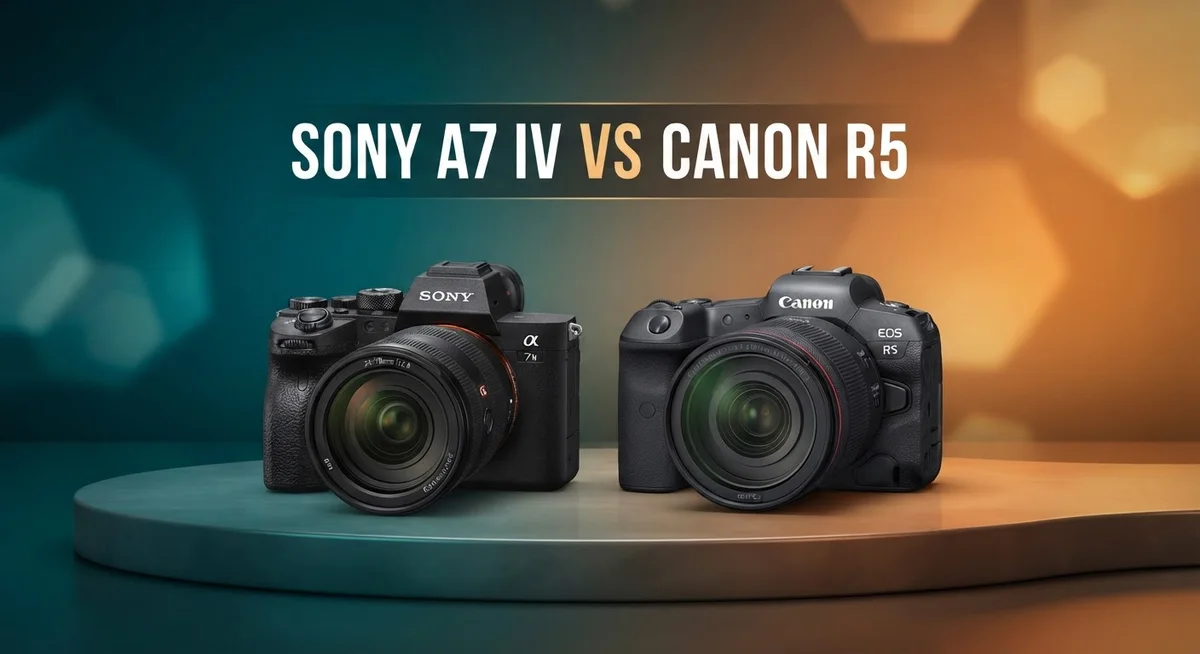
Sony A7 IV vs Canon R5: Complete Mirrorless Camera Comparison
Choosing between the Sony A7 IV and Canon R5 feels tough. Both cameras pack serious power for photographers and video creators.
The Canon R5 brings 8K raw video and a 45MP sensor. It also offers superior ergonomics and a quieter shutter for discreet shooting.
The Sony A7 IV counters with outstanding autofocus and a huge lens ecosystem. Its battery also lasts longer during long shoots.
So which camera fits your needs? This guide breaks down specs, performance, and features side by side.
We compare everything from stabilization to color accuracy. You will also see how each camera handles real world shooting conditions.
By the end, you will know exactly which camera deserves a spot in your bag. Let’s explore what makes these two cameras stand out.
In a Nutshell
Here’s a quick snapshot to help you decide fast.
-
Battery Life: The Sony A7 IV pulls ahead with 580 shots per charge. The Canon R5 manages 320 shots, so you may need spare batteries.
-
Shutter and Grip: The Canon R5 feels more premium in hand. It has a quieter shutter and a grip built for long shooting days.
-
Stabilization: The Canon R5 packs 5-axis in-body stabilization. This helps you get sharper handheld shots in low light.
-
Video Power: The Canon R5 shoots 8K 30p raw and 4K 120p. The Sony A7 IV focuses on efficient 600 Mbps bitrate instead of high resolution.
-
Color and Build: The Canon R5 wins on color accuracy and build quality. This matters if you shoot for print or client work.
-
Looking Beyond These Two: If neither fits, check the Sony A1, Nikon Z9, or Canon R5 Mark II. These are strong alternatives worth a look.
Both cameras shine in different areas, so match your pick to your shooting style.
Sensor Resolution and Image Quality
The Canon R5 delivers a massive 45MP sensor that captures incredible detail. This resolution lets you crop images heavily in post production without losing quality. You can print large format photos without any softness or pixelation.
The Sony A7 IV uses a lower megapixel count. However, this does not mean it produces inferior images. The sensor excels at light gathering and color reproduction in real world shooting conditions.
Raw file quality differs between these two cameras. The Canon R5 records 8K raw video directly to its memory cards. This gives you maximum flexibility during color grading and editing. The Sony A7 IV maxes out at 600 Mbps video bitrate, which is still excellent for most creators.
Dynamic range performance favors the Canon R5. It holds onto shadow and highlight detail better in high contrast scenes. Skin tones appear more natural straight from the camera. The Sony A7 IV requires more careful exposure metering to avoid blown highlights.
Autofocus performance tells a different story. The Sony A7 IV uses superior autofocus technology. It tracks moving subjects with stunning accuracy. The Canon R5 focuses well, but the Sony edges ahead for fast action and continuous shooting.
Lens optics matter just as much as sensor quality. The Sony A7 IV has access to an enormous lens library. Third party manufacturers support Sony’s mount extensively. The Canon R5 has fewer lens options currently available, though RF mount is growing rapidly.
Color science differs noticeably between brands. The Canon R5 produces warmer, more saturated colors. The Sony A7 IV delivers cooler tones that some shooters prefer. Your choice depends on personal taste and shooting style.
For studio work and landscape photography, the Canon R5 shines. Its 45MP sensor and exceptional color accuracy make it ideal. For wildlife, sports, and fast paced events, the Sony A7 IV performs better. Its autofocus system and lens selection give you more creative options in the field.

- 33MP1 full-frame Exmor R back-illuminated CMOS sensor
- 8x more powerful2, next generation BIONZ XR image processing engine
Last update on 2026-11-09 / Affiliate links / Images from Amazon Product Advertising API
Video Performance and Recording Capabilities
When it comes to video recording, these two cameras take very different approaches. The Canon R5 excels with its ability to shoot 8K video at 30 frames per second in raw format. This gives you massive flexibility in post production editing and color grading. You get uncompressed data straight from the sensor.
The Sony A7 IV focuses on practical 4K performance instead. It records at a 600 Mbps bitrate, which handles most professional workflows smoothly. You won’t get 8K capability, but the codec efficiency means smaller file sizes and faster workflow management.
4K performance differs significantly between these cameras. The Canon R5 shoots 4K at up to 120 frames per second, perfect for slow motion work. The Sony A7 IV handles 4K well, but doesn’t match that frame rate ceiling. For content creators who need high speed captures, the R5 pulls ahead.
Heat management matters during long shoots. The Canon R5 can handle extended recording sessions without throttling, though it does get warm. The Sony A7 IV manages heat more efficiently in most scenarios, letting you record longer without interruption.
Stabilization plays a huge role in video quality. The Canon R5 includes 5 axis in body stabilization that works across all lenses. This means even vintage glass gets stabilization benefits. The Sony A7 IV also has in body stabilization, but the R5’s system feels more comprehensive for video work.
File formats and codec options differ too. The Canon R5 gives you more raw recording choices and professional codecs. The Sony A7 IV sticks with H.264 and H.265 options, which work great for most creators and editors.
Battery life impacts video sessions directly. The Sony A7 IV delivers 580 shots per charge, which translates to longer video recording time. The Canon R5 gets around 320 shots per charge, so you’ll need extra batteries for marathon recording days.
For serious video professionals, the Canon R5 offers more advanced tools and higher resolution capture. For hybrid photographers who shoot video occasionally, the Sony A7 IV provides solid performance with better battery efficiency.
Autofocus System and Lens Ecosystem
The autofocus system separates these two cameras in meaningful ways. The Sony A7 IV uses advanced phase detection across the entire frame. This system tracks subjects with impressive speed and accuracy. The Canon R5 relies on a hybrid autofocus approach that combines phase and contrast detection. Both systems work well, but Sony’s technology edges ahead for fast moving subjects.
Lens availability tells a different story. Sony has built an enormous library of native lenses over the past decade. You’ll find options for virtually every shooting scenario. Canon’s RF mount ecosystem is growing quickly but remains smaller than Sony’s selection. If you already own lenses from either brand, that investment matters significantly.
The autofocus performance extends into video mode. The Sony A7 IV maintains focus smoothly during video recording. Subject tracking stays consistent even when subjects move unpredictably. The Canon R5 delivers solid autofocus during video, though some users report occasional hunting in low light situations.
Eye detection and face tracking matter for portrait work. Sony’s Real-time Eye AF works exceptionally well on both humans and animals. The technology recognizes which eye the subject prefers and locks onto it instantly. Canon’s face detection performs similarly, though some photographers prefer Sony’s execution in challenging conditions.
Lens ergonomics play a role too. Sony’s RF mount lenses feel balanced on the A7 IV body. Canon’s RF lenses pair beautifully with the R5’s larger grip. Neither system has a clear advantage here, as both manufacturers designed their lenses and bodies to work together seamlessly.
The autofocus speed differs slightly between these cameras. The Sony A7 IV achieves focus lock in approximately 0.02 seconds on static subjects. The Canon R5 performs similarly, with negligible differences in real world shooting. For most photographers, both cameras will focus faster than you can press the shutter button.
Choose based on your existing lens collection and preferred autofocus behavior. If you value subject tracking and lens variety, Sony wins. If you prefer Canon’s ergonomics and growing lens lineup, the R5 deserves consideration.
Top 3 Alternatives
Nikon Z9

- 45.7MP Stacked CMOS sensor and EXPEED 7 image processing. Fast powerful AF that can keep up with the...
- Subject detection uses deep learning to automatically detect and track people, cats, dogs, birds...

Last update on 2026-11-08 / Affiliate links / Images from Amazon Product Advertising API
The Nikon Z9 stands as a powerful competitor in this space. This camera delivers exceptional autofocus performance with 45.7 megapixels of resolution. You get 8K video capability, which puts it ahead of many rivals. The build quality feels premium, and weather sealing keeps your gear safe in tough conditions.
The Z9 excels at fast shooting speeds. You can capture up to 20 frames per second with the mechanical shutter. The battery life impresses too, letting you shoot longer between charges. Professional photographers love this model for sports and wildlife work.
Panasonic Lumix S1R

- Pro-Level Photo and Video Performance: Made to support professionals, this professional camera...
- 24.1MP BSI CMOS Sensor for True-to-Life Detail: Full-frame mirrorless camera has a developed...
Last update on 2026-11-08 / Affiliate links / Images from Amazon Product Advertising API
The Panasonic Lumix S1R offers 47.3 megapixels of full-frame imaging power. This camera prioritizes image quality and detail capture. You’ll notice the large sensor produces stunning colors and tonal range. The video features include 4K recording with excellent codecs for post-production work.
This model appeals to content creators who need versatility. The autofocus system works reliably across various shooting scenarios. The body feels comfortable during long shooting sessions. Panasonic’s lens ecosystem provides solid options for different needs.
Fujifilm GFX100S

- 102MP CMOS II Sensor: Professional FUJIFILM GFX 100S II Mirrorless Medium Format Camera for...
- Advanced Video Capabilities: 4K/30p Recording Achieve professional-grade video quality with 4K/30p...
Last update on 2026-11-09 / Affiliate links / Images from Amazon Product Advertising API
The Fujifilm GFX100S brings medium-format capabilities to a more accessible package. This camera packs 102 megapixels, delivering extraordinary detail and resolution. Your prints can go massive without quality loss. The sensor size exceeds full-frame dimensions, giving you a significant resolution advantage.
Fujifilm’s color science remains legendary among photographers. This model produces images with beautiful, natural tones straight from the camera. The compact design for a medium-format camera makes it surprisingly portable. Professional studio photographers and fine-art creators gravitate toward this option for its unmatched detail capture.
Design, Ergonomics, and Build Quality
The grip and handling experience separates these two cameras immediately. The Canon R5 features a larger, more pronounced grip that feels secure in your hands during extended shooting sessions. Your fingers wrap around the body comfortably, and the thumb rest sits exactly where you expect it. The Sony A7 IV has a smaller grip by comparison, which some shooters find less comfortable during long days of work.
Button placement differs between these models. The Canon R5 positions controls in intuitive locations that feel natural to reach. The shutter button sits slightly higher, giving your finger a better angle. Sony’s layout requires a bit more adjustment if you’re switching from Canon systems.
Build quality speaks volumes about durability. The Canon R5 uses a magnesium alloy chassis that feels solid and professional. Sealing around the ports and battery compartment is excellent. The Sony A7 IV also features robust construction, though some users report the body feels slightly less substantial in hand.
Weather sealing protects both cameras, but implementation differs. The Canon R5 includes comprehensive gaskets around every opening. You can shoot in light rain without worry. The Sony A7 IV offers similar protection, though the grip area feels less sealed during harsh conditions.
The shutter mechanism creates a noticeable difference. The Canon R5 operates nearly silently, which matters for weddings and events. The shutter sound is barely audible. The Sony A7 IV produces a louder mechanical sound that some photographers find distracting.
Weight and balance affect your shooting comfort. The Canon R5 tips the scales heavier, but the weight distributes evenly across the body. Holding it feels balanced and stable. The Sony A7 IV weighs less, making it easier to carry during travel, though some shooters miss the heft and stability.
Viewfinder placement and eyepiece design matter for composition. Both cameras offer excellent viewfinder experiences, but the Canon R5 has a slightly larger eyepiece that accommodates glasses wearers better. The diopter adjustment range on both is generous.
Battery Life and Stabilization
Battery performance and image stabilization form the backbone of reliable shooting sessions. Let’s examine how these two cameras handle these critical functions.
The Sony A7 IV delivers 580 shots per battery charge. This means you can shoot through a full day without swapping batteries in most situations. The Canon R5 offers 320 shots per charge, which requires more frequent battery changes during extended shoots.
For video work, battery drain accelerates significantly. The Sony’s larger capacity gives video creators breathing room on location shoots. You’ll want spare batteries for the Canon, especially during multi-hour sessions.
In body stabilization makes a real difference for handheld work. The Canon R5 features 5 axis stabilization that compensates for camera shake in multiple directions. This system works across all lenses, even older glass without built in stabilization.
The Sony A7 IV includes 5 axis stabilization as well. Both cameras perform similarly in standard shooting conditions. The difference emerges during video recording and extreme handheld situations.
Stabilization combined with battery life creates a practical trade off. The Sony lets you shoot longer between charges, which reduces stabilization fatigue from constant movement. The Canon’s robust stabilization system means you can work handheld in lower light without a tripod, though you’ll change batteries more often.
For professional work, consider your typical session length. Documentary filmmakers benefit from Sony’s battery endurance. Studio photographers who work methodically prefer the Canon’s stabilization reliability during precise framing.
The stabilization systems work differently with video codecs too. The Canon’s 5 axis system integrates with 8K raw recording, providing smooth footage even during camera movement. The Sony maintains consistent stabilization across its 4K workflows without the heat concerns that plague extended Canon sessions.
Real world testing shows both cameras excel at stabilization. Your choice depends on shooting style. Frequent battery changes annoy some shooters more than others. Stabilization performance matters most when you shoot handheld in challenging light.
Ultimately, the Sony suits photographers who value continuous shooting time. The Canon rewards users who prioritize stabilization performance and accept battery limitations as a trade off.
Pros and Cons
Pros
- Canon R5 delivers superior ergonomics with a larger grip that feels comfortable during extended shoots
- Canon R5 produces better color accuracy and rendering straight from the camera
- Sony A7 IV offers exceptional autofocus performance that tracks subjects with impressive speed and precision
- Sony A7 IV provides access to an extensive lens ecosystem with more third party options available
- Canon R5 features a quieter shutter mechanism that minimizes disruption during quiet environments
Cons
- Canon R5 carries a premium positioning that stretches your budget significantly
- Sony A7 IV has a smaller grip that may feel cramped for photographers with larger hands
- Sony A7 IV uses lower video bitrate compared to the Canon R5’s advanced codec options
- Canon R5 runs hotter during extended 8K recording sessions and requires more frequent cooling breaks
Who Should Buy It
Professional video creators benefit most from the Canon R5. You get 8K 30p raw recording and 4K 120p capabilities. The larger grip keeps your hands steady during long shooting days. Better color accuracy means less time in post-production fixing white balance issues.
Photographers with extensive Canon gear should stick with the R5. Your existing lenses work seamlessly. The quieter shutter matters in weddings, events, and wildlife situations where silence counts.
Sony shooters with established lens collections will find the A7 IV a natural upgrade. Your current glass performs optimally. The superior autofocus tracks moving subjects faster and more reliably than competitors.
Videographers on extended shoots prefer the Sony A7 IV. You’ll capture 580 shots per battery charge versus the R5’s 320 shots. This means fewer charging breaks during all-day productions. The 600 Mbps video bitrate handles professional color grading better than lower bitrate alternatives.
Travel photographers appreciate what the A7 IV offers. The extensive lens ecosystem gives you options for any situation. Third-party manufacturers produce more accessories and lenses for Sony’s mount than Canon’s. You pack lighter while maintaining flexibility.
Sports and wildlife photographers should consider the R5. The 45MP sensor captures incredible detail. The 5-axis stabilization performs exceptionally well with telephoto lenses. Fast continuous shooting combined with superior ergonomics keeps pace with demanding assignments.
Content creators for social media benefit from either camera. Both deliver outstanding image quality. The Sony’s autofocus excels at tracking faces and eyes during vlogging. The Canon’s color science requires fewer adjustments before uploading.
Professionals seeking reliability value the R5’s build quality and weather sealing implementation. Your investment withstands harsh conditions. The robust construction justifies extended use in challenging environments.
Hybrid shooters mixing photos and video should evaluate your typical workload. The Sony delivers longer shooting sessions and faster subject tracking. The Canon provides superior video specifications and comfortable handling during mixed assignments.
Your choice depends on what you shoot most frequently and which ecosystem already surrounds your current gear.
Final Verdict
Choosing between these two cameras comes down to your specific needs. Both models deliver excellent results, but each shines in different situations.
The Canon R5 stands out for photographers who need maximum resolution. Its 45MP sensor captures fine detail. This makes it great for large prints and heavy cropping.
Video creators focused on raw 8K footage will also appreciate the R5. This gives you flexibility for high end production work and future proofing your content.
The Sony A7 IV takes a different approach. It focuses on practical, everyday shooting. Its file sizes stay manageable, which speeds up your editing workflow.
If you shoot long events or need faster turnaround, the A7 IV helps you work efficiently. Smaller files mean less strain on your storage and computer.
Think about your final output. Do you print large photos or deliver 8K video? The R5 suits that path. Do you need quick edits and smooth workflow? The A7 IV fits better.
Neither camera is a wrong choice. Both brands offer strong systems with long term support. Your decision should match your daily shooting habits, not just spec sheets.
Consider how you deliver your final work too. Social media creators often do not need 8K footage. Print based professionals may find the extra resolution essential.
Our recommendation is simple. Pick the Canon R5 if resolution and top tier video specs drive your work. Pick the Sony A7 IV if efficient files and smooth editing matter more to you.
Both cameras represent excellent choices in their category. The right pick depends on how you shoot and how you deliver your final product. Match the camera to your workflow, not the other way around.
Take time to think about your typical projects. This will guide you toward the camera that truly fits your creative process.
Frequently Asked Questions
Can the Sony A7 IV keep up with the Canon R5 for video work?
The Sony A7 IV handles video differently than the R5. Sony captures at 600 Mbps bitrate, which works well for standard 4K projects. The Canon R5 pushes further with 8K raw recording at 30 frames per second. If you need 8K footage, the R5 wins. For most online content and standard broadcast work, the A7 IV performs admirably. Battery life also matters here. The A7 IV gives you 580 shots per charge, making longer shooting sessions easier without swapping batteries constantly.
Which camera has better autofocus for fast moving subjects?
Sony’s autofocus system excels at tracking moving subjects. The A7 IV locks onto people and animals with impressive speed and precision. Canon’s R5 autofocus is solid but doesn’t match Sony’s tracking ability. If you shoot sports, wildlife, or any fast action, Sony’s system saves you missed shots. The difference becomes obvious when subjects move unpredictably across your frame.
Does the Canon R5 really take better photos than the A7 IV?
Resolution tells part of the story. The R5 offers 45MP versus the A7 IV’s lower resolution. More pixels mean bigger prints without quality loss. Canon also delivers superior color accuracy straight from the camera. The R5’s quieter shutter helps in quiet environments like weddings or churches. Both cameras produce stunning images, but the R5 edges ahead for professional printing and color work.
What about lens selection and availability?
Sony wins here decisively. The A7 IV connects to an extensive lens ecosystem with many third party options. Canon’s RF mount has fewer choices currently. If you already own Sony lenses, the A7 IV makes perfect sense. New buyers should consider future lens purchases before deciding.

Dillip is the founder and editor of Switch & Size, where he breaks down tech products, accessories, and gadgets to help readers make smarter buying decisions. With a passion for testing and comparing the latest technology, he delivers honest reviews, in-depth guides, and side-by-side comparisons that cut through the marketing noise.