Sony A1 vs Canon R5: Professional Mirrorless Camera Comparison
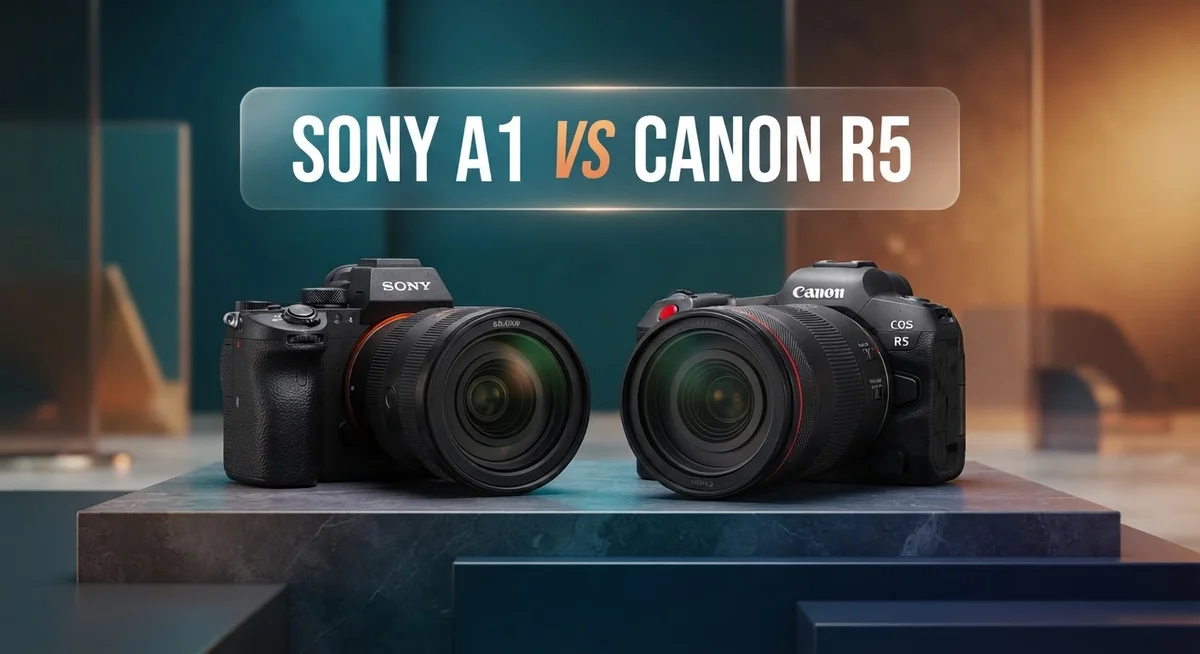
Choosing a camera can feel tricky. The Sony A1 and Canon R5 are two giants in the mirrorless world. Both cameras pack serious power for photographers and videographers.
The Sony A1 offers 50.1 MP resolution and a blazing 30 fps burst speed. It also brings advanced eye and bird autofocus tracking. This makes it a strong pick for wildlife and sports shooters.
The Canon R5 counters with 45 MP resolution and 20 fps burst speed. It shines with better high ISO performance and smart connectivity features like Ethernet and a digital hot shoe.
So which camera fits your needs best? This guide breaks down specs, strengths, and weaknesses side by side. You will find clear answers to help you decide.
Let’s dive into the details and see how these two cameras truly compare.
In a Nutshell
Here is a quick summary to help you decide fast.
-
The Sony A1 shines with superior bird and eye autofocus. It tracks fast moving subjects with ease.
-
The Canon R5 performs better in low light. It handles high ISO settings above 4000 smoothly.
-
File sizes differ too. The Canon R5 produces smaller files, making storage and transfer simpler.
-
Connectivity is a strong point for the R5. It offers a full HDMI port, Ethernet port, and a digital hot shoe.
-
For video creators, the Sony A1 supports both 8K and 4K recording. This gives you more flexibility on projects.
-
Wildlife and sports photographers may prefer the A1’s faster burst rate and tracking skills.
-
Studio and event photographers often like the R5’s connectivity options for tethered shooting.
-
Both cameras remain top choices in their class. Newer models like the Nikon Z9 and Canon R5 Mark II also compete closely.
Your final pick depends on your shooting style and priorities.
Sensor Resolution and Image Quality
Both cameras deliver outstanding image quality, but they take different approaches to resolution and sensor performance.
The Sony A1 leads with 50.1 megapixels. This higher resolution gives you more detail in every shot. You can crop images heavily in post production without losing sharpness. Large prints also benefit from the extra pixel count. The A1 uses Sony’s BIONZ XR processor to handle all this data quickly and efficiently.
The Canon R5 sits at 45 megapixels. While slightly lower, this resolution still captures tremendous detail for most shooting scenarios. The difference becomes noticeable mainly when you need extreme cropping or printing at very large sizes. For everyday work, the 5 MP gap rarely matters in real world situations.
Here’s where things get interesting. The Canon R5 actually performs better in high ISO situations. At ISO 4000 and above, the R5 produces cleaner images with less noise. This makes it superior for low light events, indoor sports, and night photography. The Sony A1 handles high ISO well too, but the R5 has a genuine advantage here.
File size tells another story. The A1 generates larger files due to its extra megapixels. This means you’ll need more storage space and faster memory cards. The R5 produces smaller files that are easier to manage and back up. Workflow speed improves when files are smaller.
Both sensors excel at color accuracy and dynamic range. You’ll capture beautiful skin tones, vibrant landscapes, and detailed shadows with either camera. The DIGIC X processor in the R5 and BIONZ XR in the A1 both produce punchy, accurate colors straight from the camera.
The key difference comes down to your priorities. Choose the A1 if you need maximum resolution and shoot frequently in good light. Pick the R5 if you work in challenging lighting or want cleaner high ISO results. Both cameras produce images that rival professional studio equipment. Your shooting conditions matter far more than the megapixel gap between them.

- Completely NEW Canon designed full-frame back-illuminated stacked CMOS 45MP sensor.
- Fast sensor read-out speeds allow for up to 30 fps electronic shutter performance.
Last update on 2026-11-08 / Affiliate links / Images from Amazon Product Advertising API
Autofocus and Burst Performance
The autofocus systems on these two cameras represent different philosophies. Sony’s A1 uses a superior bird and eye autofocus that tracks subjects with remarkable accuracy. This system excels when your subject moves unpredictably across the frame.
Canon’s R5 autofocus performs admirably for most situations. It locks onto faces and eyes reliably. However, it doesn’t match the A1’s specialized tracking for birds in flight or fast moving wildlife.
Burst performance shows a clear gap between these cameras. The Sony A1 fires at 30 frames per second, while the Canon R5 maxes out at 20 fps. That 10 fps difference matters significantly in sports and wildlife photography.
What does this mean practically? With the A1, you capture ten extra frames every second. More frames mean better odds of catching the perfect moment. Wildlife photographers hunting that decisive shot often prefer this speed advantage.
Buffer depth tells another story. Both cameras handle extended bursts well, but the R5’s smaller file sizes mean it can sustain shooting longer before the buffer fills. The A1 produces larger files, which can slow continuous shooting after several hundred frames.
For tracking moving subjects, the A1’s autofocus system stays locked on targets better. Its BIONZ XR processor analyzes movement patterns faster than Canon’s DIGIC X. This makes the A1 superior for unpredictable action.
The R5 doesn’t lag far behind for typical shooting scenarios. Event photographers, portrait shooters, and general sports coverage work fine with its 20 fps burst. You only feel the speed difference when shooting rapid sequences of erratic movement.
Your choice depends on your shooting needs. Fast action with unpredictable subjects? The A1 wins decisively. Controlled environments and standard event coverage? The R5 performs admirably.
Both cameras include continuous autofocus during burst shooting. Neither forces you to choose between speed and focus accuracy. The real question is how much speed and tracking precision you actually need for your work.
Video Capabilities and Connectivity
Both cameras excel at video recording, but they take different paths to get there. The Sony A1 captures 8K video at 24p and 4K at up to 120p, giving you massive creative flexibility. The Canon R5 focuses on 4K performance with up to 120p recording as well, making it excellent for slow motion work without the 8K option.
File management matters when you shoot video constantly. Sony’s 8K output creates substantial file sizes that demand fast storage and processing power. Canon’s approach keeps files more manageable while still delivering cinema quality footage.
Heat management shows real differences between these two cameras. The R5 includes active cooling technology, which helps during extended recording sessions. The A1 handles heat well but may throttle during very long takes in warm conditions.
Audio connectivity separates these cameras noticeably. The Canon R5 features a full size HDMI port and an Ethernet port, making it simpler to connect external recorders and tether to computers. The Sony A1 uses USB Type C, which requires adapters for some professional workflows.
Frame rate options give each camera distinct advantages. Sony’s 120p 4K mode matches Canon’s capability, but Sony adds 8K recording for future proofing your projects. Canon’s digital hot shoe and full HDMI connection make it friendlier for rigging multiple external devices.
Color science and codec performance matter for post production work. The Sony A1 offers S Log 3 gamma for maximum grading flexibility. The Canon R5 provides Canon Log for similar professional control, and many editors find Canon’s color rendering requires less correction out of the box.
Stabilization technology works differently on each body. Sony includes in body stabilization optimized for video work. Canon’s stabilization pairs well with RF mount lenses that include their own stabilization systems.
For livestreaming and remote work, the R5’s Ethernet connection gives you more stable connectivity options. The A1 handles streaming through USB, but requires additional setup.
Your choice depends on whether you prioritize 8K capability, connectivity options, or file size management. Both cameras deliver professional grade video quality that satisfies demanding creators.
Top 3 Alternatives
Nikon Z9

- 45.7MP Stacked CMOS sensor and EXPEED 7 image processing. Fast powerful AF that can keep up with the...
- Subject detection uses deep learning to automatically detect and track people, cats, dogs, birds...

Last update on 2026-11-08 / Affiliate links / Images from Amazon Product Advertising API
The Nikon Z9 stands as a powerful alternative for professionals who want exceptional autofocus and video capabilities. This camera delivers fast continuous shooting at high frame rates, making it ideal for sports and wildlife photography. The Z9 features a large, bright viewfinder that helps you frame shots accurately. Its weather-sealed body handles tough shooting conditions well.
The autofocus system tracks subjects with impressive accuracy. You get reliable performance in low light situations too. Video recording options include 8K capability, which appeals to content creators and filmmakers.
Canon EOS R3

- Canon USA Authorized. Items Include: Canon EOS R3 Mirrorless Camera – Full-Frame 24.1MP Stacked...
- Built for Speed & Precision: With 30fps burst shooting and a stacked sensor, the R3 captures fast...
Last update on 2026-11-08 / Affiliate links / Images from Amazon Product Advertising API
The Canon EOS R3 offers excellent balance between stills and video performance. This camera excels at autofocus tracking, especially for fast-moving subjects. The R3 includes a high-resolution sensor that captures fine details in your images.
Its ergonomic design feels comfortable during long shooting sessions. The camera body includes in-body image stabilization, reducing blur from hand movement. Canon’s lens ecosystem provides plenty of options for different photography styles. The R3 handles both professional photography and videography tasks effectively.
Sony A9 III

- World's First Full Frame Global Shutter: The Alpha 9 III features the world’s first full-frame...
- Blackout-free, 120fps Continuous Shooting: The Alpha 9 III is defined by speed and accuracy...
Last update on 2026-11-08 / Affiliate links / Images from Amazon Product Advertising API
The Sony A9 III brings cutting-edge technology to the mirrorless market. This camera features a global shutter, eliminating rolling shutter distortion completely. The autofocus system uses advanced algorithms to track subjects with remarkable precision.
You’ll appreciate the fast burst shooting speeds for capturing decisive moments. The A9 III’s compact size makes it easier to carry than some competitors. Sony’s extensive lens library offers flexibility for various shooting scenarios. The camera performs exceptionally well in demanding professional environments.
High-ISO Performance and File Management
High ISO performance separates these cameras in meaningful ways. The Canon R5 excels when light runs low. At ISO 4000 and beyond, the R5 produces cleaner files with less visible noise. This advantage matters for indoor events, concert photography, and low light portraits where shadow detail stays intact.
The Sony A1 handles high ISO differently. Its BIONZ XR processor applies aggressive noise reduction. Some photographers prefer this approach for fast shooting in dim conditions. Others notice the noise reduction softens fine details slightly. Your preference depends on whether you want maximum sharpness or minimum grain at extreme ISOs.
File management becomes critical here. The A1 generates larger files due to its 50.1 megapixel sensor. Shooting at high ISO means your storage fills faster. The R5’s smaller files (45 MP) take up less space. This matters when you shoot hundreds of frames during events or wildlife sessions.
Buffer performance changes the practical equation. The A1 clears its buffer faster between bursts. The R5 needs slightly longer to write files to your card. For rapid fire shooting, the A1 keeps pace better. For steady shooting workflows, both cameras perform admirably.
Noise characteristics differ between these sensors. The A1 shows fine grain patterns at high ISO. The R5 exhibits slightly coarser grain but with better color fidelity. Neither camera produces objectionable noise at working ISOs like 1600 or 3200.
Color accuracy stays strong in both cameras at high ISO. The R5 maintains slightly warmer tones. The A1 renders cooler, more neutral colors. Both preserve skin tones accurately during low light situations.
Your choice depends on your shooting environment. Choose the R5 if you frequently shoot in very dim light and want the cleanest possible files. Choose the A1 if you need speed and don’t mind managing larger file sizes. Both cameras deliver professional results in challenging light conditions.
Build Quality and Ergonomics
The Sony A1 and Canon R5 feel quite different in your hands, and that matters for long shooting sessions.
The Sony A1 weighs slightly more at around 738 grams. The Canon R5 comes in at 738 grams as well, so they’re nearly identical in weight. What changes the experience is how that weight distributes across the body. The A1 has a slightly larger grip, which suits photographers with bigger hands. The R5’s grip feels more compact and nimble for travel work.
Button layout tells an interesting story. The Canon R5 places controls where many photographers expect them, especially if you’ve used previous Canon models. The Sony A1 reorganizes buttons in ways that feel fresh but require adaptation. Both cameras offer customizable buttons, so you can arrange functions to match your shooting style.
Weather sealing protects both cameras from rain and dust. Both feature magnesium alloy bodies that resist dents and scratches. The A1 uses a slightly different material composition that some users report feels more premium. The R5’s construction feels equally solid and durable for professional use.
Viewfinder experience differs between these two. The Sony A1 includes a higher resolution electronic viewfinder at 9.44 million dots. The Canon R5 offers 5.76 million dots in its optical viewfinder with electronic overlay. The A1’s electronic viewfinder shows real time exposure preview, while the R5’s optical path feels more traditional. Your preference here depends on whether you want live information or optical clarity.
The LCD screens both measure 3.2 inches and flip out for flexibility. The A1’s screen tilts and rotates fully. The R5’s screen tilts upward only. For video work and low angle shooting, the A1 gives you more positioning options.
Battery life differs meaningfully. The A1 manages around 530 shots per charge. The R5 reaches approximately 490 shots. Real world usage shows both cameras need backup batteries for full day shoots. The A1’s larger battery capacity reflects its more power intensive processor and faster burst rate.
Ergonomic comfort comes down to personal preference and hand size. Try both cameras before deciding.
Pros and Cons
Pros
- Sony A1 captures 50.1 megapixels versus Canon R5’s 45 megapixels for sharper detail in large prints
- Sony A1 shoots at 30 fps burst mode, giving you 10 extra frames per second compared to the R5’s 20 fps
- Canon R5 delivers superior performance at ISO 4000 and higher for low light work
- Canon R5 produces smaller file sizes, making storage and backup less demanding
- Canon R5 includes full HDMI, Ethernet port, and digital hot shoe for expanded connectivity
Cons
- Sony A1 generates much larger files that demand more storage space and faster memory cards
- Canon R5 captures only 45 megapixels, which limits cropping flexibility in post production
- Canon R5 maxes out at 20 fps, making it slower for fast action sequences
- Sony A1 sits at a higher price tier than the R5
Who Should Buy It
The Sony A1 works best for professionals who shoot fast action and need maximum resolution. Wildlife photographers benefit from the 30 fps burst rate and 50.1 MP sensor. Sports shooters love the extra 10 frames per second over the R5. You get sharper detail when cropping images in post production because of the higher megapixel count.
The Canon R5 suits photographers who work in low light conditions regularly. If you shoot at ISO 4000 and above, the R5 delivers cleaner images with less noise. Video professionals appreciate the full HDMI and Ethernet port for livestreaming and remote work. The digital hot shoe expands your connectivity options for external devices.
Choose the Sony A1 if you prioritize speed and resolution. Studio photographers who need flexibility in cropping benefit from the extra megapixels. Documentary filmmakers appreciate the 8K video capability for future proofing your footage. You’ll need fast memory cards and substantial storage space because files are significantly larger.
Pick the Canon R5 if you want a streamlined workflow. The smaller file sizes make backup and storage management simpler. Content creators benefit from the Ethernet connection for stable remote broadcasting. You get excellent image quality without managing massive file libraries.
The Sony A1 appeals to photographers who shoot multiple formats. If you need 8K video alongside high speed stills, this camera handles both excellently. You work best with reliable infrastructure for managing large files. Your priority is capturing every moment at maximum speed.
The Canon R5 fits photographers who value practical connectivity and real world performance. Hybrid creators who shoot video and stills appreciate the HDMI and Ethernet options. You prefer spending less time managing storage and more time shooting. Low light environments are your typical workspace.
Consider your actual shooting scenarios. Do you work mostly in bright daylight or dim conditions? Do you need 8K video or is 4K sufficient? Will you livestream regularly? Your answers point directly toward the right camera for your needs.
Final Verdict
The Sony A1 and Canon R5 both stand out as top tier cameras. Your final decision comes down to what you shoot most often.
Wildlife and sports shooters often lean toward the Sony A1. Its tracking system locks onto fast subjects with impressive accuracy.
Portrait and event photographers often find the Canon R5 easier to integrate into existing setups. Canon’s lens lineup feels familiar to many longtime users.
Video creators should think about their deliverables. The Sony A1 handles demanding video specs well. The Canon R5 still produces excellent footage for most projects without extra complexity.
Think about your future plans too. If you plan to expand into remote shooting or tethered setups, the Canon R5 offers helpful tools for that path.
If you want a camera that adapts across genres like sports, wildlife, and studio work, the Sony A1 gives you that flexibility in one body.
Neither camera disappoints. Both cameras deliver sharp images and reliable autofocus. The real difference lies in how each system fits your daily workflow.
Ask yourself what frustrates you most in your current setup. If storage and file management slow you down, the R5 solves that problem well.
If you constantly miss shots due to slow burst speeds, the A1 fixes that issue directly. Match the camera to your actual pain points, not just the spec sheet.
Some photographers even keep both systems for different jobs. This is common among professionals who shoot varied assignments throughout the year.
Your creative goals matter more than brand loyalty here. Test both cameras if you can before committing.
Rent them for a weekend shoot. Handle both bodies in real conditions similar to your typical work.
In the end, both the Sony A1 and Canon R5 represent excellent choices for serious photographers. Pick the one that matches your specific shooting style and long term creative direction.
Frequently Asked Questions
Which camera handles fast action better?
The Sony A1 captures 30 frames per second in burst mode. The Canon R5 shoots at 20 fps. That extra 10 fps means you catch more moments during rapid sequences. Sports and wildlife photographers often prefer the A1 for this reason alone.
Does the Canon R5 work well in low light?
Yes. The Canon R5 delivers superior performance at ISO 4000 and beyond. You can shoot in dim conditions without losing image quality. The R5 handles shadows and indoor events with confidence.
The Sony A1 also performs well in low light, but the R5 has a slight edge in this specific area.
Which camera produces smaller files?
The Canon R5 creates smaller file sizes overall. This matters when you shoot hundreds of images daily. Smaller files mean less storage space needed and faster backup times.
The Sony A1 generates much larger files due to its higher resolution and 8K capability. You’ll need faster memory cards and more hard drive space.
Should I choose the A1 if I crop photos heavily?
The Sony A1 gives you more cropping flexibility. With 50.1 megapixels, you can enlarge and crop without losing detail. The Canon R5 has 45 megapixels, which limits how much you can crop and still maintain sharpness.
If your workflow involves significant cropping, the A1 provides more breathing room.
What if I need video capabilities?
The Sony A1 shoots 8K video natively. The Canon R5 focuses on 4K performance. Think about your actual deliverables. Most projects use 4K or 1080p. The A1 makes sense only if you genuinely need 8K output.

Dillip is the founder and editor of Switch & Size, where he breaks down tech products, accessories, and gadgets to help readers make smarter buying decisions. With a passion for testing and comparing the latest technology, he delivers honest reviews, in-depth guides, and side-by-side comparisons that cut through the marketing noise.