
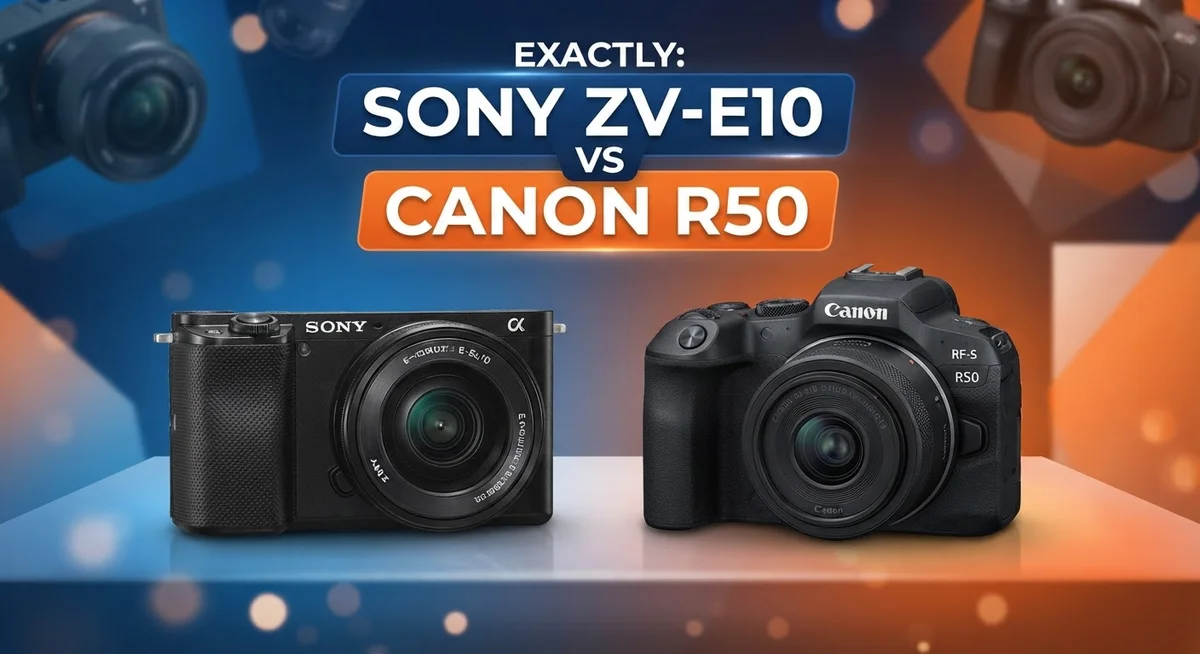
Sony ZV-E10 vs Canon R50: Mirrorless Camera Comparison Guide
Picking a camera feels tricky. You want great video. You also want sharp photos. The Sony ZV-E10 and Canon R50 both promise a lot.
These two cameras attract different creators. The ZV-E10 shines for vlogging and quick clips. The R50 gives you more control for photography.
Both cameras use APS-C sensors. Both stay light and easy to carry. But their designs serve different goals.
This guide breaks down real differences. We look at autofocus, video quality, and handling. We also check what each camera lacks.
By the end, you will know which camera fits your style. Whether you shoot vlogs or portraits, this comparison helps you choose with confidence.
In a Nutshell
Here is a quick snapshot of both cameras. Use this list to spot the key differences fast.
-
The Sony ZV-E10 skips a viewfinder. It focuses fully on video creators and vloggers.
-
The Canon R50 includes an electronic viewfinder. This makes it more flexible for photography and video work.
-
Autofocus favors the R50. It tracks humans, animals, and birds with great accuracy.
-
The ZV-E10 wins on audio. Its internal microphone sounds clearer for solo talking videos.
-
Body design differs too. The ZV-E10 stays light and pocket friendly. The R50 feels a bit more balanced for photo shoots.
-
Watch for the R50 flash hotshoe. Some users report it feels fragile over time.
-
Consider the newer Canon R50 V. It brings 10-bit HLG video support for richer color grading.
-
Think about your main goal. Pick the ZV-E10 for pure vlogging. Pick the R50 for a mix of photos and video.
This simple comparison helps you match each camera to your creative needs.
Sensor and Image Quality
The sensor and image quality tell an interesting story for these two cameras. Both use APS-C sensors, which means they capture similar detail and color information. However, how they process that information differs quite a bit.
The Sony ZV-E10 produces sharp images with warm, pleasing colors. Its sensor excels at capturing skin tones, which matters if you film yourself or interview people. The camera processes video footage smoothly, even in tricky lighting situations. You get natural-looking results without heavy editing.
The Canon R50 delivers excellent image quality for both photos and videos. Its sensor handles highlights better, meaning bright areas stay detailed instead of washing out. The R50 also captures more shadow detail, giving you extra flexibility during editing. This makes the R50 better suited for mixed shooting where you need both photography and videography.
One key difference shows up in autofocus performance. The R50’s autofocus recognizes human faces, animals, and birds with impressive accuracy. This keeps subjects sharp automatically, even when they move. The ZV-E10’s autofocus works well for stationary subjects but struggles when people move around the frame.
Video quality leans toward the ZV-E10 for vlogging purposes. The camera stabilizes footage internally, reducing shake from handheld shooting. Colors appear vibrant and consistent frame to frame. If you film yourself talking to the camera, the ZV-E10 handles this task excellently.
For photography, the R50 edges ahead. Its sensor captures more dynamic range, meaning you preserve detail in both bright and dark areas of your photo. This gives you more room to adjust exposure during editing. The R50 also offers better color accuracy for professional work.
The Canon R50 V model adds 10-bit HLG video capability. This means even more color information gets recorded, which helps if you grade footage heavily. The standard R50 uses 8-bit recording, which is still very good but offers less flexibility.
Choose the ZV-E10 if video vlogging is your main focus. Pick the R50 if you split time between photography and videography. Both deliver excellent image quality for their intended purposes.

- 24.2MP APS-C Exmor CMOS Sensor and fast BIONZ X processor
- 4K Movie oversampled from 6k w/ full pixel readout, no pixel binning

Last update on 2026-11-09 / Affiliate links / Images from Amazon Product Advertising API
Video Capabilities and Recording Features
The ZV-E10 and R50 handle video recording in very different ways. Sony built the ZV-E10 specifically for content creators who film themselves. Canon designed the R50 as a more balanced camera for both video and photography work.
Recording formats differ between these cameras. The ZV-E10 captures video at up to 4K resolution with solid frame rates. The R50 also shoots 4K video, but the newer R50 V model adds 10-bit HLG capability. This means the R50 V gives you more color information and better grading options in post-production.
Audio quality matters hugely for vlogging. The ZV-E10 features a directional microphone built into the camera body. This mic picks up your voice clearly while reducing background noise. The R50 relies on its standard microphone setup, which works fine but doesn’t compare to the ZV-E10’s audio advantage.
Stabilization features help smooth out shaky footage. Both cameras offer in-body stabilization. The ZV-E10 provides electronic stabilization that works well for handheld vlogging. The R50 also includes stabilization, making both options solid for video work.
Autofocus performance shows another key difference. The R50 recognizes human faces, animals, and birds automatically. This keeps you sharp during recording, even when you move around. The ZV-E10 focuses on faces effectively, but the R50’s system feels more advanced overall.
Connectivity options expand your recording possibilities. The ZV-E10 offers USB-C for external recording and power delivery. The R50 includes USB-C as well, so both cameras support external recorders. This matters if you want to capture uncompressed video or use professional workflows.
The ZV-E10 wins for pure vlogging thanks to its audio mic and portable design. The R50 works better if you split time between video and photography. The R50 V becomes the stronger choice if you need 10-bit color capability for serious color grading.
Autofocus System and Subject Tracking
The autofocus system separates these two cameras in meaningful ways. The Canon R50 delivers superior autofocus performance with its ability to recognize and track humans, animals, and birds automatically. This makes it excellent for photographers who shoot diverse subjects without constant manual adjustments.
The Sony ZV-E10 offers basic autofocus that works well for stationary subjects and general video work. However, it lacks the advanced subject recognition features found on the R50. For vloggers filming themselves, this limitation rarely matters since you stay relatively still during recording.
Subject tracking differs significantly between the two models. The R50’s autofocus system locks onto moving subjects with impressive accuracy. It maintains focus even when your subject moves across the frame or changes distance. This capability shines during wildlife photography, sports events, or dynamic video shoots.
The ZV-E10 uses contrast detection autofocus that performs adequately for video. It focuses reliably on stationary faces and objects. However, tracking fast moving subjects becomes more challenging. The camera sometimes hunts for focus or loses lock during rapid motion.
For real world use, the R50 proves more versatile across different shooting scenarios. Photographers appreciate the intelligent subject detection when capturing unpredictable moments. The system reduces the need to manually select focus points constantly.
Vloggers using the ZV-E10 find the autofocus sufficient for their typical workflow. You frame yourself in the shot, lock focus, and record. The camera maintains focus throughout your monologue or demonstration. This simplicity actually suits the vlogging purpose well.
Eye autofocus performance also differs. The R50 tracks eyes with precision on both humans and animals. The ZV-E10 offers basic eye detection but with less sophistication. This matters most for portrait photographers seeking razor sharp results.
If autofocus versatility matters to you, the R50 wins decisively. Choose the ZV-E10 when your subjects remain relatively still and you prioritize portability and audio quality over advanced focus tracking.
Top 3 Alternatives
Fujifilm X-S20

- FUJIFILM X-S20 Mirrorless Camera with XC 15-45mm f/3.5-5.6 OIS PZ Lens (USA Warranty) 16781943
- SanDisk 128GB SDXC Extreme PRO Memory Card, Vivitar Memory Card Wallet, SD Card Reader
Last update on 2026-10-12 / Affiliate links / Images from Amazon Product Advertising API
The Fujifilm X-S20 offers excellent video performance for content creators. This camera delivers smooth autofocus tracking and natural color rendering. You get compact size with professional features. The film simulation modes help you achieve unique looks without heavy editing. Battery life performs well during long shooting sessions.
The X-S20 handles low light situations better than many competitors. Its sensor captures fine details and maintains color accuracy. Vlogging becomes easier with the flip screen and built-in microphone support. You’ll appreciate the intuitive menu system.
Nikon Z30

- Designed for creators, vloggers and streamers: Nikon's easy to use Z 30 mirrorless 4K camera with a...
- Pro-grade video quality: Crisp 4K resolution, autofocus with eye tracking for people and pets...
Last update on 2026-11-09 / Affiliate links / Images from Amazon Product Advertising API
The Nikon Z30 focuses specifically on vlogging and content creation. This camera features excellent autofocus that keeps you sharp while moving. The compact body fits easily in bags or backpacks. Nikon’s color science produces pleasing skin tones naturally.
Battery life extends longer than similar models. The flip screen angles perfectly for selfie shooting. Audio input options let you connect external microphones for better sound quality. The camera handles 4K recording smoothly. You get reliable performance in various lighting conditions.
Panasonic Lumix S5II

- Enhanced Imaging Power: The Panasonic Lumix S5II Mirrorless Camera is tailor-made for discerning...
- Cinematic Video Excellence: Elevate your filmmaking with the Lumix S5 II's impressive video...
Last update on 2026-10-07 / Affiliate links / Images from Amazon Product Advertising API
The Panasonic Lumix S5II represents a full-frame option for serious creators. This camera provides exceptional image quality and low-light capability. You gain access to extensive lens options through the L-mount alliance. Video features include high bitrate recording options.
The larger sensor captures more light information. This means cleaner footage in dimly lit environments. The S5II handles color grading beautifully in post-production. Weather sealing protects your investment during outdoor shoots. You’ll find this camera grows with your skills over time.
Viewfinder, Display, and Ergonomics
The viewfinder and display setup creates a fundamental difference between these two cameras. The Sony ZV-E10 lacks a viewfinder entirely, relying solely on its rear LCD screen for framing shots. This design choice keeps the camera compact and lightweight, perfect for vloggers who move around frequently.
The Canon R50 includes an electronic viewfinder, giving you a second way to compose images. Many photographers prefer using the viewfinder because it reduces screen glare in bright sunlight and feels more natural to their eye. The viewfinder also conserves battery power compared to constant LCD screen use.
Both cameras feature flip-out rear screens that rotate for flexible shooting angles. The ZV-E10’s screen tilts upward, making it easy to frame yourself while recording vlogs. The R50’s screen also provides similar flexibility for selfie recording and low-angle shots. The LCD panels on both cameras deliver clear, vibrant images for reviewing your work.
Ergonomics differ noticeably between these two models. The ZV-E10 feels lighter and more portable due to its compact body and absent viewfinder. You’ll appreciate this when holding the camera for extended vlogging sessions. The R50 adds a side-mounted tripod socket, which the ZV-E10 doesn’t include. This socket makes it simpler to attach the R50 to stabilizers and rigs without awkward adapters.
Grip comfort favors the R50 slightly. Its larger body provides more space for your fingers, reducing hand fatigue during long shoots. The ZV-E10’s smaller frame works well for people with smaller hands or those prioritizing portability over extended comfort.
The R50 V variant maintains the same viewfinder and display setup, so these ergonomic differences remain consistent across the R50 lineup. If you frequently shoot in bright conditions or prefer traditional framing methods, the R50’s viewfinder becomes a significant advantage. For vloggers who move constantly and prioritize lightweight gear, the ZV-E10’s streamlined design makes more sense overall.
Audio Quality and Microphone Performance
The Sony ZV-E10 shines when it comes to audio capture. This camera features a built-in microphone that’s specifically optimized for voice recording. Vloggers appreciate the directional mic that picks up your voice clearly while reducing background noise.
The Canon R50 uses a standard omnidirectional microphone. It captures sound from all directions equally, which works fine for general recording but lacks the voice-focused design of the ZV-E10. If you speak directly to the camera, you’ll notice the Sony handles your audio better.
Both cameras let you connect external microphones through their audio inputs. This opens up serious possibilities for content creators who want professional sound. You can attach a wireless lavalier mic or a shotgun mic to either camera. The external mic option levels the playing field considerably for serious audio work.
The ZV-E10 includes a headphone jack for monitoring audio while you record. This lets you hear exactly what the microphone captures in real time. The R50 also has a headphone jack, so both cameras support this essential feature.
Wind noise becomes a real problem when filming outdoors. The ZV-E10’s directional microphone handles wind better than the R50’s omnidirectional setup. If you record outside frequently, the Sony gives you cleaner audio straight out of the box.
Recording levels matter too. The ZV-E10 offers automatic audio level control that adjusts to your voice volume. This prevents audio from getting too loud or too quiet. The R50 provides manual control over audio levels, which gives you more power but requires more attention during recording.
For vlogging specifically, the ZV-E10 wins this round. Its microphone design matches what content creators actually need. The R50 works fine for general use, but it doesn’t prioritize voice recording the way the Sony does.
If professional audio quality matters to you, external microphones are your best bet with either camera. However, the ZV-E10 starts with a significant advantage right out of the box.
Pros and Cons
Pros
- ZV-E10 excels at vlogging with its directional microphone that captures clear voice and reduces background noise
- ZV-E10 fits easily in bags and backpacks due to its compact, lightweight frame without a viewfinder
- R50 recognizes human faces, animals, and birds automatically for faster, more accurate focusing during photo sessions
- R50 includes an electronic viewfinder so you can frame shots like traditional cameras
- R50 performs better for general photography work across different lighting conditions and subject types
Cons
- ZV-E10 lacks a viewfinder, forcing you to rely only on the rear screen for composition
- ZV-E10 offers basic autofocus that struggles with moving subjects and complex scenes
- R50 has a problematic flash hotshoe that users report as unreliable or poorly designed
- R50 uses a standard omnidirectional microphone that picks up unwanted background noise during video recording
Who Should Buy It
The Sony ZV-E10 suits you best if vlogging and content creation drive your camera choice. This camera prioritizes your voice and movement. You get a directional microphone that captures clean audio. The compact body fits into bags without bulk. You can film yourself talking to the camera with ease. The flip-out screen rotates for self-filming angles.
The Canon R50 works better if photography matters more than video. You get an electronic viewfinder for traditional framing. The autofocus system recognizes human faces, animals, and birds automatically. This means faster, sharper shots in real situations. The R50 handles different lighting conditions with better performance overall.
Choose the ZV-E10 when your subjects stay relatively still or when you film yourself speaking. The camera excels at capturing your voice clearly without background noise interference. External microphone support lets you upgrade audio quality whenever you need it. The lightweight design means you can carry it all day without fatigue.
Pick the R50 if you shoot mixed content or primarily photographs. The viewfinder changes how you compose images. You frame shots like traditional cameras instead of relying only on the rear screen. The autofocus speed matters when subjects move unpredictably. Animals, birds, and people get tracked more reliably.
Consider the R50 V if you want advanced video features. This variant adds 10-bit HLG video capability for professionals. You still get the viewfinder and improved autofocus. The upgrade suits filmmakers who need color grading flexibility.
The ZV-E10 appeals to travel vloggers and solo content creators. Portability and audio quality rank highest for your needs. You don’t need a viewfinder since you’re filming yourself or stationary subjects.
The R50 appeals to hybrid shooters and photography enthusiasts. You need reliable autofocus and composition tools. The viewfinder gives you confidence when framing shots. Animal and bird recognition helps you capture wildlife moments faster.
Your shooting style determines the winner here. Ask yourself if you film yourself more, or if you photograph other subjects. That single question answers which camera suits you better.
Final Verdict
Your final choice comes down to one simple question: what do you shoot most?
The Sony ZV-E10 stands out as a vlogging tool. It packs a faster sensor and a body built for creators who talk to the camera.
If you post videos, run a YouTube channel, or film yourself often, this camera fits your workflow. It handles fast-moving content creation with ease.
The Canon R50 takes a different path. It acts as a true hybrid camera that handles both stills and video with confidence.
Its smart autofocus system makes it a strong pick for anyone who shoots people, pets, or wildlife. The viewfinder adds a layer of control that many photographers still prefer.
Think about your next twelve months of shooting. Will you film mostly talking head videos and social clips? Or will you shoot a mix of portraits, events, and casual video?
Neither camera is a bad pick. Both cameras serve different creators well. Your answer depends on your actual shooting habits, not just specs on paper.
If you already lean toward video projects and solo content, the ZV-E10 makes sense. Its design removes friction for people who talk directly to the lens.
If you want one camera that handles family photos, travel shots, and occasional video, the R50 offers more balance. Its autofocus and viewfinder give you more control across situations.
Some buyers may also want to check the R50 V if advanced video features matter more. Others might prefer exploring the Sony a6400 or Nikon Z50 II for extra options.
Test both cameras if you can. Handling a camera before buying helps you understand what feels natural to your hands and shooting style.
In the end, your content type should guide your decision. Match the camera to your habits, not the other way around.
Frequently Asked Questions
Can I use the ZV-E10 for photography, or is it only for video?
The ZV-E10 handles photography well, but it’s not its main strength. The camera captures sharp images with good color accuracy. However, its autofocus system lacks the smart subject recognition that the R50 offers. You’ll find manual focus more useful for photo work on the ZV-E10.
If photography matters equally to video in your projects, the R50 becomes the smarter choice. The ZV-E10 works best when video content takes priority.
Which camera has better autofocus for moving subjects?
The Canon R50 wins here. Its autofocus system recognizes human faces, animals, and birds automatically. This makes tracking moving subjects faster and more reliable during photo sessions.
The ZV-E10’s autofocus performs adequately for stationary subjects or when you’re filming yourself speaking. It struggles with fast-moving targets or complex scenes. If your subjects move unpredictably, the R50’s tracking system gives you confidence.
Do I need the viewfinder on the R50, or can I just use the screen?
You don’t need the viewfinder, but many photographers prefer it. The R50’s electronic viewfinder lets you frame shots like traditional cameras. It also reduces glare in bright sunlight and steadies your framing.
The ZV-E10 relies only on the rear screen for composition. This works fine outdoors and for vlogging. Some creators actually prefer screens for self-filming because you see yourself clearly.
Should I buy the R50 V instead of the standard R50?
The R50 V adds 10-bit HLG video capability for advanced color grading. Choose it if you edit video professionally or need cinema-grade footage. Otherwise, the standard R50 handles most content creation needs perfectly well.

Dillip is the founder and editor of Switch & Size, where he breaks down tech products, accessories, and gadgets to help readers make smarter buying decisions. With a passion for testing and comparing the latest technology, he delivers honest reviews, in-depth guides, and side-by-side comparisons that cut through the marketing noise.


