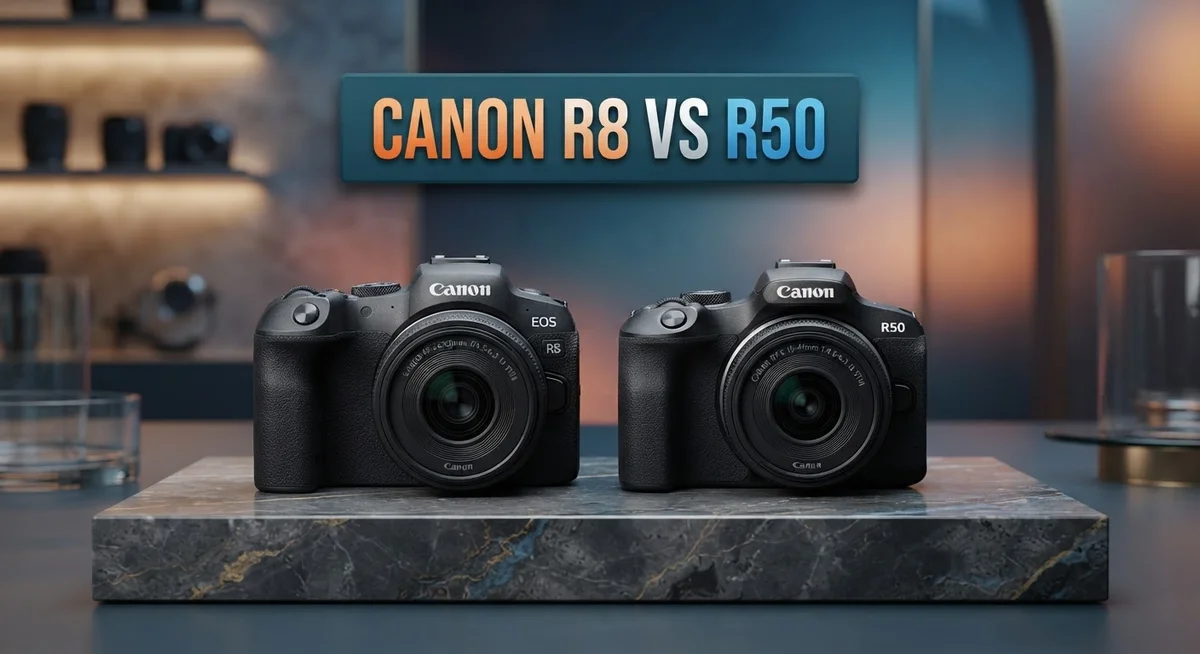
Canon R8 vs R50: Full-Frame vs APS-C Mirrorless Camera Comparison
Picking a new camera can feel tricky. The Canon R8 and Canon R50 both stand out as great choices. But they serve different needs.
The R8 brings a full frame sensor into a light body. It gives you fast shooting speeds and strong autofocus. This makes it a solid pick for creators who want pro level results.
The R50 takes a different path. It uses an APS-C sensor and focuses on simplicity. Beginners often love its touchscreen and easy handling.
So which one fits you best? That depends on your goals. Do you want full frame power or a beginner friendly setup?
In this guide, we break down specs, pros, cons, and competitors. You will see how the R8 and R50 compare in real world use. By the end, you will know exactly which Canon camera suits your style.
In a Nutshell
-
The R8 packs a full frame sensor for richer detail and smoother low light shots.
-
The R50 relies on an APS-C sensor, making it a fun pick for casual shooting and travel.
-
Autofocus on the R8 feels sharper. It tracks moving subjects with ease.
-
The R50 offers a simple, responsive touchscreen. New shooters will find it easy to learn.
-
Burst speed favors the R8, reaching 40 fps with the electronic shutter.
-
Neither camera has in-body stabilization. This means lens choice matters a lot for steady shots.
-
The R50 stays light and pocket friendly. It suits daily carry and quick trips.
-
The R8 appeals to photographers who want full frame results without extra bulk.
-
Both cameras share Canon’s RF mount, so lens options grow as your skills grow.
-
Pick the R8 for image quality and speed. Pick the R50 for simplicity and portability.
Sensor and Image Quality
The sensor you choose shapes every photo you take. Let’s see how these two cameras compare.
The R8 uses a full frame sensor. This means the light hitting the sensor spreads across a larger area. You get richer colors, smoother gradients, and cleaner shots in dim light. Full frame sensors excel when you push ISO higher or shoot in shadows.
The R50 uses an APS-C sensor. It’s smaller than full frame, which means less light reaches the sensor in the same conditions. However, APS-C sensors still deliver sharp, detailed images for everyday photography and social media sharing.
Low light performance differs between them. The R8 handles high ISO values with less visible noise. If you shoot events, portraits indoors, or work during golden hour, the R8 gives you more flexibility. The R50 performs well in daylight and bright conditions. You may need to boost ISO more in darker scenes, but the results stay usable for most projects.
Dynamic range tells another story. The R8 captures more tonal information. Skies stay detailed, shadows hold texture, and highlights don’t blow out as easily. This matters when you edit photos later. The R50 captures good dynamic range for an entry level camera, though the full frame advantage shows in tricky lighting.
Color science feels similar on both cameras. Canon’s image processing delivers warm, pleasing tones. The difference comes down to sensor size and processing power. The R8’s larger sensor gathers more color information per pixel.
Autofocus performance links directly to sensor quality. The R8’s full frame sensor supports more autofocus points and faster tracking. The R50 has solid autofocus for its class, but the R8 feels snappier when subjects move quickly.
For image quality, the R8 pulls ahead. Full frame sensors simply capture more light and detail. But the R50 still produces excellent images. Your skill level and shooting style matter more than sensor size when you’re starting out. Both cameras let you grow your skills without hitting a wall.

- Includes Versatile 18–45mm Lens: Covering wide to standard focal lengths, this compact zoom lens...
- Oversampled 4K with Dual Pixel AF: Enjoy sharp, smooth footage with reliable subject tracking...
Last update on 2026-11-09 / Affiliate links / Images from Amazon Product Advertising API
Autofocus and Shooting Performance
The autofocus systems on these cameras work differently because of their sensor sizes. The R8 uses 1053 autofocus points across its full frame sensor. The R50 uses 651 autofocus points on its smaller APS-C frame.
Real world shooting feels different between them. The R8’s autofocus tracks moving subjects with greater precision. The R50 still performs well for everyday photography, but the R8 edges ahead for fast action.
Eye detection works on both cameras. The R8 catches eyes faster and holds focus more reliably during quick movements. The R50 handles portrait work fine, yet the R8’s full frame advantage shows when subjects move unpredictably.
Continuous shooting speed matters for sports and wildlife. The R8 fires at 40 frames per second using its electronic shutter. The R50 maxes out at a slower rate, making the R8 the better choice for rapid sequences. If you shoot events or wildlife, this difference adds up quickly.
The mechanical shutter changes things slightly. The R8 drops to 6 fps with its mechanical shutter. The R50 also uses a mechanical shutter with more modest speeds. Neither camera feels slow for most work, but electronic shutter speed separates them clearly.
Autofocus speed under low light reveals another gap. The R8 locks focus faster in dim conditions. The R50 can struggle when light drops, especially with slower lenses. For indoor events or evening shoots, the R8 performs noticeably better.
Subject tracking technology favors the R8. Its full frame sensor and advanced autofocus system keep focus locked on moving subjects more consistently. The R50 works fine for stationary subjects and slower movements.
The R8 wins for autofocus and shooting performance. Its full frame sensor, higher autofocus point count, and faster burst speed create a clear advantage for demanding situations. The R50 handles everyday shooting smoothly and remains responsive for casual photographers.
Choose the R8 if you need speed and accuracy. Pick the R50 if you shoot slower, planned moments and value simplicity.
Design, Portability, and Ergonomics
The body design of each camera reflects its intended use. The R8 fits full frame power into a compact frame, weighing just over 700 grams with the battery. The R50 goes even smaller, making it ideal for photographers who travel light or shoot for hours without fatigue.
Hold the R8 and you notice the grip depth. Your fingers wrap around the body comfortably, even with larger lenses attached. The button layout follows Canon’s familiar pattern, so switching from other models feels natural. The R50 takes a different approach with a shallower grip, which some hands find less secure but others prefer for its minimal footprint.
Portability matters when you’re on the move. The R50 slips into a small bag or large jacket pocket without any fuss. The R8 requires a bit more space, though it still beats many full frame cameras. Battery life differs too. The R8 uses a larger battery that lasts longer per charge, while the R50 drains faster due to its smaller power cell. Bring a spare battery for either camera if you shoot all day.
The viewfinder placement on the R50 sits higher than the R8. This means less neck strain when you compose shots, especially during long sessions. The R8’s viewfinder sits slightly lower, though the difference is subtle. Both cameras feature electronic viewfinders with smooth refresh rates and clear magnification.
Weather sealing tells another story. The R8 includes dust and water resistance, protecting your investment during outdoor shoots. The R50 lacks this protection, so you’ll want to keep it dry and clean. This matters if you shoot in rain, snow, or dusty environments.
Button placement on the R50 feels more spread out, giving your thumb room to breathe. The R8 concentrates controls in a tighter space, which some photographers find more efficient. The touchscreen on the R50 responds quickly and feels responsive to your touch, while the R8 includes a touch-sensitive back for menu navigation.
Both cameras balance weight and function well. Your choice depends on how much gear you want to carry and what conditions you’ll face.
Top 3 Alternatives
Sony A6700

- 26.0MP APS-C format Exmor R back-illuminated CMOS sensor
- BIONZ XR processing power for exceptional image quality

Last update on 2026-11-09 / Affiliate links / Images from Amazon Product Advertising API
The Sony A6700 offers excellent autofocus performance with real-time tracking. This camera excels at capturing fast-moving subjects. It features a 26-megapixel sensor that delivers sharp, detailed images in various lighting conditions.
The compact design makes it easy to carry on shoots. You get reliable battery life for full days of shooting. The camera’s menu system takes time to learn, but once you master it, workflow becomes smooth.
Nikon Z6III

- Bundle Includes: Nikon Z6 III Mirrorless Camera with 24-120mm lens + Camera Bag + 128GB Memory Card
- 24.5MP PARTIALLY STACKED FULL FRAME SENSOR: The Nikon Z6 III features a newly developed 24.5MP...
Last update on 2026-11-09 / Affiliate links / Images from Amazon Product Advertising API
The Nikon Z6III brings professional-grade performance in a manageable package. This full-frame camera captures stunning video and stills. It includes in-body stabilization, which reduces blur from camera shake.
The autofocus system locks onto subjects quickly and accurately. Battery performance is solid, lasting through extended sessions. The Z6III feels comfortable to hold and use for hours. Its weather sealing protects against dust and moisture during outdoor work.
Fujifilm X-T5

- 40.2 Megapixel X-Trans CMOS 5 HR BSI Imaging Sensor
- 15 Frames per second in Mechanical Shutter
Last update on 2026-11-09 / Affiliate links / Images from Amazon Product Advertising API
The Fujifilm X-T5 combines retro design with modern capabilities. This camera appeals to photographers who value tactile controls and film simulations. The 40-megapixel sensor produces incredibly detailed images.
Color rendering is exceptional straight from the camera. You’ll spend less time editing photos thanks to Fujifilm’s film presets. The X-T5 handles low-light situations remarkably well. Its compact size makes it perfect for travel photography. The build quality feels premium, with a satisfying mechanical shutter button.
Each option serves different photographer needs. The Sony excels in speed and autofocus. The Nikon delivers full-frame versatility. The Fujifilm offers unique aesthetics and in-camera processing. Your choice depends on your shooting style and priorities.
Stabilization and Battery Life
The R8 lacks in-body image stabilization (IBIS), which means you rely on lens-based stabilization or a tripod for smooth video and sharp stills in low light. The R50 also skips IBIS, so both cameras sit in the same boat here. If you shoot handheld often, consider RF mount lenses with built-in stabilization.
Battery life separates these two cameras more clearly. The R8 uses a smaller battery pack designed for its compact full-frame body. You’ll get roughly 320 shots per charge under normal conditions. The R50 stretches further, delivering around 370 shots per single charge thanks to its smaller sensor and lower power demands.
Real world shooting tells a different story. The R8’s full-frame sensor draws more energy when processing images at high speeds. Shooting 40 fps bursts drains the battery faster than the R50’s continuous mode. If you shoot video, both cameras drain batteries quicker than stills mode.
Carry extra batteries for both cameras. Neither option lasts a full day of heavy shooting without a backup. The R50’s advantage shrinks during demanding sessions. The R8’s advantage grows when you pair it with high-speed shooting.
For stabilization, lens choice matters more than the camera body. Canon’s RF lenses with optical stabilization work on both. The R8 pairs well with premium lenses that include stabilization. The R50 works fine with entry-level RF lenses too.
Travel photographers appreciate the R50’s slightly longer battery life. Sports shooters accept the R8’s battery drain as a trade off for speed and full-frame image quality. Video creators on either camera should plan for multiple batteries regardless.
The stabilization story stays the same for both. Battery life favors the R50 by a modest margin. Your shooting style determines which battery performance matters more to your workflow.
Lens Ecosystem and Compatibility
The lens ecosystem sits at the heart of your camera choice. Canon’s RF mount serves both the R8 and R50, which means they share access to the same lens library. This compatibility opens doors for both shooters, though the practical experience differs.
The R8 works with the full Canon RF lens collection without any crop considerations. You get true wide angles and genuine telephoto reach. The R50 uses the same lenses but applies a 1.6x crop factor. A 50mm lens becomes 80mm on the R50, which affects your framing and composition planning.
Canon offers several RF lenses optimized for APS-C shooting. These compact options work beautifully on the R50 and keep your kit lightweight. The R8 can use these lenses too, but you’ll get a narrower field of view than intended. The RF mount gives both cameras future flexibility, so lens investments today support tomorrow’s upgrades.
Third party lens support matters less here since RF mount options remain limited compared to older Canon mounts. Both cameras benefit equally from Canon’s native RF lens development. You won’t find massive third party ecosystems, but Canon continues expanding their RF lineup steadily.
Adapter compatibility changes things slightly. The R8 and R50 both accept EF lenses through Canon’s control ring adapter. This opens access to decades of Canon glass. The R50’s crop factor actually helps here, giving you extra reach with older telephoto lenses.
Lens stabilization becomes crucial for the R8 since it lacks built in stabilization. Choosing RF lenses with optical stabilization matters more for full frame shooting. The R50 benefits from stabilized lenses too, but the smaller sensor and shorter focal lengths reduce shake visibility.
Your lens strategy depends on your camera choice. R50 owners appreciate compact RF lenses designed for their sensor size. R8 shooters prioritize stabilized lenses to compensate for missing IBIS. Both cameras grow stronger as Canon releases new RF optics. The shared mount means your lens collection remains portable across both systems if you upgrade later.
Pros and Cons
Pros
- Full frame sensor captures more light and delivers sharper detail across the entire frame
- Electronic shutter reaches 40 fps for fast action sequences and sports photography
- Superior autofocus system tracks moving subjects with greater accuracy
- Compact and lightweight body fits easily into camera bags
- RF lens collection offers professional quality glass without crop limitations
Cons
- No in-body image stabilization means you depend on lens stabilization or tripods
- Battery capacity runs smaller than competing full frame models
- RF lens options remain limited compared to other camera systems
- Mechanical shutter drops to just 6 fps, limiting burst shooting speed
Who Should Buy It
The R8 suits photographers who want full frame power in a compact package. You get a larger sensor that captures more light and delivers superior detail across the entire frame. The 40 fps electronic shutter handles fast action and sports sequences without breaking a sweat. Your autofocus tracks moving subjects with greater accuracy, which matters for wildlife or event work.
Choose the R8 if you plan to build a serious lens collection. The full Canon RF mount gives you access to professional quality glass without crop limitations. You’ll grow into this camera as your skills advance. However, understand that you’ll need to invest in lens stabilization or a tripod since the R8 lacks built in stabilization.
The R50 speaks to beginners and casual photographers. You get an ultra compact body that slips into any bag. The responsive touchscreen and beginner friendly interface mean less time learning menus and more time shooting. Travel photographers love the R50 because it stays light and portable without sacrificing image quality.
Pick the R50 if you value simplicity and portability above everything else. The APS-C sensor delivers excellent results for everyday photography, social media content, and casual projects. Your battery lasts longer than the R8, which matters during day long shooting sessions. The viewfinder position feels natural, and button placement gives your thumb room to work.
Consider your lens strategy carefully. The R8 demands lens based stabilization since it lacks in-body options. The R50 works well with Canon’s APS-C optimized lenses, keeping your setup lean and affordable. Third party lens support remains limited for both cameras since RF mount options haven’t exploded like older Canon systems.
Professionals and enthusiasts lean toward the R8 for its sensor size and continuous shooting speed. Hobbyists and travelers prefer the R50 for its portability and ease of use. Your choice depends on whether you prioritize sensor capability and lens flexibility or lightweight simplicity and quick learning curves. Neither camera disappoints, but they serve different photographers with different goals.
Final Verdict
The R8 and R50 serve different photographers. Your choice depends on where you stand today and where you want to grow tomorrow.
Pick the R8 if you want a camera that grows with you. It handles low light scenes better. It tracks fast subjects with ease. Wildlife and sports shooters will love the burst speed advantage.
The R8 also fits photographers who shoot video often. Its sensor pulls in more detail during dim conditions. This makes it a strong pick for weddings, events, and indoor shoots.
Choose the R50 if you want something simple. It works well for daily snapshots and social media content. New photographers often prefer its lighter learning curve.
The R50 also suits students and hobbyists who shoot outdoors in good light. Its size makes it easy to carry on hikes or short trips.
Think about your future plans too. If you see yourself upgrading lenses and gear later, the R8 gives you more room to grow. Its full sensor size means fewer limits as your skills improve.
If you just want reliable photos without much fuss, the R50 covers that need well. It handles bright outdoor scenes and casual portraits nicely.
Both cameras hold their own strengths. The R8 brings power and speed for serious hobbyists and semi pros. The R50 brings ease of use and comfort for beginners.
Your decision should match your shooting style, not just specs on paper. Think about the photos you take most often. Think about how much control you want over settings.
In the end, both cameras deliver solid results in their own categories. Match the camera to your goals, and you will feel happy with either choice.
Frequently Asked Questions
Which camera is better for video content creation?
The R8 wins for serious video work. It shoots at 40 fps with its electronic shutter, letting you capture smooth slow-motion footage. The full-frame sensor also gives you more light sensitivity, which means cleaner video in dim conditions.
The R50 handles basic video fine. It works well for vlogging or casual clips. However, the R8’s superior autofocus system tracks moving subjects better during recording, making it ideal if you film people or action scenes.
Do I need to buy special lenses for either camera?
Both cameras use Canon’s RF mount system. The R8 and R50 share lens compatibility, so lenses work on both bodies.
However, the R8 benefits more from a growing lens collection because you can fully exploit the full-frame sensor. The R50 performs well with fewer lenses since it’s an APS-C camera designed for simplicity.
Can I use these cameras for professional work?
The R8 fits professional workflows. Its full-frame sensor, fast continuous shooting, and superior autofocus make it suitable for paid assignments. Professionals often choose this body for weddings, events, and commercial shoots.
The R50 works for hobbyist projects or personal clients. It delivers quality images but lacks the raw performance specs that demanding professional jobs require.
What if I’m a complete beginner?
Start with the R50. Its responsive touchscreen and beginner-friendly menu make learning easier. The compact size means less gear to carry around while you practice.
The R8 suits beginners who plan to invest seriously in photography. If you’re willing to learn more advanced features, the R8 grows with your skills and ambitions.

Dillip is the founder and editor of Switch & Size, where he breaks down tech products, accessories, and gadgets to help readers make smarter buying decisions. With a passion for testing and comparing the latest technology, he delivers honest reviews, in-depth guides, and side-by-side comparisons that cut through the marketing noise.